Most walk-in cooler problems don't start with a loud bang. They start quietly — and this guide shows you what to watch for before it costs you.
Share:
Summary:
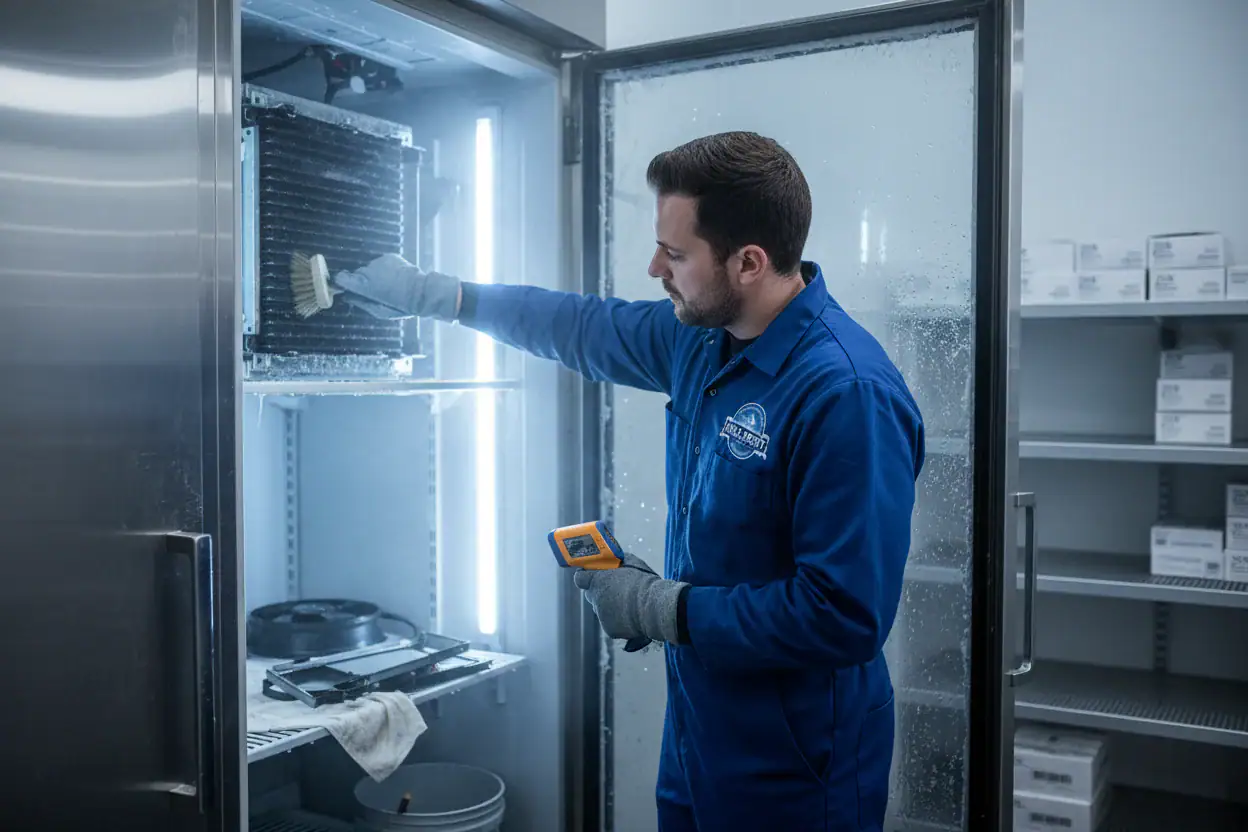
Here’s something most operators don’t realize until it’s too late: your walk-in cooler can look completely fine while quietly costing you money every single day. A worn door seal, a dirty condenser coil, a fan motor running hotter than it should — none of these announce themselves. They just run up your energy bill, wear down your compressor, and eventually turn into a $2,000 emergency call on a Friday night in July.
This guide is for operators who’d rather not find out the hard way. We’ll walk you through what a real commercial refrigeration maintenance program looks like, what you can manage in-house, and where a certified technician needs to be involved.
Most of the walk-in cooler maintenance content you’ll find online is a checklist. Clean the coils. Check the door seals. Log the temperatures. While those tasks matter, a checklist without context doesn’t tell you what happens when you skip them — or which ones your staff can realistically handle versus which ones require someone with an EPA 608 certification and a set of gauges.
Real refrigeration maintenance is a layered program. Some of it is daily. Some of it is weekly. Some of it needs a trained technician twice a year, minimum. The businesses that get 15 or more years out of their equipment aren’t doing anything magical — they’re just not skipping the parts that matter.
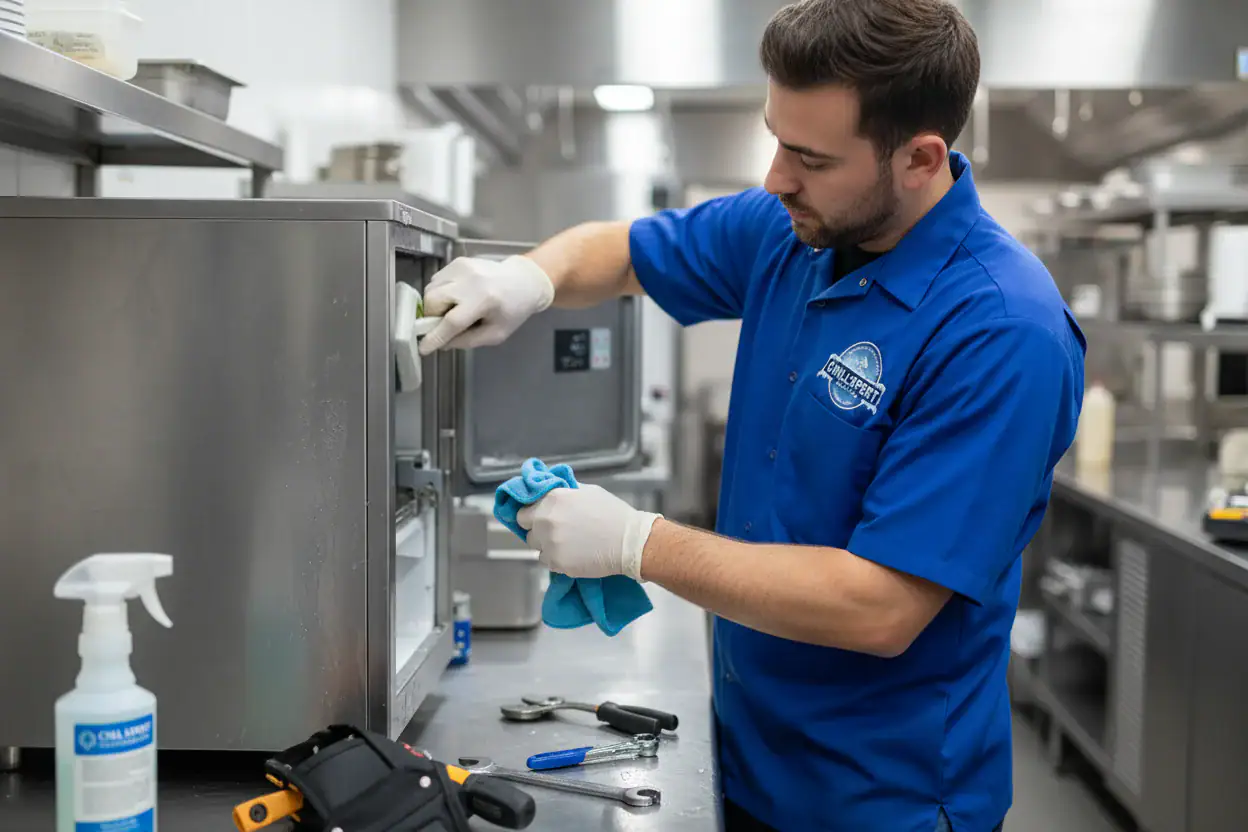
There’s a real and useful line between what your team can do in-house and what requires a certified technician. Knowing where that line is saves you money and keeps small problems from becoming expensive ones.
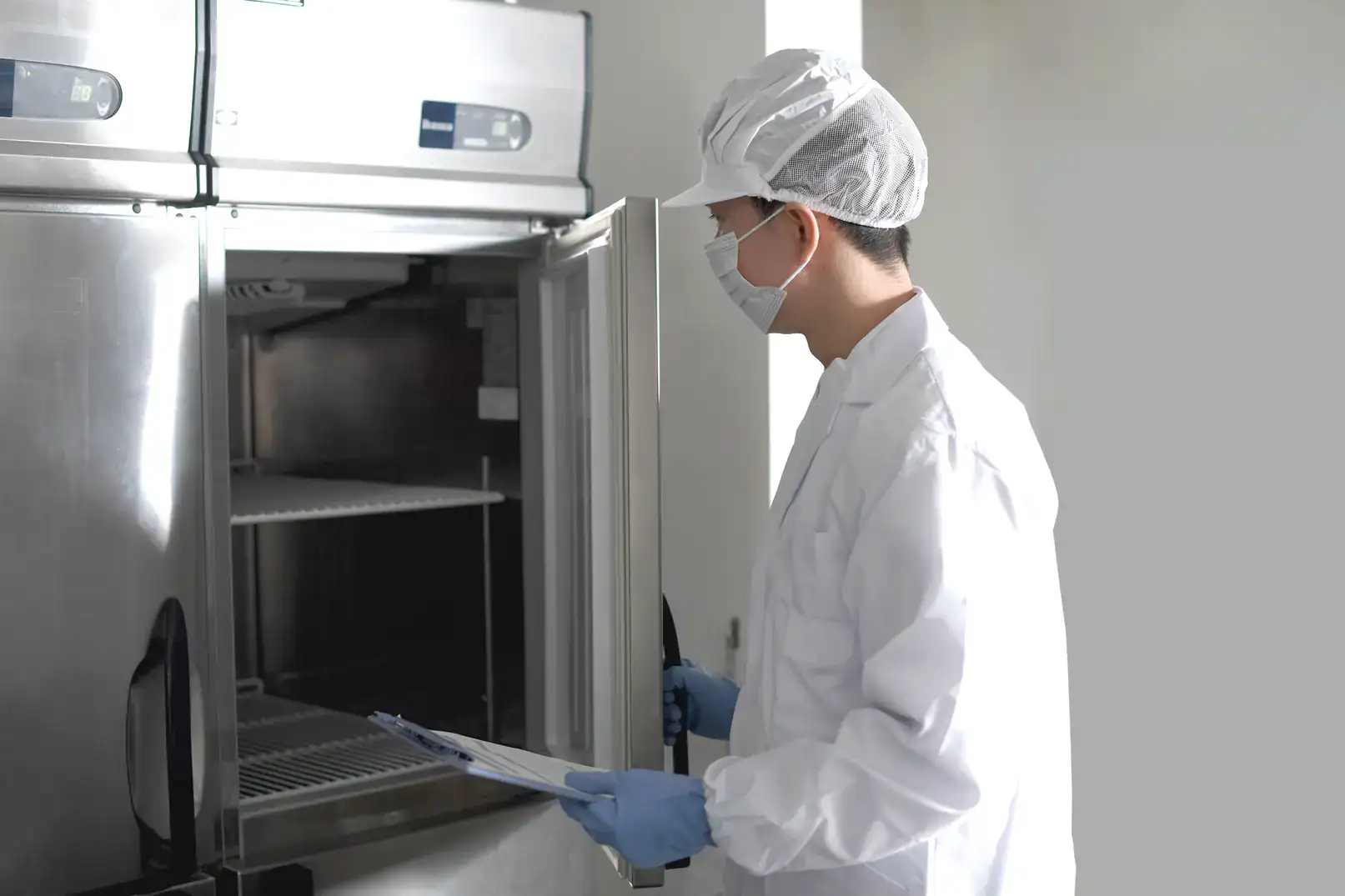
Temperature should be logged at least twice a day. Not just glanced at — written down. If your walk-in is holding at 38°F in the morning and 44°F by mid-afternoon, that drift tells you something is working harder than it should. You want that data before a technician shows up, not after.
Door seals are another one your team can monitor. Close the door on a piece of paper and try to pull it out. If it slides free without resistance, the gasket isn’t sealing properly. A failing seal doesn’t just let warm air in — it forces your compressor to compensate, and that extra load adds up fast. One study found that a compromised door seal can increase energy consumption by around 15% even while the unit appears to be running normally.
Keeping the area around the condenser unit clear is also something staff can stay on top of. Condenser coils need airflow to do their job. Boxes stacked against the unit, grease buildup on nearby surfaces, or anything blocking the intake will cause the system to run hotter and work harder than it needs to.
Interior cleaning — shelving, walls, floor drains — belongs in the weekly rotation. Drain pans that aren’t cleared regularly can back up, create standing water, and become a health code issue in addition to a mechanical one. Nassau County Department of Health inspections are not the moment you want to discover a blocked drain.
None of this is complicated. But it does need to be consistent, and it needs to be documented. A maintenance log isn’t paperwork for its own sake — it’s the record that tells a technician what changed and when, which is often the fastest way to diagnose a problem before it becomes a failure.
Walk-in cooler doors take a beating. They’re opened dozens or hundreds of times a day in a busy commercial kitchen, and the components that keep them sealing properly — gaskets, hinges, door heaters, closers — wear out faster than most operators expect.
Door gaskets are the most obvious maintenance point, but they’re also the most commonly ignored until the damage is visible. By the time a gasket is cracked or pulling away from the frame, it’s already been leaking conditioned air for weeks or months. The fix is straightforward — replacement gaskets are inexpensive and the swap is relatively quick — but the cost of letting it go is ongoing and invisible.
Hinges are another one. A door that doesn’t hang level won’t close flush, and a door that doesn’t close flush won’t seal. Over time, hinges loosen, warp slightly, or corrode — especially in environments with high humidity or salt air exposure, which is a real factor for commercial kitchens in Nassau County’s coastal communities. A door that looks closed but isn’t fully seated against the frame is doing the same damage as a bad gasket, just in a less obvious way.
For walk-in freezers specifically, door heaters are a critical and often overlooked component. These are the electric resistance elements built into the door frame that prevent ice from forming around the seal. When a door heater fails, ice builds up, the door becomes difficult to open and close, and the gasket takes damage from the repeated force of breaking that ice seal. By the time the problem is obvious, there’s usually compressor stress and gasket replacement on the bill alongside the heater itself.
If your walk-in door feels stiff, doesn’t latch cleanly, or you notice frost accumulating around the frame, those aren’t minor annoyances — they’re early warnings. A technician can assess the full door assembly in a routine visit and catch these issues before they compound. Door-related problems are among the most preventable sources of emergency calls we see across Nassau County, NY.
Want live answers?
Connect with a Chill Xpert Solutions expert for fast, friendly support.
If your in-house routine is the daily and weekly layer, professional service visits are where the deeper work happens. At a minimum, a certified technician should be on-site twice a year for a thorough evaluation — and in high-volume operations or coastal environments like much of Nassau County, quarterly visits make more sense.
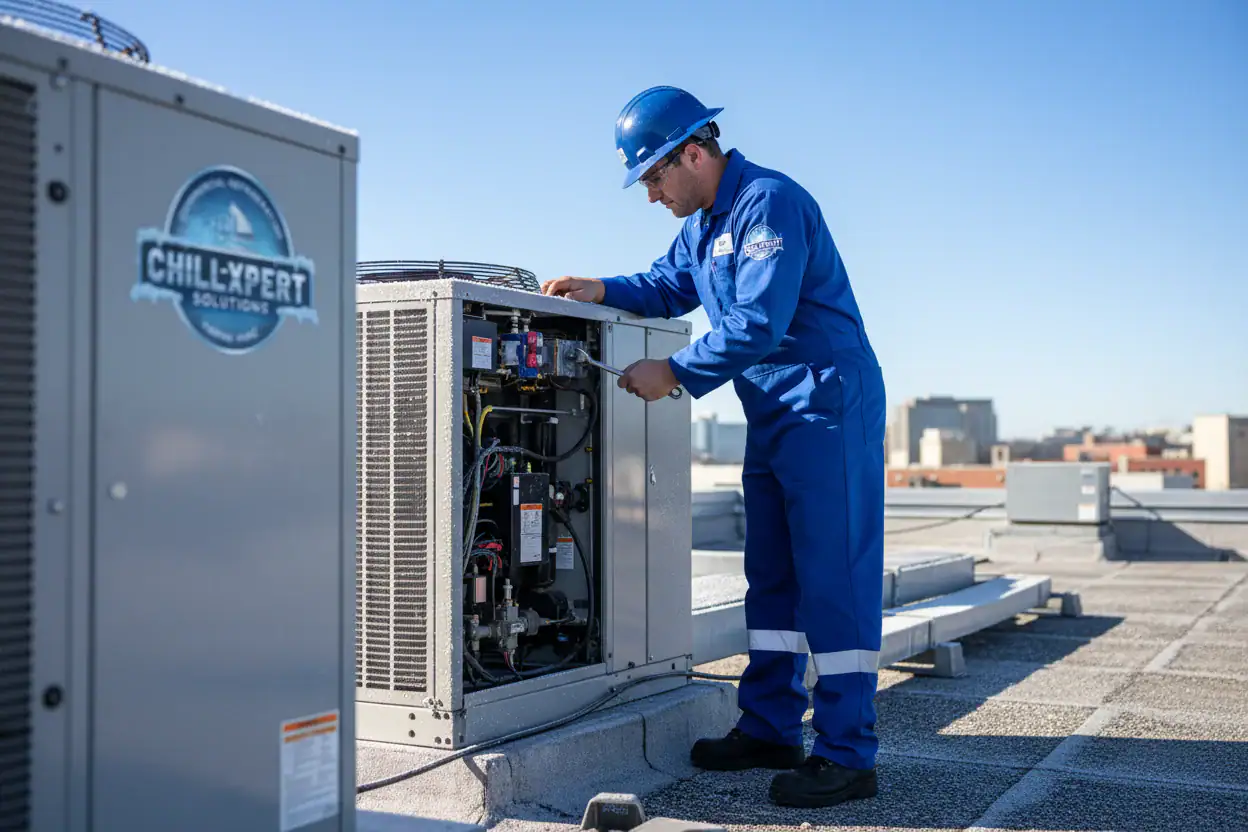
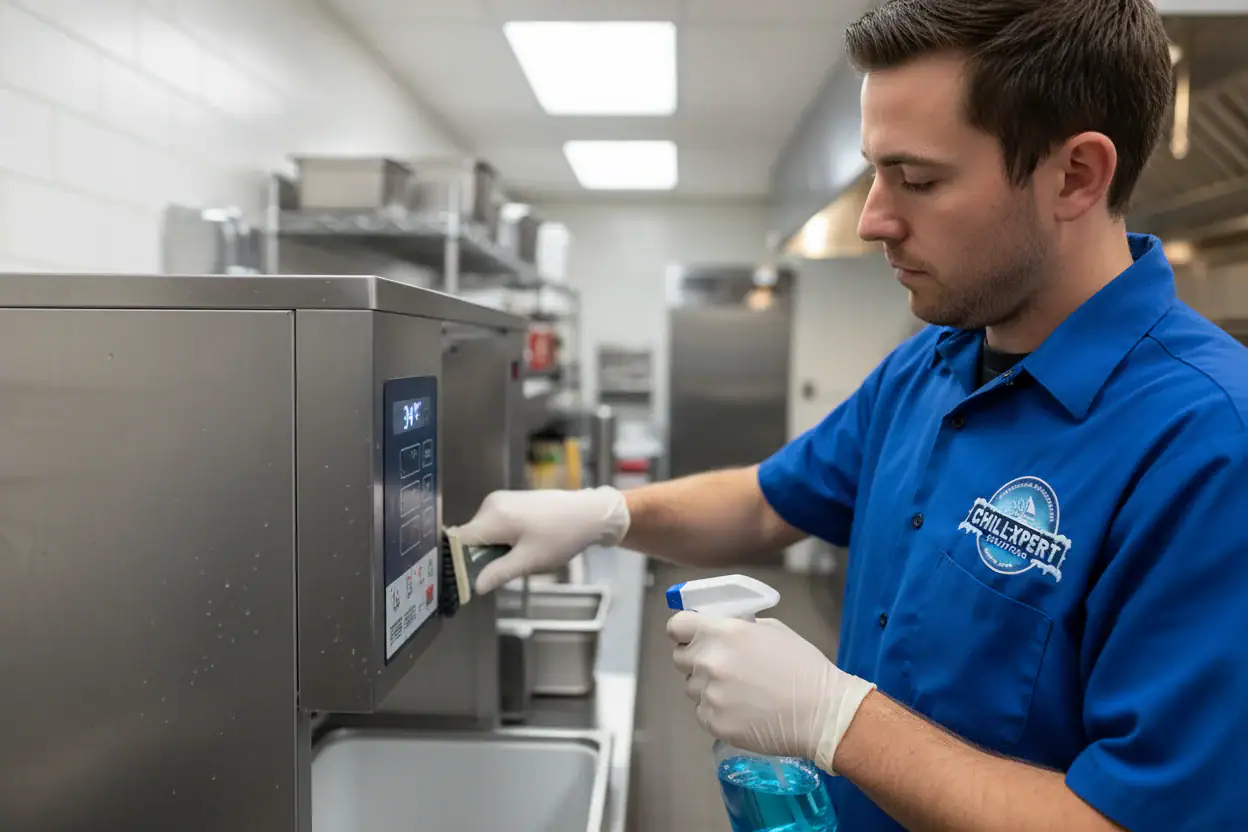
What separates a quality service visit from a cursory one is documentation and scope. A technician who shows up, does a visual check, and hands you an invoice isn’t giving you what you’re paying for. A proper visit covers refrigerant pressures, coil cleaning on both the condenser and evaporator, electrical connection inspection, thermostat calibration, fan motor assessment, defrost cycle verification, and a written summary of what was found and what was done.
That paper trail matters. It’s how you track equipment health over time, and it’s what protects you when a health inspector asks about your maintenance history.
Nassau County sits between the Atlantic Ocean to the south and the Long Island Sound to the north. That means salt-laden, high-humidity air is a year-round factor for commercial refrigeration equipment — not just a summer inconvenience. Salt air accelerates corrosion on condenser coils, refrigerant lines, copper tubing, and cabinet surfaces in ways that operators in drier inland markets simply don’t deal with at the same rate. Equipment that might hold up for 18 or 20 years with standard maintenance in a different climate can degrade significantly faster here without the right attention.
This isn’t a reason to panic — it’s a reason to be specific about who you’re working with. A technician who understands coastal environments will know to inspect for early corrosion on coil fins, check solder joints and refrigerant line connections more carefully, and recommend cleaning intervals that account for salt air exposure rather than applying a national average. We work in marine environments regularly — saltwater corrosion is something our team understands at a level that most general contractors simply don’t have exposure to.
Summer compounds all of this. When Nassau County ambient temperatures climb into the upper 80s with high humidity, your condenser is working against conditions it was never designed to treat as normal. That’s when compressors fail, that’s when service providers fill up fast, and that’s when operators who haven’t built a maintenance relationship find themselves waiting two weeks for a technician while their inventory sits at risk. The spring maintenance window — before the heat peaks — is the most valuable one on the calendar, and it’s the one that gets skipped most often.
For the delis serving the morning commuter rush, the catering halls running back-to-back weekend events, and the restaurants along Hempstead Turnpike running full dinner services six nights a week, a summer walk-in failure isn’t just an inconvenience. A single walk-in cooler failure — accounting for spoiled inventory, emergency repairs, lost revenue, and potential health code penalties — can run between $20,000 and $40,000 in total impact. That’s a real figure from real commercial operations across Nassau County.
Walk-in freezers share most of the same maintenance needs as walk-in coolers, but the margin for error is smaller. Freezers operate at much lower temperatures, which means any inefficiency in the system — a struggling compressor, a partially blocked coil, a defrost cycle that’s running too long or not long enough — shows up faster and causes more damage.
Defrost cycles are one of the most misunderstood components of commercial freezer maintenance. Every walk-in freezer has a defrost system designed to periodically melt the frost that accumulates on the evaporator coils. When that system works correctly, it’s invisible. When it fails — either running too frequently, not frequently enough, or not completing properly — frost builds up on the coils, airflow is restricted, and the unit has to work progressively harder to maintain temperature. Left long enough, you end up with a compressor under severe strain and a freezer that can no longer hold safe temperatures.
Evaporator coil condition is the other major variable in commercial freezer maintenance. Because freezers operate at lower temperatures, ice and frost accumulation on the coils is a constant dynamic. A technician performing a proper service visit will assess coil condition, verify that the defrost cycle is completing correctly, and check the drain lines that carry away the meltwater — because a blocked drain in a freezer doesn’t just cause a puddle, it causes ice buildup that can damage the drain pan and the surrounding insulation.
Electrical connections in freezers also deserve closer attention than most operators give them. The temperature cycling — from defrost temperatures back down to operating temperatures — puts repeated thermal stress on wiring, contacts, and controls. Loose or corroded connections that might be stable in a cooler can fail in a freezer environment. A thorough electrical inspection during a professional service visit catches these before they become the reason your freezer goes down at 11 p.m. on a Saturday.
The honest summary on commercial freezer maintenance is this: the tasks are similar to a cooler, but the consequences of skipping them are faster and more severe. If you’re scheduling professional service for your walk-in cooler, your freezer should be on the same schedule — ideally the same visit.
The businesses that get the most out of their refrigeration equipment aren’t doing anything complicated. They’re logging temperatures consistently, keeping door seals and condenser areas in good shape, and scheduling professional service before something breaks — not after.
If you’re not sure where your current maintenance program stands, that’s a reasonable starting point. Know what your staff is handling, know when a certified technician last looked at your refrigerant pressures and coils, and know what your door assembly looks like on the inside.
If you’re in Nassau County, NY and looking for a team that understands the local conditions — the coastal environment, the seasonal demand, the kind of commercial operations that run here — Chill Xpert Solutions has been doing this work on Long Island for over 40 years. Reach out for a free estimate and a straight conversation about what your equipment actually needs.
Article details:
Share:
Continue learning: