Your walk-in cooler can be failing long before it stops working. Here are seven warning signs Nassau County operators need to recognize — and act on.
Share:
Summary:
Most walk-in cooler failures don’t happen without warning. There’s usually a noise that wasn’t there last month, a temperature running a degree or two higher than it should, a door that doesn’t quite seal the way it used to. The problem isn’t that the signs aren’t there — it’s that they’re easy to dismiss when you’re in the middle of a busy service.
But in Nassau County, where a summer heat wave can push a borderline system over the edge overnight, dismissing those signs is a gamble with your inventory, your health inspection, and your weekend revenue. Here’s what to watch for.
The most dangerous misconception in this business is that a walk-in cooler either works or it doesn’t. In reality, there’s a long middle ground — a period where the unit is technically running but not running correctly. Temperatures are drifting up. The compressor is working harder than it should. Something is off, but nothing has broken yet.
That middle ground is your window. Catch a problem there and you’re looking at a repair call. Miss it, and you’re looking at an emergency, a potential health code violation, and possibly thousands of dollars in lost product. The seven signs below are what that middle ground looks like in practice.
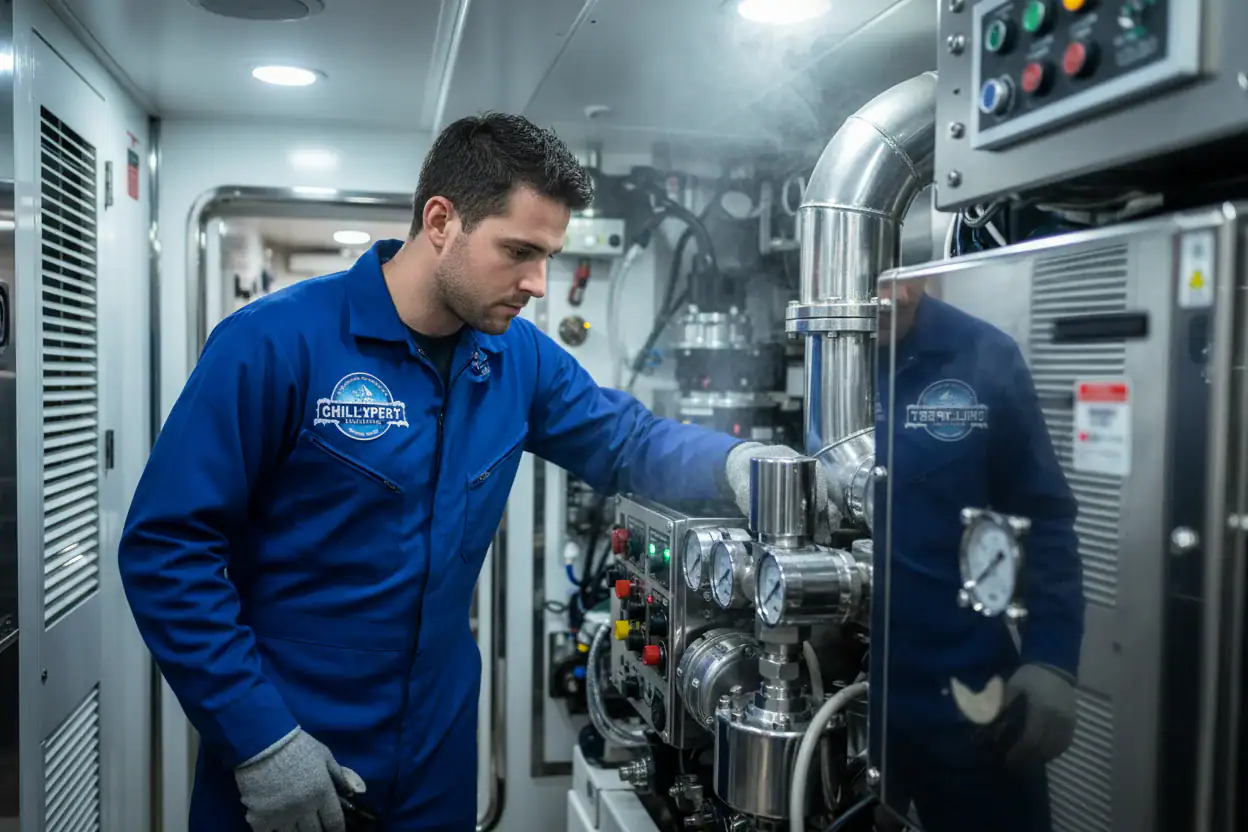
The FDA-mandated cold holding limit for food is 41°F. Your walk-in should be running between 35°F and 38°F to maintain a safe buffer below that threshold. If you’re consistently seeing 42°F, 43°F, or higher — even if the unit is still running — that’s not a minor fluctuation. That’s a system that can no longer do its job.
Temperature drift is one of the earliest and most common warning signs, and it points to several possible causes: a refrigerant leak reducing cooling capacity, a failing compressor that can no longer maintain adequate pressure, a dirty or corroded condenser coil that can’t reject heat efficiently, or a faulty expansion valve disrupting refrigerant flow. None of these fix themselves.
Here’s what makes this particularly relevant for Nassau County operators: during a Long Island summer, ambient temperatures climb into the 90s and humidity sits at 70 to 80 percent. Your condensing unit has to work significantly harder to reject heat in those conditions. A system that holds 38°F in April might struggle to hold 41°F in July — not because anything broke, but because the summer tipped an already-stressed system past its limit. If your cooler is running warm now, before the heat really sets in, that’s a sign worth taking seriously.
The fix depends on the root cause, which is why a proper diagnostic matters. A technician who jumps straight to “you need a new compressor” without checking refrigerant levels, coil condition, and electrical components isn’t diagnosing — they’re guessing. Get a real diagnosis first.
Beyond temperature, several other warning signs tend to appear before a walk-in cooler fails completely. Each one points to a specific failure mode, and understanding what you’re hearing or seeing helps you communicate it clearly when you call for service.
Unusual noises — grinding, rattling, clicking, or a compressor that cycles on and off more frequently than normal — are almost always early mechanical warnings. Compressors don’t typically fail without warning. They get louder. They run longer. They short-cycle. If your unit sounds different than it did six months ago, that change is worth a phone call.
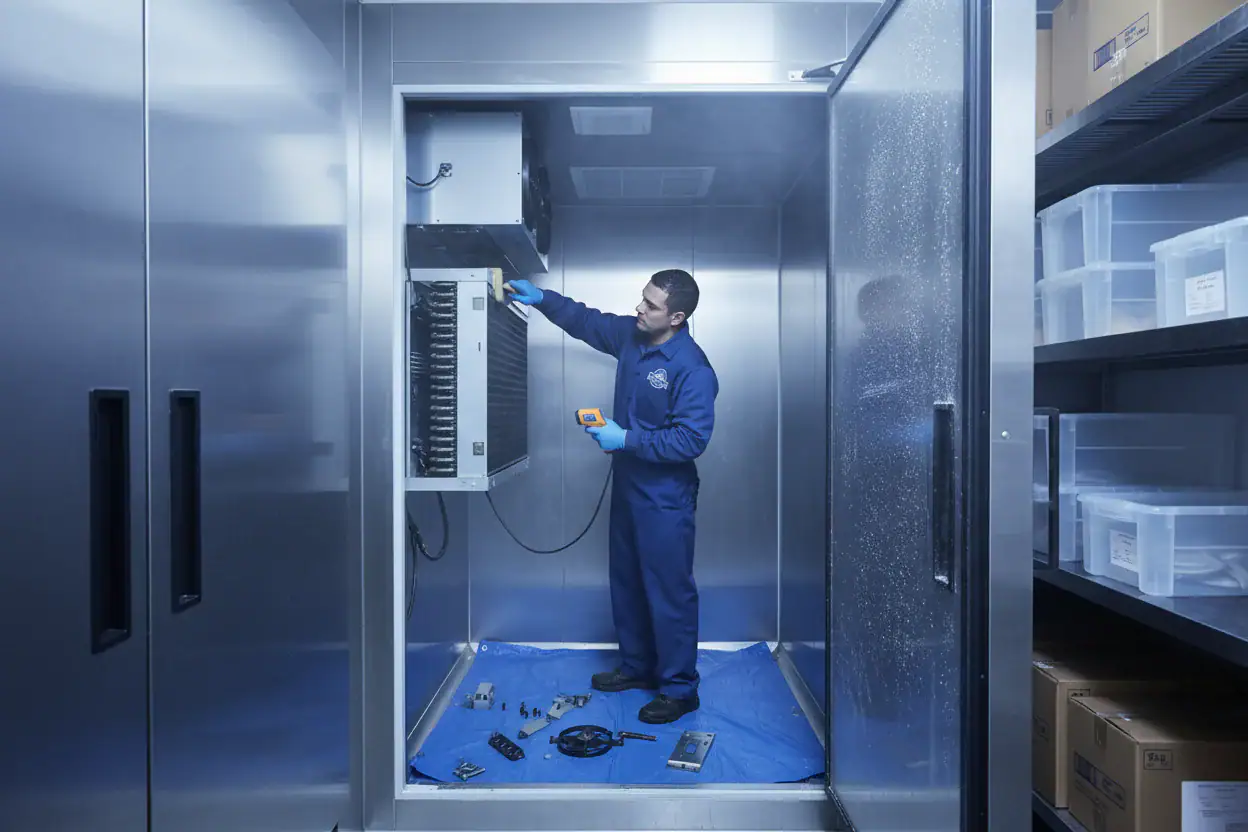
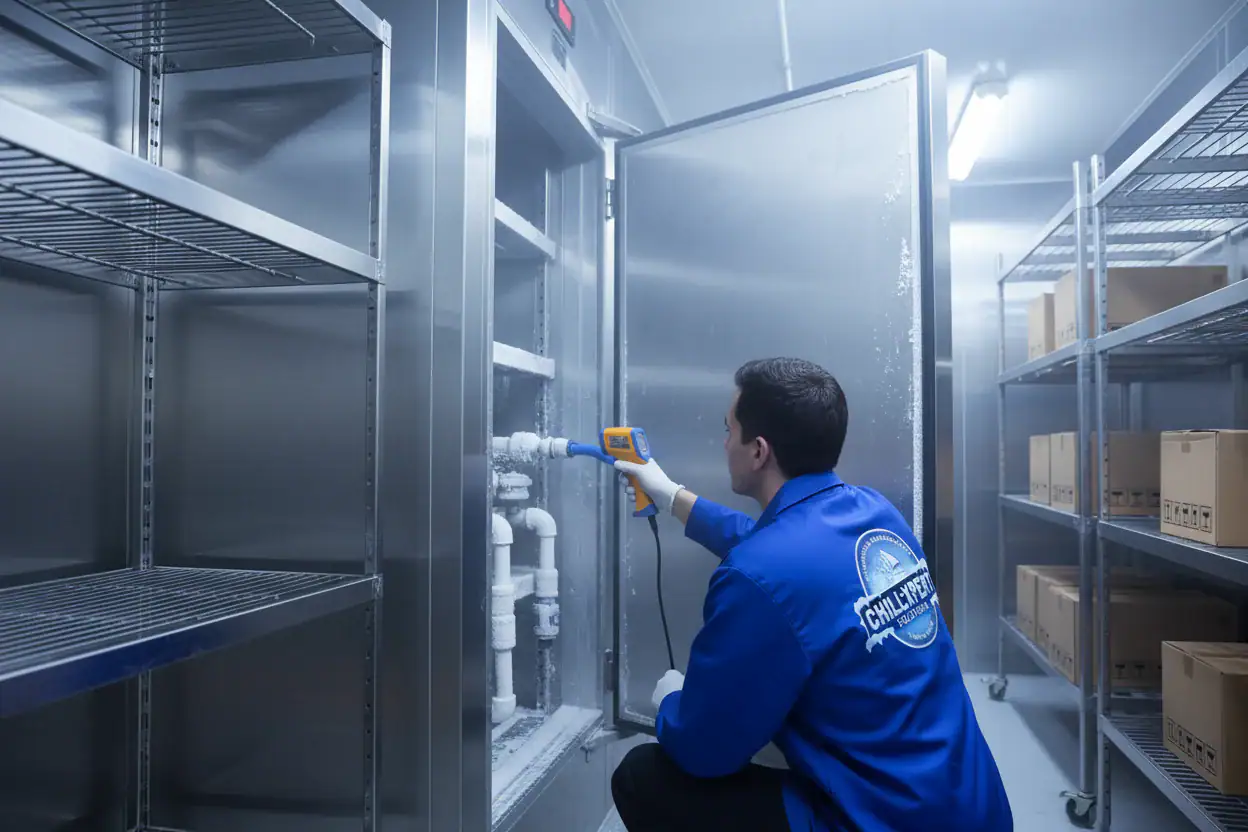
Frost or ice buildup on the evaporator coil is another sign that gets misread. Operators sometimes assume it means the unit is working hard, but it’s actually a sign of a defrost cycle failure, restricted airflow, or a refrigerant issue. A properly functioning walk-in cooler should not have heavy frost accumulation on the coil. When you see it, the system is compensating for something it shouldn’t have to compensate for.
Water pooling inside or around the unit, condensation on the walls, or a door frame collecting frost are all related warning signs. They often trace back to a failing door gasket — the seal around the door that keeps warm, humid air out. When that seal degrades, warm air enters the cooler constantly, forcing the system to work overtime. For Nassau County businesses along the South Shore in Oceanside or Massapequa, or near the water in Atlantic Beach, this is especially common. The combination of salt air and high ambient humidity accelerates gasket wear faster than operators expect, and a compromised gasket can quietly drive up your energy costs for months before the temperature finally starts climbing.
One more: unexplained spikes in your energy bill. If nothing has changed in your operation but your utility costs are rising, your refrigeration system may be the reason. An inefficient condenser coil, a refrigerant leak, or a compressor running longer than it should all translate directly into higher electricity use. It’s a slow warning sign, but it’s a real one.
Want live answers?
Connect with a Chill Xpert Solutions expert for fast, friendly support.
Walk-in freezer repair follows similar logic, but the margin for error is smaller. A walk-in freezer should maintain temperatures between -10°F and 0°F. When it starts drifting above that range — even slightly — frozen product begins to degrade, and the risk of partial thawing and refreezing creates both food safety and quality problems.
The warning signs are similar to a cooler: unusual noises, temperature drift, frost buildup, door seal issues. But because freezer temperatures are so much lower than ambient air, any failure in the system shows up faster and more severely. A walk-in freezer repair situation can escalate from “something seems off” to “everything needs to be thrown out” in a matter of hours if the failure happens overnight.
This is the part that most generic walk-in cooler content misses entirely, and it’s directly relevant to how you should be reading the warning signs above.
For businesses near the water — on Freeport’s Nautical Mile, in Atlantic Beach, along the South Shore, or on the North Shore in Oyster Bay — salt air is a constant factor. It doesn’t just corrode metal surfaces cosmetically. It degrades your condenser coil’s ability to transfer heat efficiently. A coil that’s been exposed to salt air for a season or two has to work harder to do the same job it did when it was clean. That extra workload goes straight to the compressor.
What this means practically is that the warning sign timeline is compressed. A temperature fluctuation that might give an inland operator several months of lead time before a real failure could give a Nassau County operator a few weeks. The system is already under more stress than it would be in a less demanding environment, so when something starts to go wrong, it tends to go wrong faster.
This is also why the twice-a-year professional service recommendation that applies broadly becomes even more important here. Coil cleaning, refrigerant level checks, and gasket inspections aren’t just maintenance tasks — they’re the difference between catching a problem early and dealing with an emergency in the middle of July when your condensing unit is already running at its limit.
We’ve been doing commercial refrigeration work across Nassau County since the 1980s, and the pattern is consistent: the businesses that call us for a maintenance visit in May don’t call us for an emergency in August. The ones who skip the maintenance visit are the ones we hear from on a Friday night.
This is the question most operators are actually asking when they search for information about warning signs. They want to know: is this serious enough to call someone right now, or can it wait until next week?
Here’s a practical framework. If your temperature is at or above 41°F and you have food in the unit, that’s not a “wait and see” situation. That’s a call you make now. The FDA’s temperature danger zone starts at 41°F, and Time/Temperature Control for Safety foods — meat, dairy, prepared dishes — can begin supporting bacterial growth within that range. If a Nassau County Department of Health inspector walks in while your walk-in refrigerator repair is still pending and your cooler is holding food above 41°F, that’s an automatic critical violation. The financial and operational consequences of that outcome are worse than the cost of a repair call.
If the temperature is still within range but you’re seeing one of the other warning signs — an unusual noise, frost buildup, a door that’s harder to seal, an energy bill that doesn’t make sense — that’s a “schedule it soon” situation, not an emergency. But soon means this week, not next month. Those signs exist in the window before failure, and that window closes.
The other question operators ask is whether to repair or replace. The honest answer is that it depends on the age of the unit, the nature of the failure, and what a proper diagnostic reveals. A compressor replacement on a unit that’s otherwise in good shape and has years of service left is a very different calculation than patching a system that’s already at the end of its useful life. What we’d caution against is letting a contractor push you toward replacement before they’ve actually diagnosed the problem. We’ve seen units quoted for full replacement that needed a refrigerant recharge and a coil cleaning. Get the diagnosis first, then make the decision.
The short version: don’t wait. The warning signs covered here — temperature drift, unusual noises, frost buildup, door seal issues, rising energy costs — all appear before a walk-in cooler fails completely. That’s the whole point. They’re giving you time to act without an emergency, without throwing out product, and without fielding a health department violation on a day when you’re already slammed.
Nassau County summers are hard on refrigeration equipment. The humidity, the heat, and for coastal businesses, the salt air — all of it adds up. The systems that hold up are the ones that get looked at before something goes wrong, not after.
If something on this list sounds familiar, it’s worth a call. Chill Xpert Solutions offers free estimates, responds to emergencies across Nassau County in under two hours, and has been doing this work on Long Island for over 40 years. Reach out before the problem makes the decision for you.
Article details:
Share:
Continue learning: