Not all refrigeration repair companies are equal. Here's what to verify before you hand over the keys to your walk-in cooler.
Share:
Summary:
A walk-in cooler that quits on a Saturday night isn’t just an inconvenience — it’s a financial emergency. Inventory starts losing value the moment the temperature climbs, and every hour you spend waiting on a technician who isn’t qualified, doesn’t have the right parts, or can’t actually fix the root cause is an hour that costs you. The frustrating part is that most restaurant owners in Nassau County don’t find out they hired the wrong company until the second failure. This guide exists so you don’t have to learn that lesson the hard way. Here’s what to verify before anyone touches your equipment.
Most refrigeration repair companies will tell you they’re fast, experienced, and affordable. That’s true of almost every company in this space, which means it tells you almost nothing useful. The questions that actually separate a qualified commercial refrigeration specialist from a generalist with a van are more specific — and the answers are easy to verify if you know what to ask.
Start with certifications, then move to parts, then ask about response time. Not the other way around. Price is the last thing to discuss, because the cheapest option almost always costs more by the time the second service call rolls around.
This one isn’t optional — it’s federal law. Under Section 608 of the Clean Air Act, any technician who services, repairs, or maintains equipment that could release refrigerants into the atmosphere must hold EPA 608 certification. That includes walk-in coolers, walk-in freezers, reach-in units, and ice machines. If a technician handles refrigerant without this certification, the work is being done illegally, and any liability that follows lands on your property.
There are four certification types under EPA 608: Type I covers small appliances under five pounds of refrigerant, Type II covers high-pressure systems, Type III covers low-pressure systems, and Universal covers all of the above. For most commercial kitchen refrigeration repair, you want a technician certified at the Universal level — meaning they’re qualified to work on the full range of systems they’re likely to encounter in a busy restaurant or deli.
The reason this matters beyond legal compliance is diagnostic accuracy. Technicians who’ve gone through proper certification training understand refrigerant handling, pressure diagnostics, and system behavior in ways that general HVAC technicians often don’t. A generalist might get a unit cold again for a day. A certified commercial refrigeration specialist finds out why it warmed up in the first place, so you’re not making the same call two weeks later.
Ask directly: “Do your technicians hold EPA 608 Universal certification?” A qualified company will confirm it without hesitation. If there’s any vagueness in the answer, that’s your signal to keep looking.
Authorized repairer status means the company has been trained and certified by the equipment manufacturer to service that specific brand. It’s not a marketing claim — it’s a verifiable, third-party credential. And it matters in two concrete ways.
First, authorized repairers use genuine OEM parts. Aftermarket parts are cheaper upfront, but they’re not manufactured to the same tolerances as the original components, and they can introduce new failure points into a system that was otherwise running well. Using non-OEM parts on a unit that’s still under manufacturer warranty can void that warranty entirely — meaning the next failure is fully out of pocket.
Second, authorized repairers have completed manufacturer-specific training. Commercial refrigeration equipment varies significantly across brands in how it handles refrigerant flow, compressor cycling, and temperature control logic. A technician who knows the system they’re working on can diagnose faster, repair more accurately, and catch secondary issues that a less familiar tech would miss.
For Nassau County restaurant owners running equipment from major commercial brands, this distinction is especially relevant. The density of food service operations along corridors like Hempstead Turnpike means there are plenty of companies competing for refrigeration repair calls — but not all of them have manufacturer authorization. Ask directly: “Are you an authorized repairer for my equipment brand?” before scheduling anything.
We hold authorized repairer status for multiple brands, which is part of why about 70% of our emergency calls get resolved on the first visit. We know the equipment, we carry the right parts, and we’re not guessing.
Want live answers?
Connect with a Chill Xpert Solutions expert for fast, friendly support.
Walk-in coolers and freezers are not the same as the reach-in units behind your bar or the display cases in your deli. They’re larger, more complex, and the consequences of a misdiagnosis are proportionally bigger. A compressor that short-cycles in a reach-in is an inconvenience. The same problem in a walk-in cooler holding $8,000 worth of seafood and proteins is a crisis.
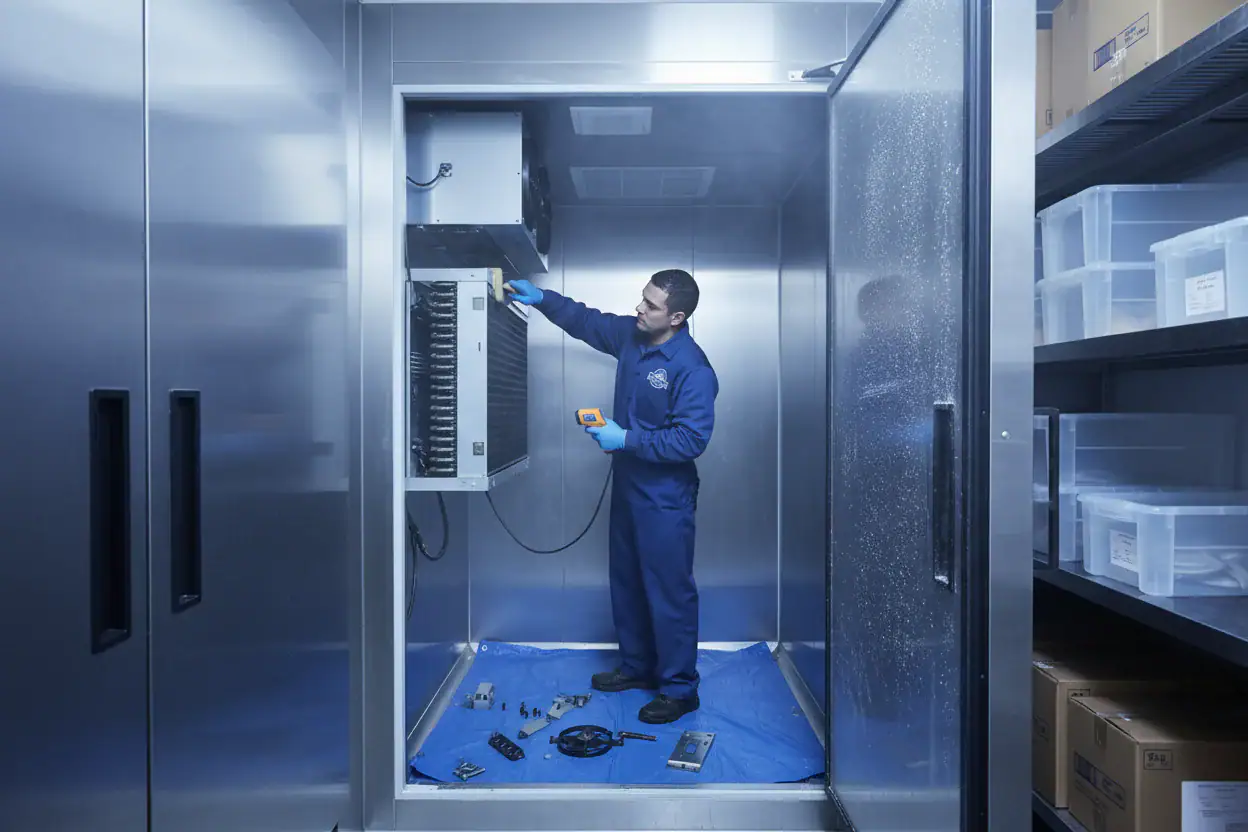
The technician you send into that space needs to know commercial refrigeration specifically — not just HVAC in general. The diagnostic process is different, the failure modes are different, and getting it wrong is expensive twice: once for the incorrect repair, and again when the real problem resurfaces.
Walk-in freezers operate at fundamentally different conditions than coolers, and the failure stakes are higher. A cooler running warm is a problem. A freezer losing temperature is a disaster — because the inventory inside is worth more, the food safety thresholds are more unforgiving, and the recovery window is shorter.
Under New York State food safety standards, refrigerated foods must be held at or below 41°F. For frozen product, the margins are even tighter, and the four-hour rule that governs perishable food safety applies from the moment temperature deviation begins. Pathogenic bacteria like Salmonella and Listeria can double every 20 minutes in the right temperature range. By the time a freezer failure is obvious, the inventory question may already be answered.
This is why walk-in freezer repair service requires a technician who understands low-temperature refrigeration specifically — the refrigerant pressures, the evaporator behavior, and the compressor load characteristics at 0°F are different from what a cooler running at 38°F demands. A technician trained on coolers alone may not have the diagnostic fluency to work accurately on a freezer system under pressure.
For Nassau County restaurants and catering operations, the financial exposure from a freezer failure is significant. Industry data puts average spoilage costs for freezer incidents between $10,000 and $50,000 depending on inventory levels. That’s before you factor in emergency service charges, health department scrutiny, and the revenue impact of menu limitations while the unit is down. The technician you call for walk-in freezer repair service needs to be someone who has done this work specifically — not someone learning on your equipment.
These two questions sound simple, but they’re the difference between a same-day repair and a multi-day shutdown. The single biggest variable in how long a commercial refrigeration failure affects your business isn’t the repair itself — it’s whether the technician arrives with the right part on the truck.
A company that diagnoses the problem, orders the part, and schedules a return visit has just added two to five days to your downtime. In that window, you’re either running with limited menu capacity, renting temporary refrigeration, or absorbing inventory losses that dwarf the cost of the repair. For a Nassau County restaurant doing volume on a Friday night, that math gets painful fast.
Ask directly: “Do your service vehicles carry parts inventory for common commercial refrigeration repairs?” A company that takes this seriously will be able to tell you specifically that they stock parts for the brands and system types they service. Vague answers about “usually having what you need” are not the same as a stocked truck with a real parts inventory.
The reliability question is equally concrete. “When you say you’ll be here in two hours, what does that actually mean?” is a fair thing to ask. Some companies quote response windows they can’t consistently meet. We have trucks based in Nassau County specifically so that sub-two-hour response to true emergencies isn’t a marketing claim — it’s a logistical reality. We’ve been serving Nassau and Suffolk Counties for over 40 years, and our response commitments are built around where our customers actually are.
One more thing worth asking: does the company use direct employees or subcontractors? This matters because subcontractors introduce variability in training, certification, and accountability that you can’t control. When we send a technician to your restaurant, it’s one of our own people — EPA 608 certified, trained on commercial systems, and accountable to us directly.
The five things worth verifying before you hire anyone for commercial restaurant refrigeration repair come down to this: EPA 608 certification, authorized repairer status, parts availability, honest response time commitments, and direct employees rather than subcontractors. None of these are hard to confirm. Most qualified companies will answer all five without hesitation.
Nassau County’s food service market is busy, competitive, and unforgiving when equipment fails. The density of restaurants, delis, and catering halls here means there’s no shortage of companies willing to take your call — but the ones who can actually resolve your problem the same day, with the right parts, by a certified technician who knows your equipment, are a shorter list.
If you’re in the middle of a refrigeration emergency or just want to know who to call before one happens, Chill Xpert Solutions has been that company for Nassau County businesses for over four decades. Reach out for a free estimate — and get a straight answer before any work begins.
Article details:
Share:
Continue learning: