Your ice machine might be failing quietly right now. Here's how to recognize the signs before it becomes an emergency.
Share:
Summary:
Here’s the thing about commercial ice machines: they don’t usually fail loudly. There’s no warning alarm, no error message you can’t ignore, no dramatic moment that forces your hand. They degrade quietly — slower production, a faint smell, ice that doesn’t quite taste right — until one busy Saturday night, you’re suddenly out of ice and calling anyone who picks up the phone.
If you’re a restaurant, deli, catering hall, or bar owner in Nassau County, NY, that scenario is expensive in ways that go beyond the repair bill. This post is about catching the problem before it gets there.
A lot of operators assume that cleaning the ice machine covers it. Sanitizing the bin, wiping down the interior, maybe swapping the water filter — that’s maintenance, right? Not quite. Cleaning handles sanitation, which matters because ice is legally classified as a food under the FDA Food Code. But cleaning alone doesn’t tell you whether your refrigerant charge is off, whether your harvest cycle is calibrated correctly, or whether scale has been quietly building up on your evaporator plates for the past eight months.
Professional ice machine maintenance is a different category of work. It requires tools, training, and in the case of refrigerant handling, EPA Section 608 certification — which is a legal requirement, not just a credential worth mentioning. A proper service visit goes well beyond what any operator can reasonably do on their own.
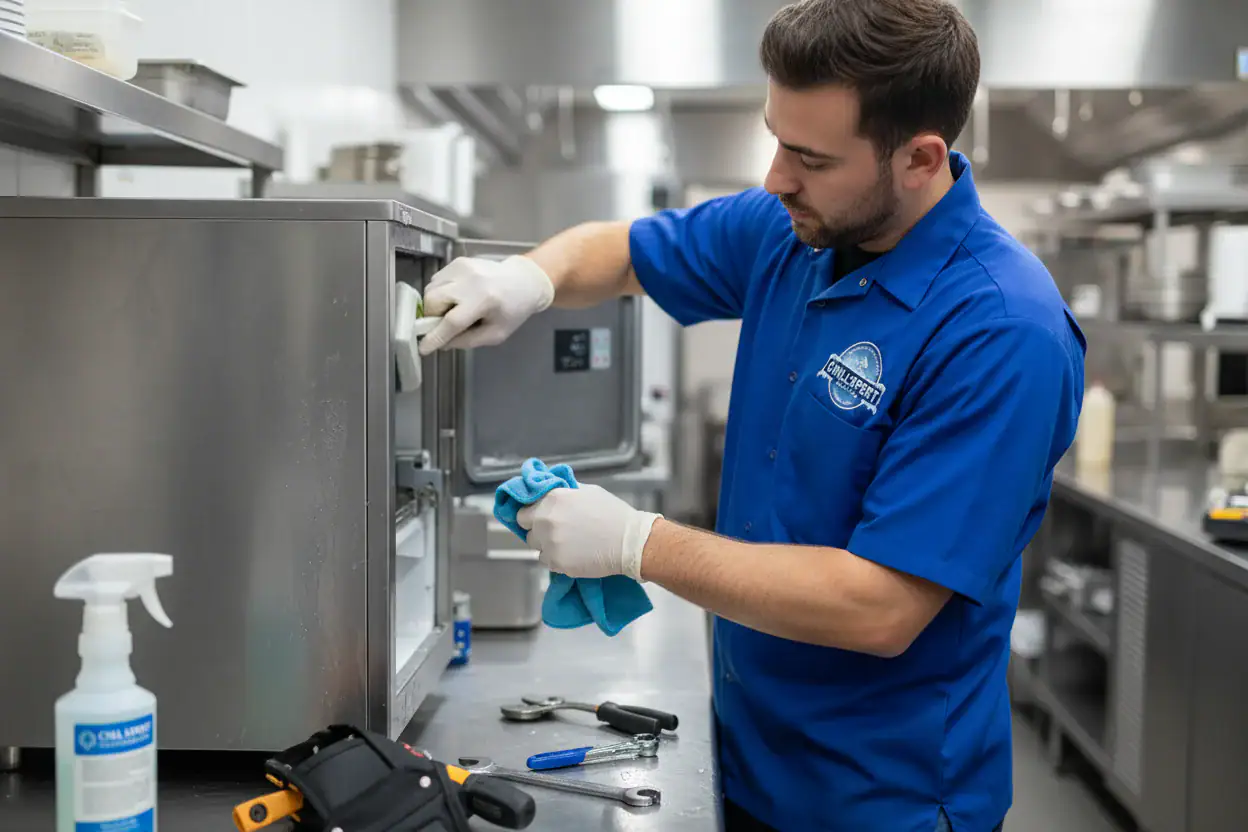
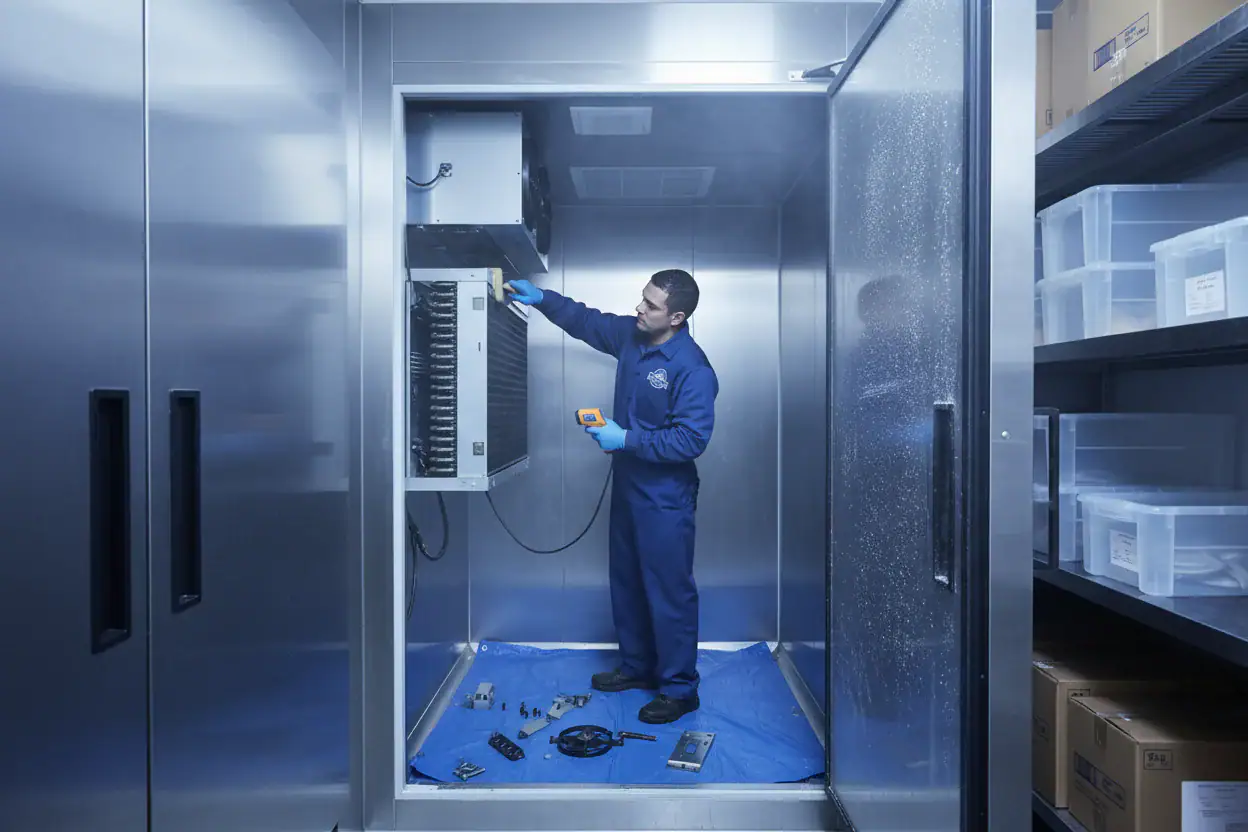
During a professional maintenance visit, a qualified ice machine technician works through the system methodically — not just the parts you can see, but the components that determine whether the machine keeps running reliably for another six months or quietly builds toward a breakdown.
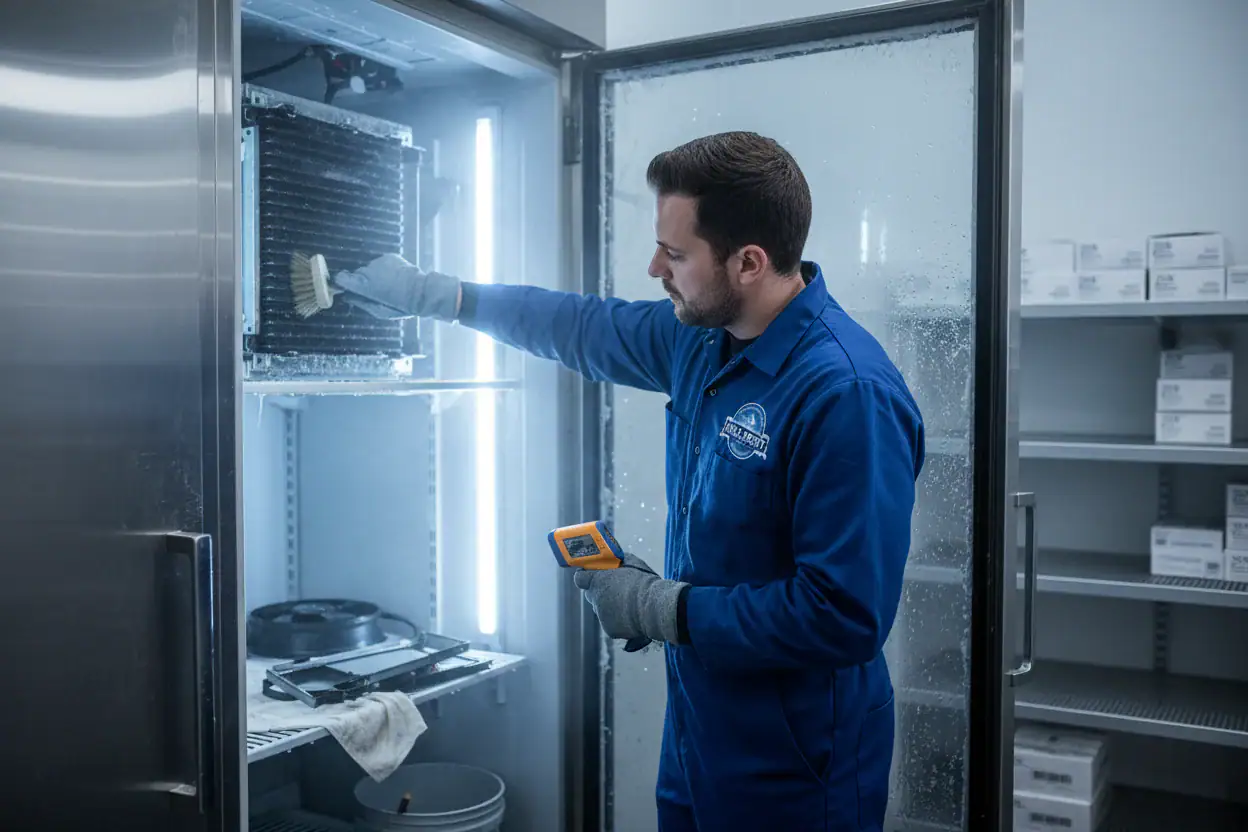
That means cleaning and inspecting the condenser coils, which are one of the most common failure points in commercial ice machines. A clogged condenser can’t dissipate heat properly, so the machine overheats and shuts itself down on safety controls. In Nassau County, NY’s summers — hot, humid, and coastal — condensers clog faster than operators expect, especially in kitchens without great airflow.
The technician will also verify the refrigerant charge, inspect electrical connections, test safety controls, and check the harvest cycle to make sure ice is releasing from the evaporator plates correctly. They’ll descale the evaporator if mineral deposits have accumulated — and in Nassau County, where water quality varies significantly across communities, scale buildup is a real and recurring issue. Water distribution systems get inspected. Bin gaskets get checked. Water inlet valves, water filters, and pressure levels all get looked at.
The reason this matters is that most of these issues don’t produce obvious symptoms until they’ve already caused damage or reduced efficiency significantly. A refrigerant charge that’s slightly off won’t stop the machine from making ice — it’ll just make it work harder, run longer cycles, and wear out faster. You won’t notice until production drops or the compressor fails prematurely.
Manufacturers generally recommend professional service every three to six months for commercial equipment. High-volume operations — catering halls running events every weekend, bars doing a full summer season — are better served by quarterly visits. Lower-volume environments can stretch to semi-annual service, but “I’ll call someone when something goes wrong” is not a maintenance strategy. It’s a breakdown strategy.
This is a question we get often, and the honest answer is that the line between maintenance and repair isn’t always obvious until a technician has looked at the machine.
Maintenance is scheduled, preventive work done on a machine that’s functioning. Repair is corrective work done on a machine that isn’t. But the reality is that a lot of ice machine repair calls turn out to be problems that maintenance would have caught — a clogged water inlet valve, a failing thermostat, scale buildup that’s choked off the evaporator. These aren’t catastrophic failures. They’re gradual ones that become expensive when they’re ignored long enough.
The warning signs that you’ve crossed from “due for maintenance” into “needs repair now” include ice production that has dropped noticeably — not just slightly slower, but meaningfully less volume than the machine used to produce. Ice that’s smaller than normal, misshapen, or clumping together in the bin. A machine that’s running continuously but producing very little. Unusual sounds — grinding, clicking, or a compressor that cycles on and off more frequently than it should. And ice that tastes metallic, musty, or just off. That last one is often dismissed as a water issue, but it’s frequently a sign of biofilm or mold growing inside the machine on surfaces the ice touches directly.
Here’s what makes that last point serious beyond the operational inconvenience: mold and pink or black slime inside a commercial ice machine are documented health code violations. The Nassau County Department of Health permits and inspects over 5,700 food service establishments across the county. Ice is classified as a food. A health inspector who opens your machine and finds visible biofilm doesn’t need to test the ice — the violation is the contamination of the food-contact surface itself. That’s five violation points and a fine, and it’s entirely preventable.
If any of those signs sound familiar, the machine needs attention now, not at the next scheduled service interval.
Want live answers?
Connect with a Chill Xpert Solutions expert for fast, friendly support.
Not every technician who shows up with a toolbox is qualified to work on commercial refrigeration equipment. This isn’t a knock on general HVAC contractors — it’s just a different category of work. Commercial ice machines involve refrigerant systems, food-contact sanitation requirements, brand-specific diagnostic protocols, and components that require manufacturer-level training to service correctly.
When you’re vetting a technician, there are a few things worth asking about directly — not because you’re trying to quiz them, but because the answers tell you whether they’re actually equipped to solve the problem.
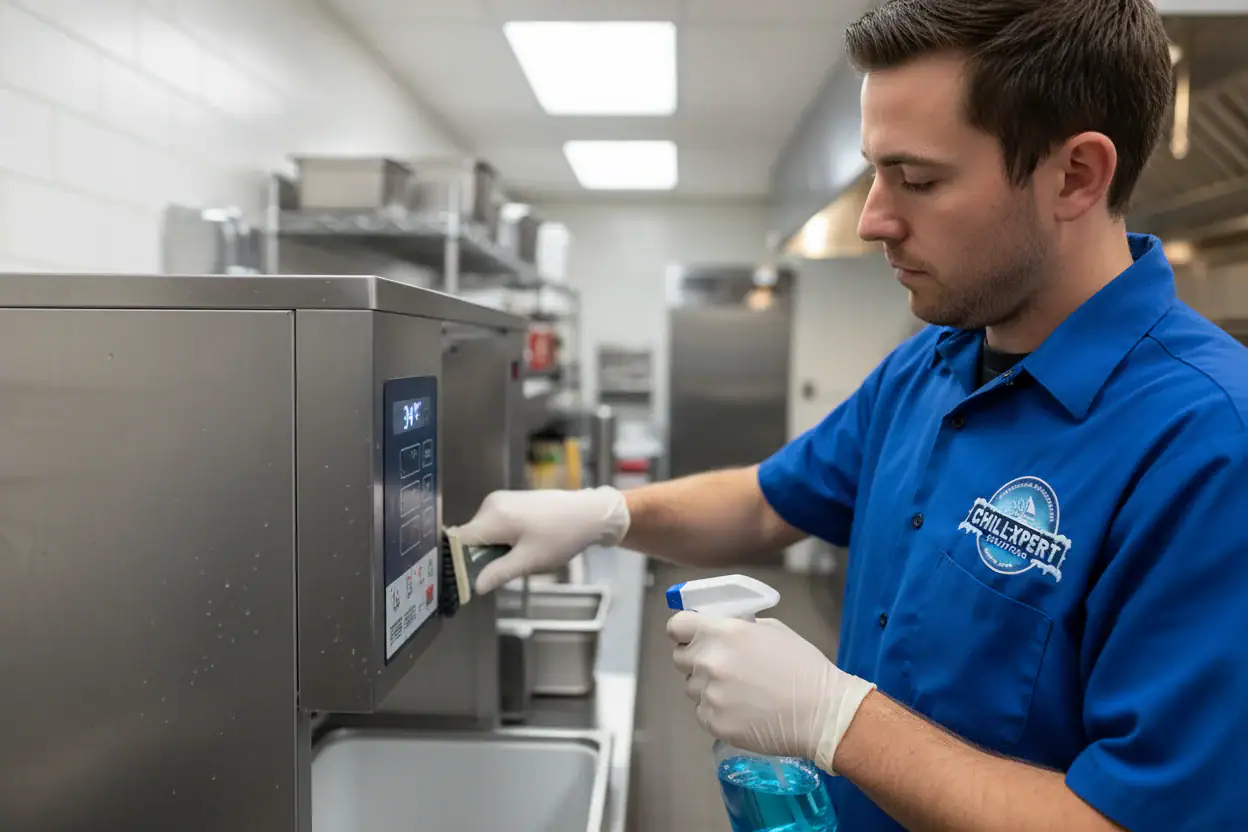
EPA Section 608 certification is legally required for any technician who handles refrigerants. This isn’t optional, and it’s not a technicality — fines for non-compliance reach tens of thousands of dollars per violation per day. More practically, a technician without this certification cannot legally verify or adjust your refrigerant charge, which is one of the core tasks in a proper maintenance visit.
Ask for it directly. A legitimate commercial refrigeration technician will have it and won’t hesitate to confirm it.
Beyond EPA certification, factory authorization for your specific brand matters more than most operators realize. Hoshizaki, Manitowoc, Scotsman, True, Beverage-Air — these manufacturers provide specialized training to authorized service providers because their equipment has brand-specific diagnostic systems, failure patterns, and OEM parts requirements. A technician who is factory-authorized for your brand has been trained on exactly how that machine behaves when something is going wrong, not just how refrigeration systems work in general.
That distinction matters when the technician is standing in front of your machine at 7 PM on a Friday trying to figure out why it stopped producing ice. Experience with that specific brand means faster diagnosis, correct parts the first time, and a repair that actually holds.
We carry parts for every major brand on our trucks because the alternative — ordering a part and coming back in three days — isn’t realistic for a commercial kitchen running a full service. Most repairs we handle are completed the same day, on the first visit.
This is really the question underneath all the others. You can verify certifications and ask about brands, but what you actually want to know is whether this company is going to show up, fix the problem correctly, and not leave you in a worse position than you started.
A few things worth paying attention to: Does the company give you a clear, upfront estimate before any work begins? Do they explain what they found and why they’re recommending what they’re recommending? Do they answer the phone when you call — not a voicemail, not a callback form, but an actual person?
For Nassau County, NY operators specifically, response time is a real differentiator. A company that covers Nassau and Suffolk County and can get a technician to you in under two hours is a different proposition than a regional provider dispatching from a call center somewhere. The density of food service operations across Nassau County — along Hempstead Turnpike, through the South Shore communities, out to the catering halls and event venues that run back-to-back bookings on weekends — means that when something fails, it fails during your busiest window, not your slowest one.
The coastal character of Nassau County also creates equipment conditions that not every contractor accounts for. Salt air accelerates corrosion on condenser coils and metal components. Businesses along the South Shore in communities like Long Beach, Island Park, and Atlantic Beach deal with ambient conditions that push maintenance intervals shorter than the standard recommendation. Waterfront venues and marina operations face this even more acutely. A technician who understands that context — who has spent time working on equipment in these environments — brings something different to the visit than one who treats every machine the same regardless of where it’s sitting.
We’ve been working on commercial refrigeration equipment across Nassau County for over 40 years. That includes restaurants, delis, airports, catering halls, and marine operations where the equipment lives in conditions that would accelerate wear on a standard commercial machine. When we show up, we know what we’re looking at.
The straightforward answer: before summer. Nassau County, NY’s peak season — hot, humid, and the busiest stretch of the year for restaurants, bars, catering halls, and waterfront venues — is exactly when ice machines are under the most stress and when the cost of a breakdown is highest. Scheduling a professional service visit in the spring means you go into that season knowing the machine has been inspected, cleaned, and calibrated by someone who can legally and competently do the work.
If you’re already past that window, or if any of the warning signs in this post sound familiar, the right time is now. A machine that’s showing symptoms doesn’t get better on its own.
Chill Xpert Solutions serves Nassau County operators across the full range of commercial food service — and if you have questions before you’re ready to schedule, we’re available around the clock. Real people answer our calls, and we’ll give you a straight answer about what your machine needs.
Article details:
Share:
Continue learning: