Boat air conditioning works completely differently than home systems. Learn what makes marine AC unique, common problems you'll face, and what to know before installation or repair.
Share:
Summary:
Ninety-five degrees in your cabin. Humidity so thick you’re sweating through your shirt. You’re docked with shore power connected, but your boat feels like a sauna anyway.
Without working marine air conditioning, that’s summer boating in Nassau County, NY. And if you think you can just install a residential AC unit and call it done, you’re about to learn an expensive lesson about saltwater corrosion.
Marine air systems aren’t residential units crammed into boats. They’re specialized equipment built for an environment that destroys standard HVAC components within months. Understanding what makes them different—and why that matters—helps you avoid costly mistakes when installing, maintaining, or repairing your boat’s climate control.
Your boat doesn’t have room for the massive outdoor condenser that cools your house. Marine air conditioning solves this with a completely different approach: seawater cooling.
A raw water pump pulls ocean or lake water directly through your hull, circulates it through a heat exchanger, then discharges it back overboard. This seawater absorbs heat from your refrigerant system—the same heat that would normally transfer to outdoor air in a residential unit. It’s more efficient in confined spaces, but it means every component touching that saltwater needs serious corrosion resistance.
The refrigeration cycle itself works the same way. Refrigerant absorbs heat at the evaporator coil, gets compressed to high pressure and temperature, releases that heat at the condenser, then expands back to low pressure and starts over. But marine systems pack all this into spaces where most HVAC contractors wouldn’t attempt an installation, using materials that can survive constant saltwater exposure and vibration.

Three system types dominate marine air conditioning, and your choice depends on vessel size and how much you’re willing to spend.
Self-contained units put everything—compressor, evaporator, condenser, blower—into one chassis that fits under bunks, inside lockers, or beneath settees. These are the most common for boats up to 40 feet. You’ll find units from 6,000 to 24,000 BTU that cool one cabin or can duct to a second space. Installation is simpler and costs less. The downside is noise—the compressor runs right in your living space, and you’ll hear it.
Split systems separate the noisy compressor and condenser from the air handlers, just like home AC. The condensing unit goes in your engine room or a mechanical space. Quieter evaporator units install in cabins, connected by insulated refrigerant lines. This works well for mid-sized vessels where you want multiple zones without compressor noise in every cabin. Installation is more complex and expensive, but the comfort improvement is significant.
Chilled water systems are what serious yachts use—typically vessels 80 feet and larger. A central chiller cools freshwater that circulates through insulated piping to air handlers throughout the boat. Each handler has its own thermostat for true zone control. There’s no practical limit on the number of handlers or distance from the chiller. The system costs substantially more but provides the most capacity and flexibility.
All three types fight the same battle against saltwater. The difference is how they move cooled air and where they hide the noise.
Marine air conditioning costs two to three times what residential AC costs, and the price difference isn’t arbitrary—it reflects genuine engineering challenges that standard HVAC equipment can’t handle.
Saltwater destroys ordinary materials within months. Standard residential condensers use aluminum and copper that corrode rapidly in marine environments. Marine units require titanium or cupronickel heat exchangers, stainless steel hardware, and specialized anti-corrosion coatings. These materials cost significantly more and demand different fabrication techniques.
Vibration from engines and wave action would shake apart residential equipment. Marine systems use reinforced mounting systems, flexible connections, and components specifically tested for constant motion. Your home AC sits on a concrete pad and never moves. Your boat’s AC endures vibration that would loosen connections and crack solder joints in standard equipment.
Power constraints on vessels are severe compared to houses. You might have 12V or 24V DC battery banks, 115V shore power, or generator power with voltage fluctuations. Marine AC units need soft-start technology or variable-speed compressors to work within these limitations. A 16,000 BTU marine unit pulling 13-15 amps is a major electrical load when you’re managing limited capacity.
Space limitations force installations that would be impossible in residential work. No attic for ductwork. No outdoor pad for condensers. No mechanical room. Everything fits into odd-shaped compartments under furniture or in engine rooms where access requires disassembling half the boat. Installation that takes one day in a house can take three days on a boat, with every hull penetration creating potential leak points.
The marine environment is fundamentally harsher. Constant humidity. Corrosive salt air. Extreme temperature swings. Equipment designed for stationary land installation fails quickly without proper marine engineering.
Want live answers?
Connect with a Chill Xpert Solutions expert for fast, friendly support.
Marine air conditioning fails in predictable patterns, and most problems trace to three systems: seawater flow, airflow, or refrigerant. Identifying which system is causing your issue speeds diagnosis and helps you communicate effectively with technicians.
Seawater flow problems top the list. Your system needs consistent water circulation to cool the condenser. When flow drops, you get high-pressure faults, weak cooling, or complete shutdown. The usual culprits are clogged sea strainers full of seaweed and debris, blocked through-hull fittings, failed raw water pumps, or marine growth choking the heat exchanger coils.
Airflow restrictions cause frozen evaporator coils despite hot cabin temperatures. The system needs free-flowing air across the evaporator to absorb heat. Dirty filters, collapsed ductwork, blocked vents, or undersized returns all strangle airflow. Most boats have multiple air filters—one at the return grill and another at the unit—and many owners only clean the visible one.
Refrigerant issues usually signal bigger trouble. Low refrigerant means a leak somewhere. Unlike residential systems where leaks are often worth repairing, marine refrigerant leaks typically indicate broader corrosion problems. Finding and fixing leaks in a saltwater environment often costs more than replacing the unit, especially if it’s over five years old.
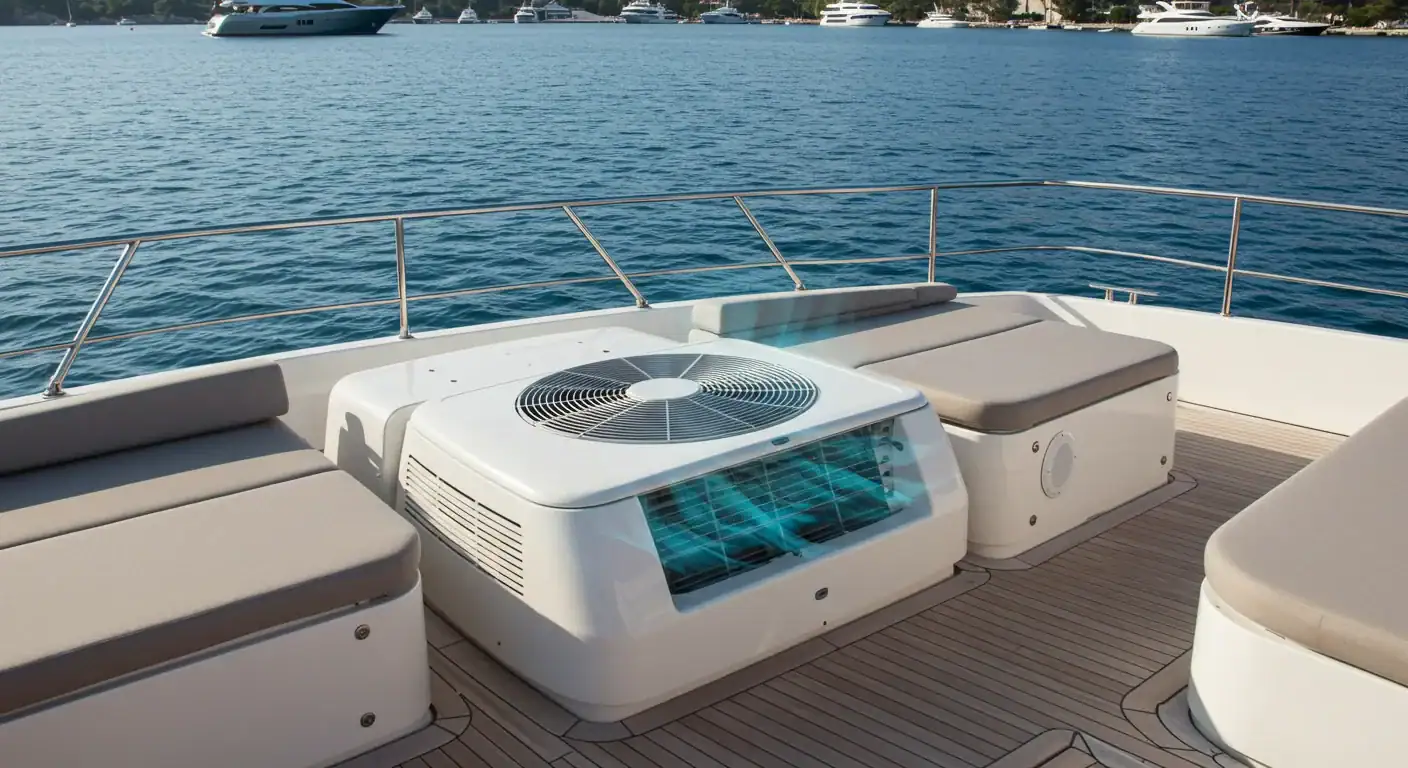
Saltwater doesn’t just damage marine AC components—it actively destroys them through corrosion, marine growth, and scale deposits. Regular maintenance isn’t optional; it’s the difference between 15 years of reliable service and failure in five.
Sea strainers need weekly cleaning during heavy use, minimum bi-weekly during boating season. These basket filters catch debris before it reaches your water pump. They also collect seaweed, jellyfish, plastic bags, and everything else floating in your marina. A clogged strainer starves your system of cooling water, triggering high-pressure faults and potentially burning out your compressor. Checking the strainer takes five minutes. Replacing a failed compressor takes days and costs thousands.
Coil descaling prevents the slow efficiency loss most owners don’t notice until their system barely cools anymore. Barnacles, algae, and biofilm build up inside the seawater side of your heat exchanger, insulating coils and preventing heat transfer. Flushing with a marine descaling solution every few years removes this growth. The improvement in cooling performance and reduced amp draw is immediate and dramatic.
Air filters get neglected because most boats have at least two and owners only clean the obvious one. The return air grill filter is visible and gets regular attention. The second filter—usually mounted directly on the unit inside a cabinet or under a bunk—gets forgotten. Both need monthly cleaning during active use. Clogged filters restrict airflow, freeze evaporator coils, and force your compressor to work harder while delivering weaker cooling.
Condensate drains clog with wet dust and mold, overflowing onto cabin floors or into bilges. Running a pipe cleaner through the drain line every few months prevents this. Many boats route condensate to shower sump boxes, but older installations have dedicated pumps requiring periodic inspection.
Marine AC demands more maintenance than residential systems. But emergency repairs while you’re trying to enjoy your boat cost far more in money, time, and frustration than preventive maintenance ever will.
Some marine AC problems you can handle yourself. Others require specialized knowledge and equipment that only certified marine HVAC technicians possess. Knowing which is which saves time and prevents damage from well-intentioned but incorrect repairs.
Basic maintenance and troubleshooting are owner territory. You can clean air filters, check sea strainers, inspect visible hoses for cracks, and verify water flow from the discharge port. You can reset breakers, adjust thermostat settings, and clear blocked vents. These simple checks solve many common issues and should be your first response when something stops working.
Call us when you see error codes—especially high-pressure or low-pressure refrigerant faults. These indicate problems with refrigerant levels, compressor function, or system pressures requiring proper diagnosis. Refrigerant work demands EPA certification and specialized equipment. It’s not a YouTube tutorial project.
Electrical issues beyond breaker resets need professional attention. Marine electrical systems are complex, and improper repairs cause fires or electrocution. If your AC won’t power on, trips breakers repeatedly, or shows burnt wiring or corroded connections, stop and call someone who actually knows marine electrical work.
Compressor failures, refrigerant leaks, and major component replacements all require professional service. We can diagnose whether repair makes economic sense or if replacement is smarter. We’ll ensure new equipment is properly sized for your vessel, correctly installed to marine standards, and safely integrated with your boat’s electrical system.
The distinction is straightforward: basic maintenance and simple troubleshooting are your responsibility. Diagnosis and repair of refrigerant systems, electrical problems, or major component failures require specialized expertise. Finding a contractor who understands marine HVAC—not just someone willing to experiment on your boat—determines whether you get reliable results or expensive problems.
Marine air conditioning isn’t optional for Nassau County, NY boat owners who actually use their vessels in summer. It’s essential equipment that protects your investment and makes time on the water enjoyable instead of miserable.
The right system depends on your vessel size, electrical capacity, and how you use your boat. Self-contained units work for most boats under 40 feet. Larger vessels benefit from split systems or chilled water configurations. But regardless of which type fits your needs, proper installation and consistent maintenance determine whether you get 15 years of trouble-free service or constant expensive repairs.
Specialized knowledge matters. Marine HVAC requires understanding saltwater corrosion, boat electrical systems, space constraints, and installation challenges that standard HVAC contractors never face. We bring over 40 years of marine HVAC expertise to Nassau County and Long Island vessel owners, with the specialized knowledge, genuine marine-grade parts, and 24/7 availability that keeps your system running when you need it most.
Article details:
Share:
Continue learning: