Most HVAC repair mistakes aren't obvious until the bill arrives. Here's what Nassau County homeowners get wrong — and how to avoid paying for it twice.
Share:
Summary:
Most people don’t think about their HVAC system until something goes wrong. That’s understandable — it runs in the background, doing its job, until one day it doesn’t. But the moment it fails, the decisions you make in the next few hours can either contain the damage or multiply it.
In Nassau County, where summers get genuinely humid and winters bite hard, a broken system isn’t just uncomfortable — it’s urgent. This guide walks through the mistakes we see homeowners make most often, what those mistakes actually cost, and what a smarter approach looks like from the start.
There’s a version of this story we hear constantly: a homeowner noticed something off — a strange noise, a room that wouldn’t cool down, an energy bill creeping up — and decided to wait and see. A few weeks later, what could have been a straightforward repair became a system failure in the middle of a heat wave.
Catching a developing problem early typically means a repair in the $150–$400 range. Let it go, and you’re often looking at $1,500 or more — sometimes a full system replacement averaging $7,500. That gap isn’t bad luck. It’s the predictable result of ignoring warning signs that were already telling you something was wrong.
The average single-family home in Nassau County is about 73 years old. That means the majority of homes here were built before modern HVAC systems existed in their current form — before today’s efficiency standards, before modern refrigerants, before the equipment sizing calculations that installers use now.
Many of those homes have had systems added, replaced, or modified over the decades in ways that weren’t always done correctly. Research suggests that up to 90% of HVAC systems are installed with some form of error, and improper installation alone can increase a home’s energy use by 30% or more.
Add to that the coastal environment. Nassau County sits between the Atlantic Ocean and Long Island Sound, and that salt air isn’t just a scenic backdrop — it accelerates corrosion on outdoor condenser units, refrigerant lines, and compressor components in ways that inland markets simply don’t experience. A system that might last 15 years in a landlocked suburb can show significant wear much sooner here, especially along South Shore communities like Long Beach, Oceanside, and Atlantic Beach where salt exposure is most intense.
The result is that Nassau County homeowners are managing older homes, aging equipment, and an environment that stresses that equipment harder than average. That combination makes early attention to HVAC problems more important here than almost anywhere else — not as a sales pitch, but as a straightforward reality of where you live and what your home is dealing with.
When a system starts short cycling, making unusual sounds, or struggling to hold temperature on a July afternoon, those aren’t minor inconveniences to schedule around. They’re early signals of a problem that gets more expensive the longer it sits.
The financial math on delayed residential HVAC repair is pretty clear, but the emotional logic behind waiting is understandable too. Nobody wants to spend money on something that’s still technically working, and there’s always a chance it’ll hold on a little longer.
Sometimes it does. More often, the underlying issue continues to develop — a refrigerant leak stresses the compressor, a dirty coil forces the blower motor to work harder, a small electrical fault creates intermittent problems that eventually become constant ones. Each of those progressions costs more to fix than the original problem would have.
There’s also the timing factor. HVAC emergencies don’t happen on Tuesday mornings in April. They happen on Friday evenings in August, when every contractor in Nassau County is already booked. Emergency service — when you can get it — comes at emergency pricing. And if your system fails completely rather than partially, you lose the option of a targeted repair altogether. At that point, the conversation shifts from “what needs fixing” to “what needs replacing,” and the numbers change significantly.
The smarter move — and this applies to most homeowners in Nassau County regardless of how old their system is — is to treat early warning signs as a reason to call, not a reason to monitor. A diagnostic visit that tells you everything is fine costs far less than the alternative. And if something does need attention, catching it before it cascades is almost always the less expensive path.
Want live answers?
Connect with a Chill Xpert Solutions expert for fast, friendly support.
Some of the most expensive HVAC repair mistakes happen before any work is done — in the moment you’re choosing who to call. In a market as active as Nassau County, there’s no shortage of HVAC contractors. The challenge isn’t finding one. It’s knowing which questions to ask before you let someone into your home and your mechanical system.
The contractor you choose determines almost everything that follows: whether the diagnosis is accurate, whether the repair holds, whether you’re dealing with the same company if something goes wrong, and whether the person who shows up is actually qualified to work on your equipment.
This is the question most Nassau County homeowners don’t think to ask — and it’s one of the most important ones. A significant number of HVAC companies in the Long Island market operate by dispatching subcontractors rather than their own employees. You call a recognizable name, you schedule an appointment, and then someone you’ve never heard of shows up at your door.
That’s not automatically a problem, but it creates a specific accountability gap. When a subcontractor misdiagnoses a problem, installs something incorrectly, or does work that fails two weeks later, the original company and the subcontractor can each point to the other. The homeowner is left in the middle, often paying again to have a second company come in and fix what the first one got wrong.
We hear this story regularly. It’s one of the defining frustrations in the Long Island HVAC market, and it’s entirely avoidable — but only if you ask the right question upfront: does your company use subcontractors, or do your own technicians do the work?
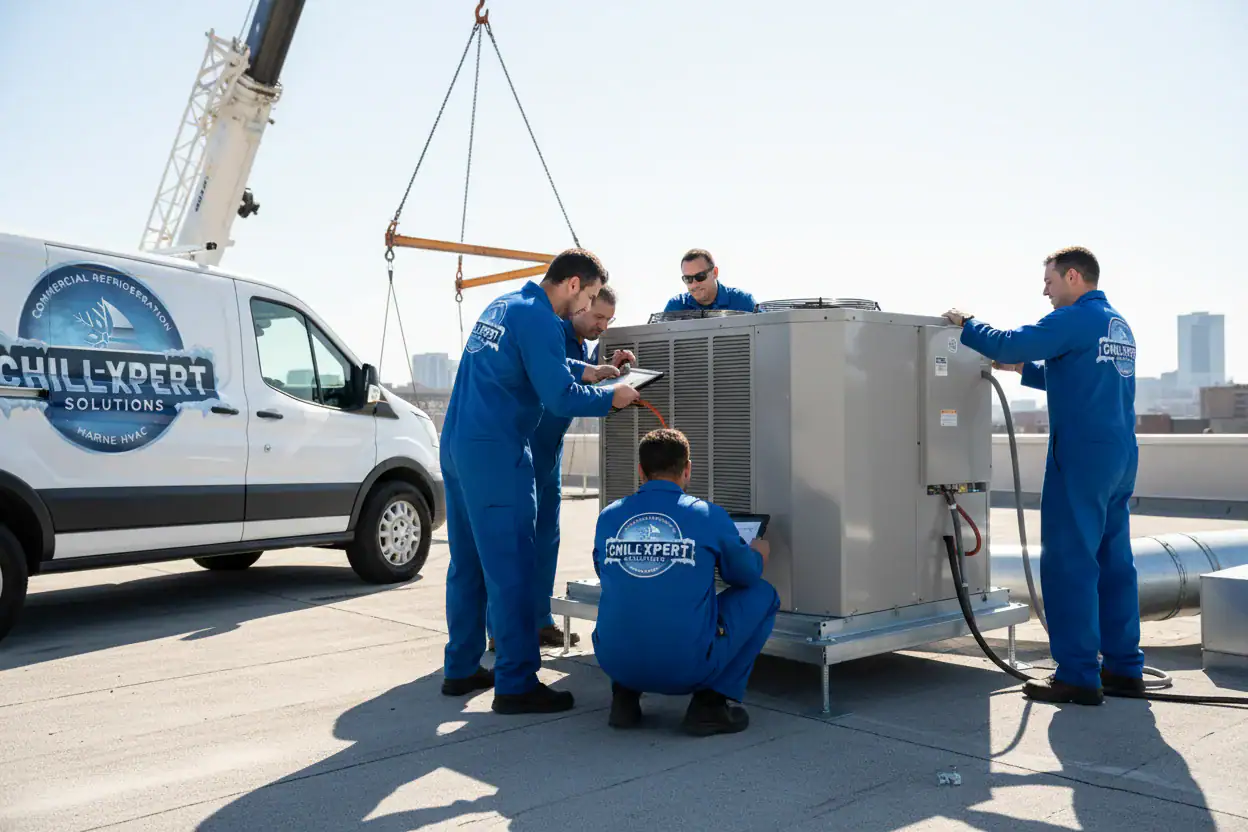
At Chill Xpert Solutions, every technician who comes to your home is our employee. No subcontractors, no handoffs, no accountability gaps. That’s a deliberate policy, not an accident. When you call us, you know exactly who’s coming — someone trained to our standards, accountable to us, and responsible for the work they do. If something isn’t right, there’s one number to call and one company that owns the outcome.
It’s also worth asking about licensing and certification before any work begins. New York State has a layered licensing structure for HVAC contractors, and the level of license a technician holds determines what they’re legally permitted to do. Only licensed contractors at the Master level can pull mechanical permits for major installations. EPA Section 608 certification is federally required for any technician handling refrigerants. These aren’t bureaucratic details — they’re the baseline that separates qualified work from guesswork.
Nassau County is not a generic HVAC market, and not every contractor who operates here understands that. The combination of coastal salt air, aging housing stock, and a significant marine and commercial sector means that local HVAC repair experience — real, specific, years-in-the-market experience — matters more here than it might in a newer inland suburb.
A generalist contractor who works primarily on newer residential construction in a different county may not recognize the corrosion patterns that affect outdoor units in Freeport or Long Beach. They may not know how to properly size a replacement system for a 1950s colonial in Garden City or Merrick that’s been modified three times over the decades. And they almost certainly can’t help if the problem involves a commercial refrigeration unit, a marine HVAC system on a vessel docked at one of Nassau County’s South Shore marinas, or a complex cooling setup in a catering hall or restaurant.
That’s not a knock on generalists — it’s just the nature of specialization. The more complex and specific the system, the more it matters that the person diagnosing it has seen that exact type of failure before.
We’ve been doing this work across Nassau and Suffolk Counties for over 40 years. That’s relevant because 40 years in this specific market means we’ve worked on virtually every system configuration, failure mode, and environmental condition Long Island produces. We carry parts on our trucks specifically because we know what breaks here and how often. Roughly 70% of our emergency calls get resolved the same day, without waiting for a part to be ordered or a second visit to be scheduled.
For North Shore homeowners in Great Neck, Port Washington, or Oyster Bay — where homes are larger and HVAC systems more complex — that diagnostic depth matters. For South Shore homeowners dealing with accelerated corrosion near the water, it matters differently but just as much. Local HVAC repair isn’t just about proximity. It’s about whether the person diagnosing your system actually understands the conditions it’s been operating in.
The through-line in every expensive HVAC mistake is the same: waiting too long, choosing the wrong contractor, or not asking the right questions before work begins. None of those are inevitable. They’re just common — especially in a busy market where homeowners are juggling a lot and hoping the system holds on a little longer.
If your HVAC is showing early signs of trouble, the best move is a straightforward diagnostic from a contractor who will tell you honestly what’s wrong, what it will cost, and whether repair or replacement makes more sense for your situation.
That’s what we do at Chill Xpert Solutions. If you’re in Nassau County and your system is giving you trouble, reach out. We’ll give you a clear answer and an upfront estimate — and we’ll send one of our own technicians, not a subcontractor, to do the work.
Article details:
Share:
Continue learning: