Walk-in coolers that can't hold temperature threaten your inventory and business. Learn the nine most common causes and what to do before spoilage costs you thousands.
Share:
Summary:
Walk-in coolers work around the clock. They cycle on and off to maintain a narrow temperature range—typically between 35 and 38 degrees—while you’re constantly opening doors, loading warm product, and putting stress on every component from the compressor to the door hinges.
When something fails, the symptoms are obvious. Temperature creeps up. Ice forms where it shouldn’t. The compressor runs nonstop or won’t turn on at all. But identifying the root cause? That’s where things get complicated. A temperature issue could be as simple as a thermostat that got bumped during a busy shift, or as serious as a refrigerant leak that’s been slowly draining your system’s cooling capacity for weeks.
The key is knowing what to look for and when to call for commercial refrigeration repair. Some problems you can troubleshoot on your own. Others require a technician who knows the difference between a quick fix and a failing compressor that’s about to cost you thousands in spoiled food and emergency walk-in cooler repair.
Door gaskets create the airtight seal around your walk-in cooler door. When they’re working properly, cold air stays in and warm air stays out. When they fail, you’re essentially air conditioning the hallway—and your refrigeration system can’t keep up.
Gaskets wear out from heavy use. They crack in winter cold, tear from constant opening and closing, and lose flexibility after years of service. Sometimes they just accumulate food residue and grease that prevents proper sealing. You might not see the gap, but your compressor notices—it runs longer and works harder to compensate for the constant warm air infiltration.
Here’s a simple test: close the door on a dollar bill. If you can pull it out easily, your seal has failed. A properly functioning gasket grips that bill tight enough that you feel real resistance. If it slides out without effort, you’re losing cold air every single time that door closes.
Replace damaged gaskets as soon as you notice them failing. Don’t wait until your cooler can’t maintain temperature anymore. A new gasket costs a fraction of what you’ll lose in wasted energy and spoiled inventory. We can swap them out the same day for most commercial walk-in coolers in Nassau County, NY.
Door gaskets might seem minor, but they’re one of the top causes of temperature loss in commercial walk-in coolers. Check them monthly. Replace them when needed. Your compressor will last years longer when it’s not compensating for failed seals.
Cold air needs to circulate throughout your walk-in cooler to maintain consistent temperature. When airflow gets restricted—boxes stacked against the evaporator, product blocking vents, shelves packed too tight—you create hot spots where temperature rises above safe food storage levels.
This happens constantly in busy operations. You get a large delivery. Space is limited. Someone stacks cases in front of the air vent because there’s nowhere else to put them. A few hours later, the cooler’s struggling to stay cold and the compressor’s running nonstop trying to compensate.
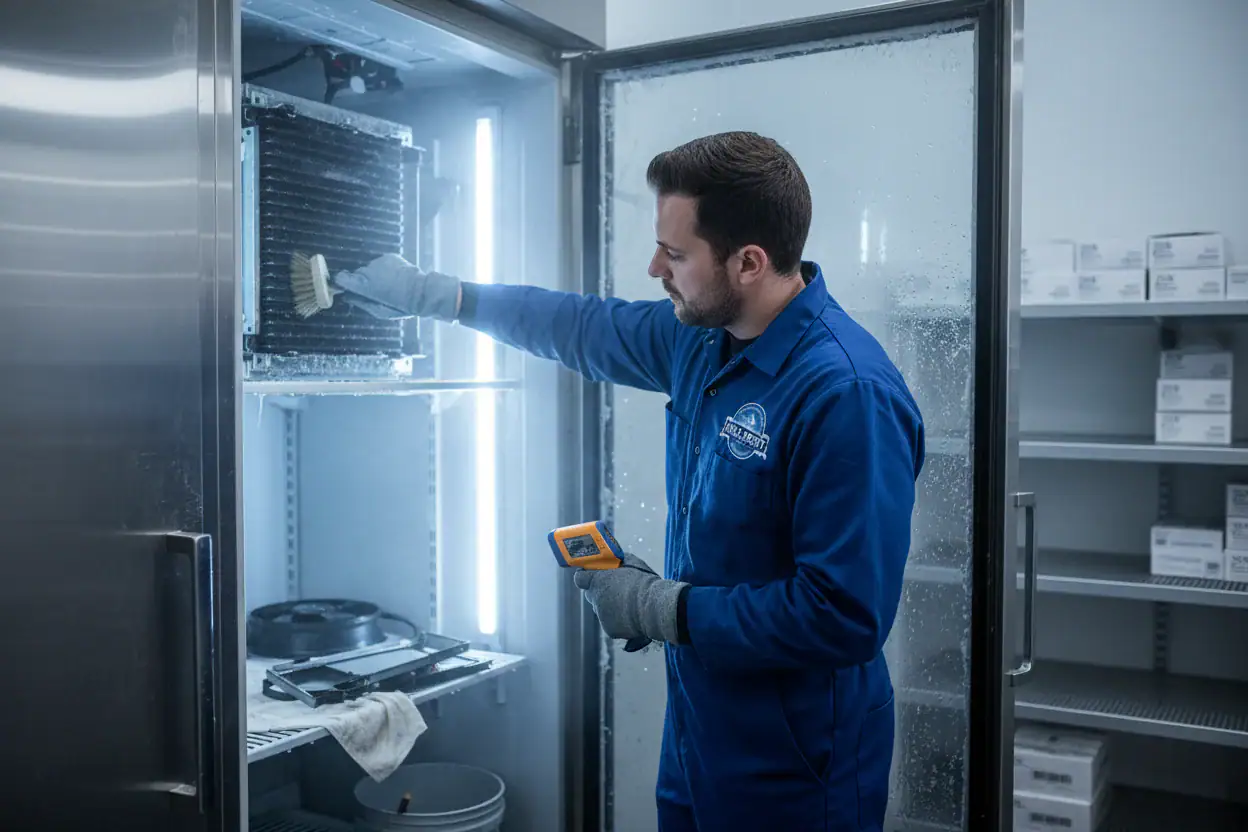
The evaporator coil generates and circulates cold air throughout your walk-in. Block it, and you’re choking your entire refrigeration system. The unit can’t pull warm air across the coil to cool it down, which means temperature rises, the compressor overworks, and your energy costs increase while food safety decreases.
Pay attention to how you load your walk-in. Leave clearance around the evaporator unit—at least a few feet so air moves freely. Don’t pack shelves so tight that air can’t flow between products. Pull shelves an inch or two from walls. These small adjustments dramatically improve system efficiency.
If your walk-in cooler stays overstocked to the point where proper airflow is impossible, you’ve outgrown your current capacity. That’s a different conversation—one that might involve a larger unit or adding a second cooler—but address it now rather than forcing a refrigeration system to do more than it was designed to handle.
And here’s what most people miss: the placement of your cooler matters too. If it’s flush against a wall with no breathing room around the condenser, you’re restricting external airflow as well. Your commercial refrigeration system needs space on all sides to dissipate heat properly. Give it room to work.
Want live answers?
Connect with a Chill Xpert Solutions expert for fast, friendly support.
Condenser coils release heat from your refrigeration system into the surrounding air. When they’re clean, this heat exchange is efficient. When they’re covered in dust, grease, and kitchen debris, your system works significantly harder to achieve the same cooling—and sometimes it just can’t keep up.
Think of it like breathing through a clogged filter. You can do it, but it takes more effort and you’re not getting the oxygen you need. Dirty condenser coils rank among the most common and most preventable causes of walk-in cooler temperature problems. They should be cleaned at least twice a year, more often in kitchen environments with heavy grease and airborne contaminants.
When condenser coils can’t release heat efficiently, the entire refrigeration cycle suffers. Temperature rises inside the cooler. The compressor runs longer and hotter. Energy costs spike. And eventually, components start failing from the added strain. A maintenance task that takes 30 minutes prevents thousands of dollars in emergency commercial refrigeration repair and spoiled inventory.
Your thermostat tells your refrigeration system when to turn on and off based on interior temperature. When it malfunctions, everything goes wrong. The cooler might run constantly, freeze everything solid, or not turn on at all.
Sometimes the problem is simple—someone accidentally changed the temperature setting during a busy shift. Other times, the thermostat itself has failed and sends incorrect signals to the compressor. You might see the display showing 36 degrees while actual temperature inside hits 45. That’s a faulty sensor lying to you about conditions inside your walk-in cooler.
Here’s how to verify: use a separate, calibrated thermometer to check actual temperature inside your walk-in. Compare it to what the thermostat display shows. If there’s a significant difference—more than a couple degrees—your temperature control system needs professional attention.
Mechanical thermostats drift out of calibration over time. Electronic controllers are more precise but can fail due to electrical issues or sensor problems. Either way, a malfunctioning thermostat means your refrigeration system isn’t getting accurate information about when to cool, leading to temperature fluctuations, food safety violations, and wasted energy.
If you’re experiencing temperature problems and you’ve ruled out gaskets, airflow, and dirty coils, the thermostat is the next logical culprit. We can test the thermostat, recalibrate it if possible, or replace it if it’s failed. This isn’t a DIY fix unless you have specific training in commercial refrigeration controls—getting it wrong can damage your compressor or create unsafe food storage conditions.
Temperature control issues appear especially often in older walk-in coolers that still use mechanical thermostats. Upgrading to an electronic controller system improves precision, provides error codes when something goes wrong, and often includes remote monitoring so you catch problems before they become emergencies. For restaurants and food service operations in Suffolk County, NY and across Long Island, NY, that upgrade can mean the difference between catching a problem at midnight and discovering it when you open the next morning to thousands of dollars in spoiled inventory.
Refrigerant absorbs heat from inside your walk-in cooler and releases it outside through the condenser. When you have a refrigerant leak, your system gradually loses its ability to cool effectively—and there’s no DIY fix for this problem.
Signs of refrigerant leaks include frost buildup in unusual locations, a hissing sound near refrigerant lines, and a cooler that can’t maintain temperature no matter how long the compressor runs. You might notice the system cycling on and off more frequently, or running constantly without ever reaching set temperature. These are red flags that refrigerant levels have dropped.
Refrigerant doesn’t just evaporate or get “used up” during normal operation. If levels are low, there’s a leak somewhere in the system. That leak needs to be found, repaired, and then the system properly recharged with the correct type and amount of refrigerant. This requires specialized equipment, EPA certification, and expertise in commercial refrigeration systems.
Adding refrigerant without fixing the leak wastes your money. The refrigerant just leaks out again, and you’re back where you started—except now you’ve spent money on a temporary band-aid instead of an actual repair. Plus, releasing refrigerants into the atmosphere is illegal and environmentally harmful.
If you suspect a refrigerant leak, call for qualified commercial refrigeration repair immediately. The longer you wait, the harder your compressor works to compensate, which can lead to compressor failure—a repair that costs exponentially more than fixing a refrigerant leak. For businesses in Nassau County, NY and throughout Long Island, NY, having access to 24/7 emergency refrigeration service means you can address refrigerant issues before they escalate into complete system failure and massive food loss.
Refrigerant leaks absolutely require professional help. Don’t wait. Don’t try to DIY it. And don’t let anyone tell you they can “top off” your refrigerant without finding and fixing the leak first. That’s not a repair—that’s a temporary patch that costs you more in the long run.
The compressor is the heart of your refrigeration system. When it starts failing, you’ll notice the walk-in cooler struggling to maintain temperature, unusual noises like grinding or clicking, or the unit cycling on and off more frequently than normal. Compressor problems often result from years of strain caused by other issues—dirty coils forcing it to work harder, low refrigerant making it run longer, or poor ventilation causing it to overheat.
A failing compressor is expensive to replace, which is why preventive maintenance matters so much. Regular commercial refrigeration services can catch the conditions that lead to compressor failure before they destroy the unit. But once a compressor starts failing, you’re looking at a significant repair cost—often running into thousands of dollars depending on the size and type of your walk-in cooler.
Defrost system failures create a different set of problems but with similar temperature consequences. Your walk-in cooler needs to periodically defrost the evaporator coils to prevent ice buildup that blocks airflow. When the defrost cycle malfunctions—whether it’s a bad timer, failed heater, or malfunctioning termination sensor—ice accumulates on the coils, airflow gets restricted, and temperature rises inside the cooler.
Article details:
Share:
Continue learning: