Your commercial refrigerator gives off warning signs before it fails. Here is what Long Island restaurant and deli owners need to watch for before the damage is done.
Share:
Summary:
Your commercial refrigerator does not announce when it is about to fail. It does not send an alert or flash a warning light. It just keeps running, quietly and gradually getting worse, until one morning you walk in and the temperature is wrong, the compressor is screaming, or the food you prepped yesterday is already turning. If you are noticing these warning signs, professional commercial refrigeration service can help identify problems before they become costly failures.
That scenario plays out constantly across Long Island. In almost every case, the signs were there weeks or months earlier. They just were not recognized for what they were.
This post is about those signs, including what to look for, what they mean, and what happens if you keep ignoring them.
A well-maintained commercial refrigerator should last 15 years or more. A neglected one often gives out before the ten-year mark, and sometimes much sooner. The gap between those two outcomes is not luck or brand quality. It comes down to maintenance.
Reactive maintenance, which means waiting until something breaks and then calling for a repair, costs two to three times more than preventive maintenance over the life of a unit. That is not a rough estimate, but rather a consistent pattern we see across commercial kitchens and food service operations throughout Nassau County and Suffolk County.
On Long Island, where a single summer weekend can make or break a restaurant’s month, the timing of a failure matters as much as the failure itself. The good news is that most breakdowns give you a window. If you know what to look for, you can catch problems early before they become expensive.
The first sign is unusual noise. A commercial refrigerator that is running well is relatively quiet, maintaining a steady hum and a periodic cycle. When you start hearing clicking, rattling, grinding, or a compressor that sounds like it is straining, something has changed. It might be a failing fan motor, a loose component, or a compressor that is working harder than it should because dirty condenser coils are forcing it to. Either way, noise is the unit’s way of flagging that something needs attention.
The second sign is temperature inconsistency. If shelves that used to hold a steady 36 degrees Fahrenheit are now fluctuating, or if you notice that food near the back is colder than food near the door, the thermostat, evaporator fan, or refrigerant level may be off. Commercial refrigerators need to hold between 34 degrees Fahrenheit and 40 degrees Fahrenheit consistently. Drift outside that range is not just an equipment problem; it is a food safety problem that can show up on a health inspection.
The third sign is excessive frost or ice buildup. A little condensation is normal. Frost accumulating on the interior walls, shelves, or evaporator coils is not. It usually points to a failing defrost system or a door seal that is no longer doing its job. The unit is working harder to compensate, your energy bills are going up, and the underlying issue is not going away on its own.
The fourth sign is water pooling inside or beneath the unit. Standing water under a reach-in or along the floor of a walk-in cooler typically means a clogged drain line or an overflowing drain pan. Left alone, it creates a slip hazard, accelerates corrosion, and becomes a breeding ground for mold and bacteria, none of which you want anywhere near food prep or storage.
The fifth sign is rising energy bills without a clear explanation. Dirty condenser coils are one of the most common and most overlooked causes of efficiency loss in commercial refrigeration. Research shows that dust buildup on condenser coils reduces efficiency by roughly 12 percent per millimeter of accumulation. That adds up quickly, and it shows up on your PSEG Long Island bill before it shows up as a visible problem. If your electric costs have been climbing and you have not changed your operations, your refrigeration equipment is worth a closer look.
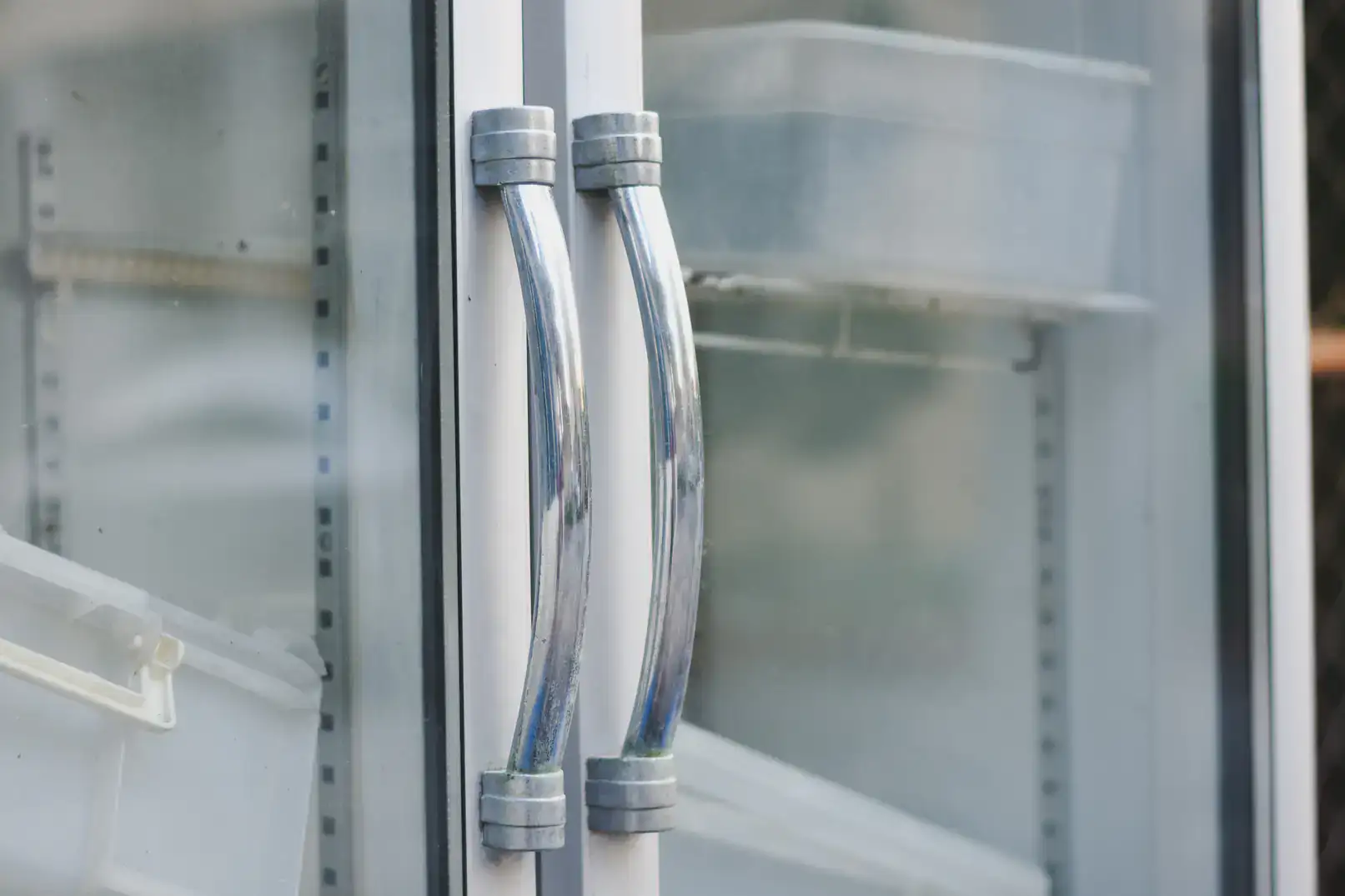
The sixth sign is worn, cracked, or poorly sealing door gaskets. Run your hand along the door seals on your reach-in units or walk-in cooler. If they are stiff, cracked, or you can feel cold air escaping, the seal has failed. The unit is now trying to maintain temperature with a leak it cannot compensate for. Gasket replacement is one of the simplest and least expensive maintenance tasks available, but when ignored, it forces the compressor to run almost continuously, shortening its lifespan significantly.
The seventh sign is a unit that never stops running. A commercial refrigerator cycles on and off as it maintains temperature. If yours is running constantly without cycling off, the system is struggling. It could be the gaskets, the coils, the refrigerant, or the thermostat, but the common thread is that something is making the unit work harder than it was designed to. Continuous operation accelerates wear on every component, and it is often the last warning before a compressor fails entirely.
Long Island’s commercial food service environment puts refrigeration equipment under specific pressures that operators in other markets do not face to the same degree. Summer on Long Island is genuinely demanding for commercial refrigeration. July and August regularly bring temperatures above 85 degrees Fahrenheit with high humidity, and that ambient heat forces compressors to work harder just to maintain safe storage temperatures. If a unit is already struggling with dirty coils, failing gaskets, or a compressor that has been running nonstop, the summer heat is often what pushes it over the edge.
For a restaurant in Huntington or a deli in Levittown, a walk-in cooler failure during a Friday dinner rush is not just an inconvenience. It is a full kitchen shutdown, a potential health code violation, and thousands of dollars in spoiled inventory all at once. For catering halls across Nassau County, the stakes are even higher. A refrigeration failure the night before a 300-person event is a completely different category of problem.
The South Shore communities, including Long Beach, Oceanside, Bay Shore, and Patchogue, deal with an additional factor that inland operators do not face: salt air. The coastal environment accelerates corrosion on condenser coils, electrical connections, and refrigerant lines. Equipment along the water needs more frequent inspection, not less. The same applies to the East End, where Hamptons restaurants running at full capacity through July and August are often the last to schedule a maintenance visit before the season starts.
The pattern we see consistently is that business owners notice one or two of the signs above, decide the unit is still working, and push the maintenance call down the priority list. Then the unit fails, usually at the worst possible time, and the repair cost, plus spoilage and lost revenue, adds up to far more than a preventive maintenance visit ever would have.
Want live answers?
Connect with a Chill Xpert Solutions expert for fast, friendly support.
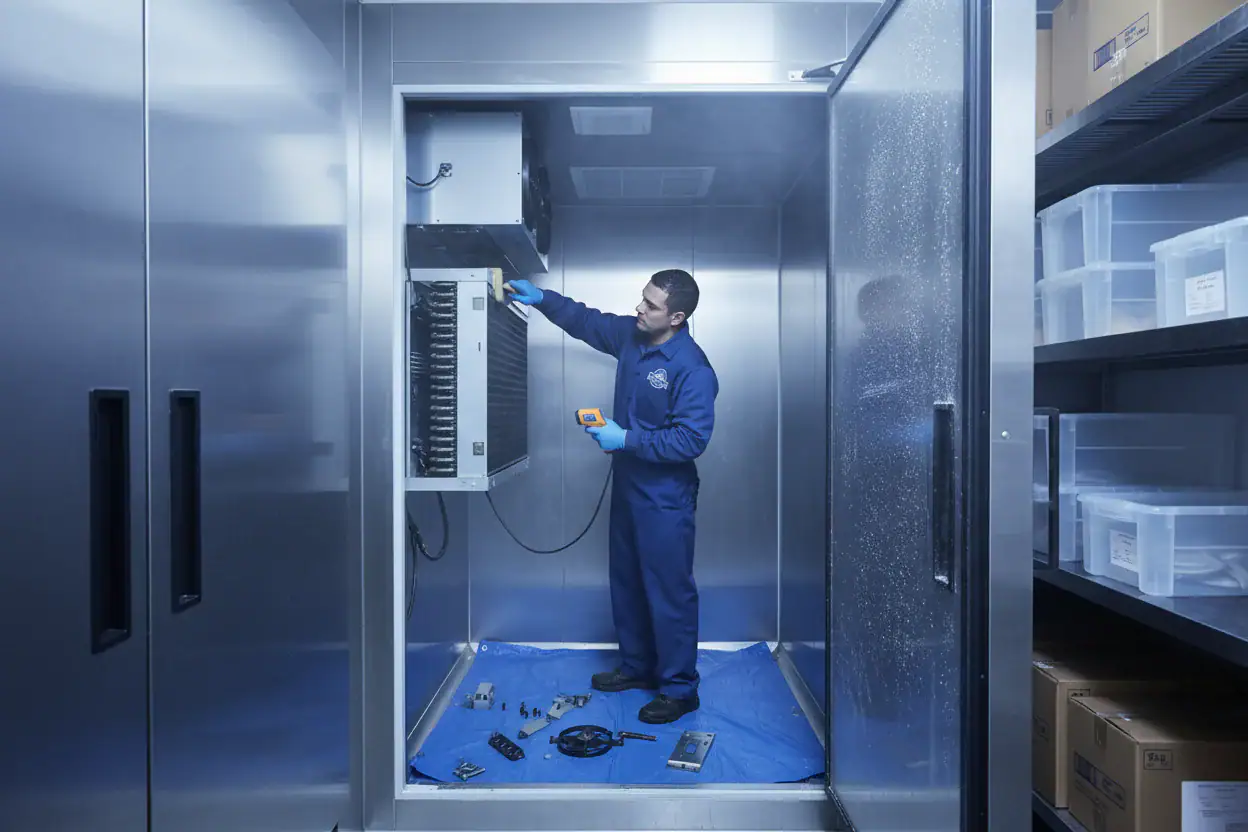
Preventive maintenance for commercial refrigeration is not a vague tune-up. It is a specific set of tasks that address the most common failure points before they become failures. A proper preventive maintenance visit should include cleaning the condenser coils, inspecting and testing the evaporator fans, checking refrigerant levels, verifying thermostat calibration, inspecting door seals and gaskets, clearing drain lines and drain pans, lubricating moving parts, and reviewing electrical connections for wear or corrosion.
When it is done right, you should walk away with a signed checklist of what was inspected, what was found, and what was done, rather than just a verbal assurance that everything looks good. If a technician cannot hand you documentation, that is worth noting.
The honest answer is that it depends on how hard the equipment works and what environment it is in, but the industry benchmark for high-use commercial units is quarterly preventive maintenance, supplemented by monthly temperature log checks and basic cleaning in between.
For Long Island operators, that schedule often needs to be front-loaded. Getting a preventive maintenance visit done in late April or early May, before the summer heat arrives, is genuinely important. A unit that is going into July with dirty coils and a struggling compressor is likely to fail in August, right when you can least afford it. The same logic applies to the fall, when catering halls and event venues across Nassau County and Suffolk County are heading into their busiest season. A preseason check in September before the wedding and holiday rush is a straightforward way to reduce the risk of a failure during your highest-revenue months.
For South Shore and waterfront businesses dealing with salt air exposure, more frequent coil inspections are worth building into the schedule. Corrosion on condenser coils does not wait for the annual preventive maintenance visit, and catching it early is significantly less expensive than replacing components that have been corroding for two years.
Monthly checks do not have to involve a technician every time. Keeping a temperature log, visually inspecting door seals, and listening for changes in operating noise are tasks any kitchen manager can handle. The point is to stay attentive because the equipment will give you signals before it gives up entirely.
It does, and it matters more than most people realize until they have had a bad experience. Commercial refrigeration is not the same as residential appliance repair. The systems are more complex, the stakes are higher, and the legal requirements are different. Any technician who handles refrigerants is federally required to hold EPA Section 608 certification under the Clean Air Act. This is not optional or a nice-to-have, but rather a legal requirement. If a technician cannot verify that certification, they cannot legally service your refrigerant system.
Beyond the legal baseline, there is a meaningful difference between a generalist who can handle basic repairs and a specialist who has spent decades working on commercial systems across every brand and configuration. A specialist has likely seen your exact failure mode before. They know what a struggling compressor sounds like on a specific walk-in brand, which components tend to go first on certain display case models, and how to read the signs that a less experienced technician might miss or dismiss.
At Chill Xpert Solutions, every technician on our team holds EPA Section 608 certification. We have been doing this for over 40 years across Nassau County, Suffolk County, and the broader Long Island area, working with restaurants, delis, catering halls, airports, medical facilities, and marine operations. We do not use subcontractors, meaning the technician who shows up is a trained member of our team rather than a third-party dispatch. That matters when you are trusting someone to work on equipment your entire operation depends on.
We also handle systems most contractors will not touch, such as custom beer and beverage cooling systems, wine storage, and marine refrigeration for yacht clubs and marina businesses along Long Island’s coastline. That depth of experience is not incidental. It means that when our technicians look at a standard walk-in cooler or reach-in unit, they bring a level of pattern recognition born from working on far more complex systems every day.
If you have ever had a technician tell you everything looks fine and then had the unit fail two months later, you already know why this distinction matters. A visual pass from someone without deep commercial refrigeration experience is not the same as a diagnostic check from a specialist who knows what to look for.
The seven signs covered in this post, which include unusual noise, temperature inconsistency, excessive frost, water pooling, rising energy costs, failing door seals, and a unit that never cycles off, are not minor quirks to monitor indefinitely. They are warnings. Each one represents a system under stress, and stress compounds over time.
A commercial refrigerator that receives regular preventive maintenance can last 15 years or more. One that does not often fails before ten. For Long Island food service operators, that gap represents a significant capital expense, alongside the downstream costs of emergency repairs, spoiled inventory, and downtime during your busiest seasons.
If you are seeing any of these signs, or if it has simply been a while since anyone looked at your equipment, reach out to Chill Xpert Solutions. We offer free estimates, we are available around the clock, and we will tell you plainly what we find and what it needs without any surprises.
Article details:
Share:
Continue learning: