Your walk-in cooler rarely fails without warning. Here are five things it may already be telling you — and what each one actually means.
Share:
Summary:
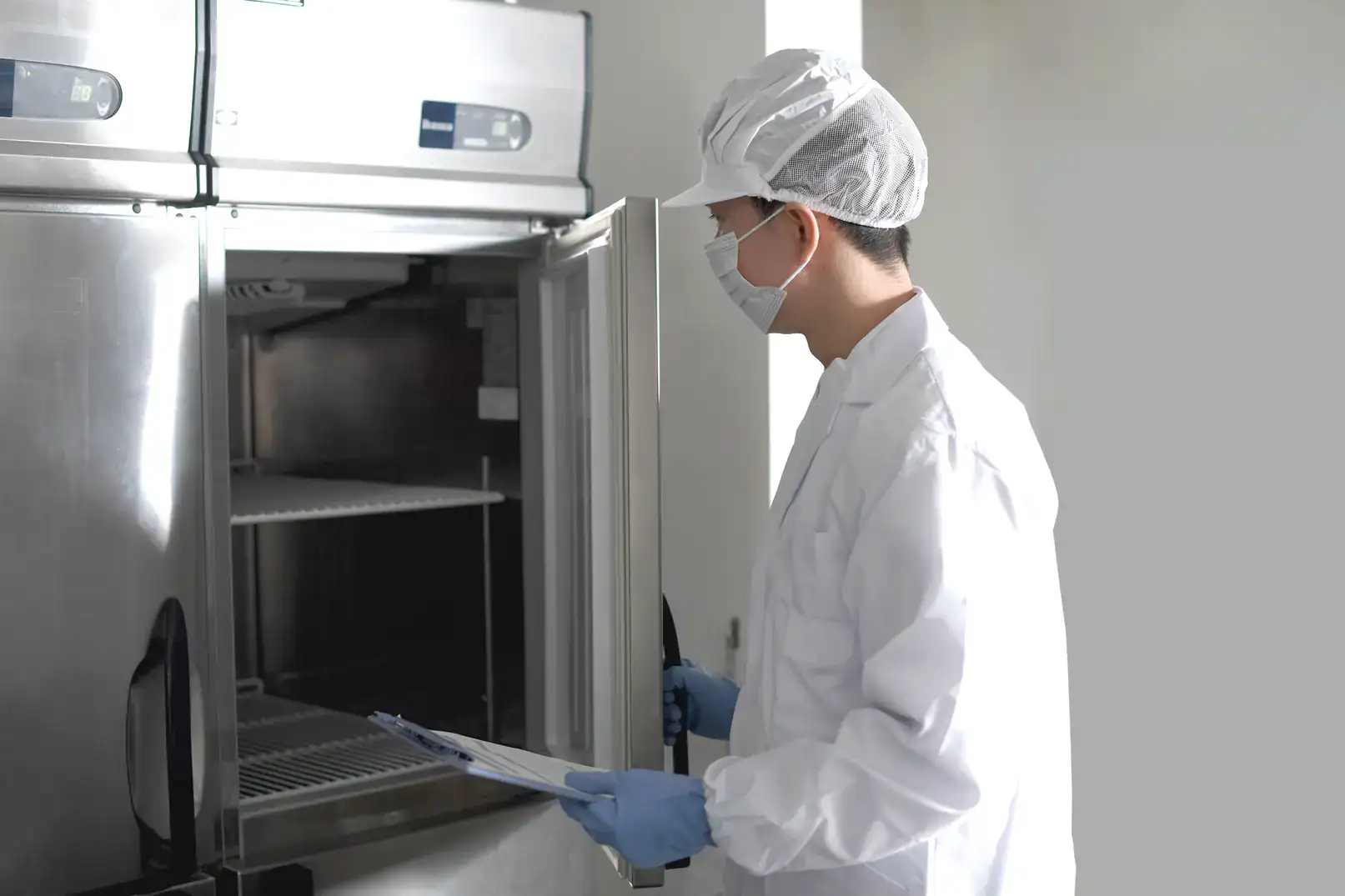
You open the walk-in at the start of your shift, and something feels off. Maybe it’s a little warmer than it should be. Maybe there’s a sound you don’t remember hearing before. Maybe there’s water on the floor near the unit. You’re not sure if it’s serious, so you keep an eye on it and get back to work.
That hesitation is completely understandable — but it’s also how a $200 repair becomes a $2,000 emergency. The good news is that most walk-in cooler problems give you warning before they become critical. Here are five things you can actually look for yourself, and what each one is likely telling you.
There’s a real difference between troubleshooting and diagnosing. We diagnose — we pressure-test refrigerant lines, check electrical connections, and evaluate compressor performance. You troubleshoot — you look for the obvious stuff that’s sometimes all it takes to catch a problem early or rule out something simple.
None of the five warning signs below require tools or technical knowledge. They require attention. And if you run a food service operation in Nassau County — whether that’s a deli on Hempstead Turnpike, a catering hall in Westbury, or a restaurant near the south shore — paying attention to your walk-in is just part of protecting your inventory and your health inspection record.
This is the most common complaint we hear, and it almost never means the system suddenly stopped working. Temperature creep — when your cooler is running but struggling to stay at the right temperature — is usually the result of something that’s been building for a while.
The first thing to check is whether the thermostat is set correctly and responding. If the setting looks right but the internal temperature is consistently reading higher than it should, that’s your first real signal. Food above 41°F enters the temperature danger zone under health code — and Nassau County’s Department of Health takes food temperature compliance seriously during inspections. You don’t want to find out you have a problem during a surprise visit.
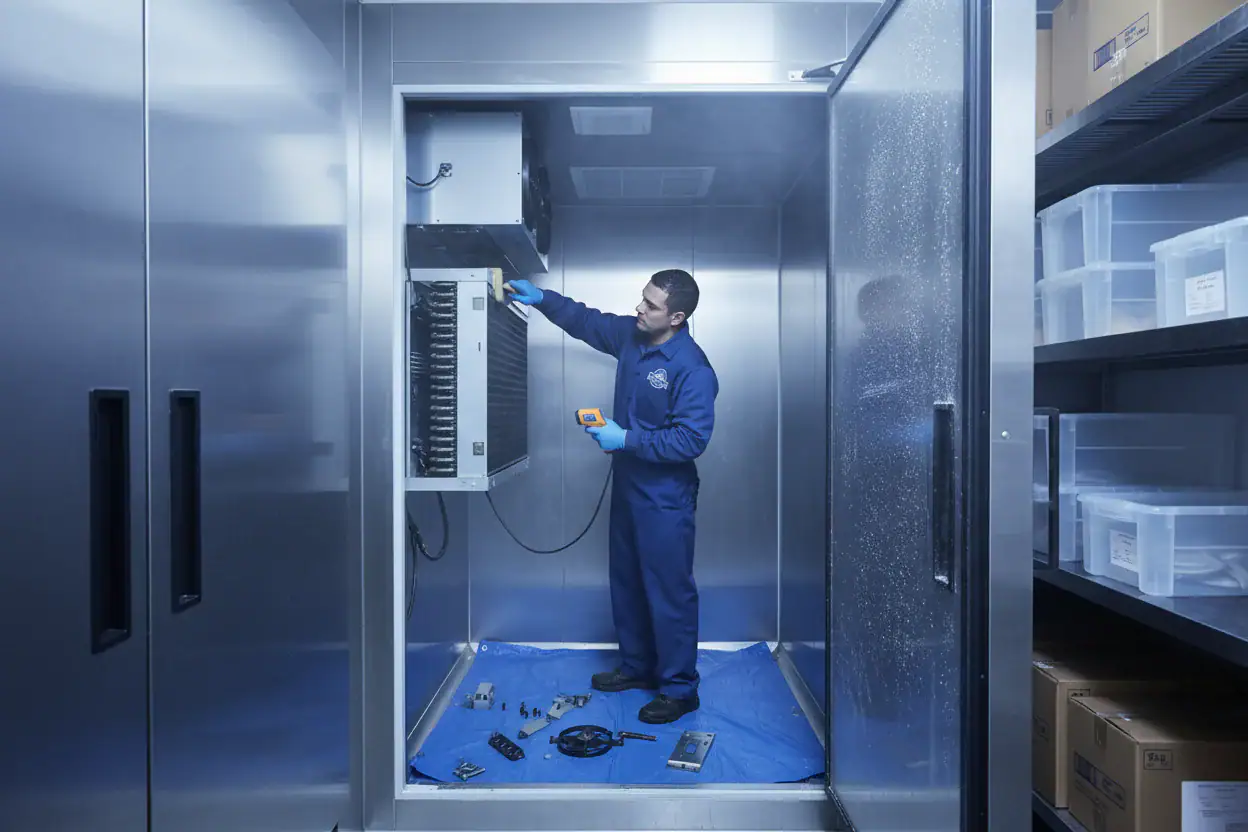
Beyond the thermostat, temperature problems are often tied to one of three things: dirty condenser coils, a refrigerant issue, or a failing compressor. Dirty coils are something you can visually inspect — they’re typically located on the exterior of the unit, and if they’re caked with dust and debris, the system is working harder than it should to reject heat.
Long Island summers make this worse than most people expect. The coastal humidity along Nassau County’s south shore means condensers clog faster here than they would in a drier inland climate, and a system that was running fine in April may start struggling by July. If cleaning the coils doesn’t move the needle on temperature, or if you’re seeing the problem in cooler months when the system shouldn’t be under that kind of load, that’s when you stop adjusting settings and start making a call.
A refrigerant leak or compressor issue won’t resolve on its own — and every day you wait, the problem compounds.
Three more warning signs tend to get dismissed as “normal” when they’re anything but.
The first is noise. Walk-in coolers make noise — compressors cycle, fans run, and refrigerant moves through lines. What you’re listening for is a change. A new grinding sound, a rattling that wasn’t there last week, or a compressor that seems to be running constantly without cycling off — these are signals. A compressor that never shuts off is usually either fighting a refrigerant issue or struggling with dirty coils. A grinding or rattling sound often means a motor mount is loose or a fan component is wearing out. Neither of these is an emergency on day one, but both will become one if ignored.
The second is frost or ice buildup on the evaporator coils inside the unit. Some frost is normal. Heavy ice accumulation — especially if it’s blocking airflow or coating the coils thickly — is not. This usually points to a defrost cycle problem, an evaporator fan issue, or a door that isn’t sealing properly and is letting in warm, humid air.
On Long Island, where summer air is thick with moisture from the Sound and the Atlantic, a compromised door seal can accelerate frost buildup dramatically. The third is water. A puddle near the base of your walk-in, or moisture collecting on the floor inside, typically means either a door gasket failure or a clogged condensate drain line. Door gaskets wear out over time — they get bumped, stretched, and compressed thousands of times a year in a busy kitchen. A quick visual check of the gasket around the full perimeter of the door can tell you a lot. If you see cracking, gaps, or areas where the seal isn’t making clean contact with the frame, that’s a problem worth addressing before it turns into a frost buildup issue or a failed health inspection.
None of these three signs require a technician to spot. But all three require one to fix correctly.
Want live answers?
Connect with a Chill Xpert Solutions expert for fast, friendly support.
Walk-in coolers and walk-in freezers share a lot of the same components, but they fail differently — and the stakes with a freezer are often higher because temperature swings affect frozen product faster and more permanently than refrigerated product.
The most common freezer-specific problem is excessive frost buildup, usually caused by a failed door heater or a defrost cycle that isn’t running properly. Unlike a cooler, a freezer operates in a much colder environment, which means any warm air infiltration turns to ice almost immediately. If you’re opening a freezer door and fighting through frost to get to product, or if the door is harder to open than usual because ice has formed around the gasket, those are signs the system needs attention.
A walk-in freezer that’s fluctuating in temperature — even if it’s still technically “cold” — is a problem. Frozen product that partially thaws and refreezes loses quality, texture, and in some cases safety. If your freezer is reading warmer than its set point, or if you’re noticing product quality declining in ways that suggest temperature inconsistency, that’s not something to watch and wait on.
The first check is the same as with a cooler: verify the thermostat is set correctly and that the reading matches what you’d expect. After that, check the door. Freezer doors take a lot of abuse in busy operations, and a gasket that’s lost its seal or a door that isn’t latching fully is often the culprit behind temperature swings. In a freezer environment, even a small air gap lets in enough warm moisture to cause significant frost accumulation and temperature instability.
If the door checks out, the next likely culprit is the defrost system. Walk-in freezers run automatic defrost cycles to prevent ice from building up on the evaporator coils — if that cycle fails, ice accumulates until it blocks airflow entirely, and the freezer can no longer maintain temperature no matter how hard the compressor works. This is the scenario that tends to escalate quickly. A freezer that’s been running with a failed defrost cycle for a week can reach a point where a technician needs to manually defrost the coils before any repair work can even begin — adding time and cost to what would have been a straightforward fix earlier.
The other thing worth knowing about walk-in freezer repair specifically: compressor failure in a freezer is almost always the result of deferred smaller issues stacking up. Low refrigerant, dirty coils, and worn electrical contacts don’t each cause a compressor to fail — but together, over time, they do. A compressor that’s been working overtime to compensate for those other issues eventually gives out. Catching any one of those contributing problems early is almost always cheaper than replacing a compressor later.
There’s a version of this situation that plays out in Nassau County food service businesses more often than it should: an owner notices something off with their walk-in refrigerator, keeps an eye on it through a busy weekend, and by Monday morning the system has failed completely — taking thousands of dollars of product with it.
The math on that decision almost never works out in the owner’s favor. Emergency refrigeration calls cost significantly more than planned repairs — overtime premiums, expedited parts, and minimum hour charges add up fast. The inventory loss on top of that can be devastating. A fully stocked walk-in cooler in a busy restaurant or deli can hold $4,000 to $10,000 in product. That’s not a number you want to gamble with over a service call you were hesitant to schedule.
So when does monitoring cross the line into calling? A useful threshold: if you’ve identified a problem and it hasn’t resolved or improved within 24 hours, call. If you’re seeing temperature readings above 41°F and you can’t identify an obvious cause, call immediately — that’s a food safety issue, not just an equipment issue. If you’re hearing a new sound that’s getting worse rather than better, call. And if you’re heading into a busy stretch — a weekend, a catering event, a holiday — and something feels off, call before it, not after.
We’ve been doing walk-in cooler and freezer repair across Nassau and Suffolk County for over 40 years. In that time, we’ve seen every version of this situation, and the ones that end badly almost always share one thing in common: the owner waited longer than they should have. Not because they were careless — but because they didn’t know what they were looking at, or they weren’t sure if it was serious enough to act on. That’s exactly what this guide is for.
You don’t need to know what’s wrong before you call. That’s our job. What you need to know is whether what you’re seeing is worth acting on — and if you’ve read this far, you probably already have your answer.
The five warning signs covered here — temperature creep, unusual noises, frost buildup, door seal failure, and freezer temperature swings — are the ones we see most often, and the ones that give you the best chance of catching a problem before it becomes a crisis. None of them require technical knowledge to spot. All of them require a technician to fix correctly.
If something about your walk-in cooler or freezer is bothering you, reach out to Chill Xpert Solutions. We offer free estimates, upfront pricing before any work begins, and same-day service availability across Nassau County, NY. Real people answer our calls — including after hours. You’ll know what’s wrong, what it takes to fix it, and what it costs before we touch anything.
Article details:
Share:
Continue learning: