Replacing your AC in Nassau County? Get real 2026 pricing, repair vs replacement formulas, and expert guidance on avoiding oversized systems and surprise charges.
Share:
Summary:
Your AC limped through another summer, but the repair bills keep stacking up. Now you’re trying to figure out if it’s time to replace the whole system or if one more fix will get you through. The problem is every contractor you call gives you a different answer, and nobody wants to talk about actual numbers until they show up at your house.
Here’s what you need to know: AC replacement cost in Nassau County typically runs between $4,500 and $12,000 for a standard central air system, but that range shifts dramatically based on proper sizing, efficiency ratings, and whether your ductwork needs modifications. More importantly, there are clear industry formulas that tell you when replacement makes financial sense and when it doesn’t. Let’s start with what actually determines whether you should repair or replace.
The decision between repair and replacement isn’t about guessing or trusting your gut. It’s about math that’s been proven across thousands of HVAC installations.
Industry professionals use two main formulas. The first is the $5,000 rule: multiply your system’s age by the cost of the repair. If the result exceeds $5,000, replacement typically makes more financial sense than throwing money at aging equipment. A 12-year-old system needing a $450 capacitor replacement gives you $5,400, which signals it’s time to replace rather than repair.
The second is the 50% rule. If your air conditioner repair cost exceeds half the price of a new system, and your unit is over 10 years old, you’re better off replacing it. That $2,000 compressor replacement on a 14-year-old system? You’re putting serious money into equipment that’s already approaching the end of its 15-20 year lifespan, and you’ll likely face another major repair within the next 12-24 months.
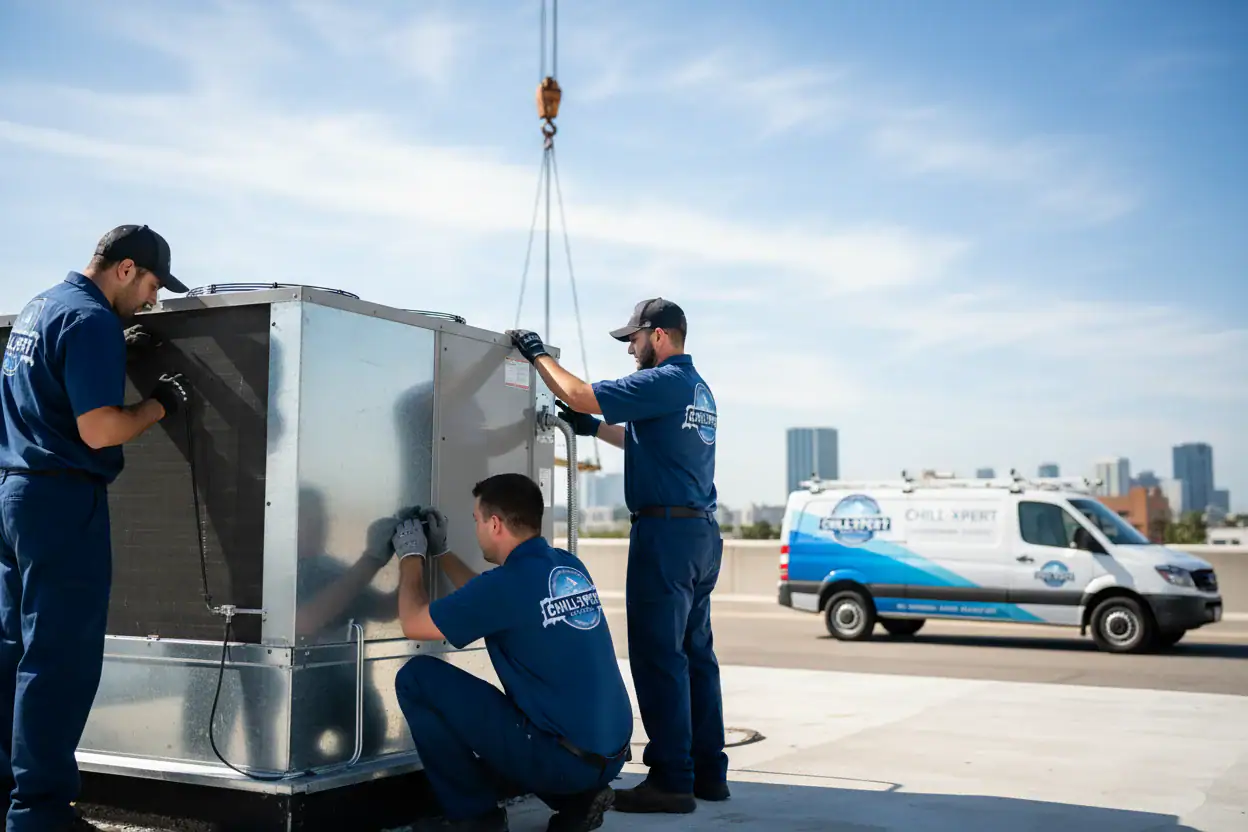
Air conditioner replacement cost breaks down into equipment, labor, permits, and sometimes ductwork modifications. Understanding each piece helps you spot inflated quotes and missing line items that contractors add later.
Equipment costs vary by size and efficiency. A 2.5-ton system costs less than a 5-ton unit, and a 14 SEER2 system costs significantly less than an 18 SEER2 model. Tonnage refers to cooling capacity, not physical weight—one ton equals 12,000 BTUs of cooling per hour. Your home’s size, insulation quality, window count and orientation, ceiling height, and sun exposure determine what tonnage you actually need, not just your square footage.
A proper Manual J load calculation figures this out precisely instead of using the old “400 square feet per ton” rule of thumb that leads to oversized or undersized systems. An oversized AC short-cycles and fails to dehumidify Long Island’s coastal humidity. An undersized system runs constantly and never catches up on hot days. Both scenarios waste energy and shorten equipment life.
Labor accounts for 40-60% of your total ac unit replacement cost. In Nassau County, HVAC professionals charge between $100 and $250 per hour depending on experience, licensing, and demand. Peak summer pricing runs 15-25% higher than fall or spring installations when contractors have more availability and less urgency from emergency calls.
Permits in Nassau County add $250 to $400 to your bill and aren’t optional. Mechanical and electrical permits are required for any HVAC replacement, and processing times average 4 to 8 weeks for standard residential projects. Your contractor should handle the permit process and include it in their quote, but it’s your responsibility to verify they’re actually pulling permits instead of cutting corners that could affect your homeowner’s insurance or future home sale.
Ductwork condition matters more than most homeowners realize until after their new system is installed. If your existing ducts are over 20 years old, poorly designed when your home was built, or showing visible damage, you might need modifications or complete replacement. Leaky ducts waste 20-30% of your cooling before it reaches your rooms, which means you’re paying to cool your attic or crawl space instead of your living areas. Duct replacement in Nassau County runs $25 to $55 per linear foot, or $1,400 to $5,600 on average for a typical Long Island home with about 100 linear feet of ductwork.
The SEER2 efficiency rating you choose affects both upfront cost and long-term operating expenses. Higher SEER2 ratings cost more initially but reduce monthly utility bills significantly in Long Island’s climate where systems run heavily from May through September. A system rated 17 SEER2 or higher qualifies for federal tax credits up to $2,000, which offsets some of the efficiency premium. Over a 15-year lifespan, the energy savings from a high-efficiency system can exceed $6,000 compared to a minimum-efficiency model.
Age alone doesn’t determine when to replace your AC, but it’s a major factor in the financial equation that most homeowners overlook until they’ve already spent too much on repairs.
Most central air systems last 15 to 20 years with proper annual maintenance. If your system is 10 years old or newer and this is your first major repair, fixing it usually makes sense. The unit still has 5-10 years of useful life ahead, and a single component failure doesn’t mean the whole system is failing. Common repairs like capacitor failures, thermostat problems, or clogged filters rarely justify full replacement on newer equipment.
Systems between 10 and 15 years old fall into a gray area where the decision gets harder. If you’re facing a major repair like a compressor replacement ($1,500-$3,000) or significant refrigerant leak ($1,200-$2,400), you’re putting serious money into aging equipment that’s statistically likely to need more work within the next 12-24 months. The math usually favors replacement, especially when you factor in energy efficiency gains from newer models and available federal tax credits.
Repair frequency tells you more than age alone. If you’ve called for AC repairs more than twice in the last 12 months, your system is showing signs of systemic decline rather than isolated component failures. That second or third repair often triggers a cascade effect where fixing one component just reveals the next failing part. Today’s compressor fix leads to next month’s coil leak, then a blower motor failure three months later.
Long Island’s coastal environment accelerates wear on HVAC equipment in ways that inland systems don’t experience. Salt air corrodes condenser coils and heat exchangers faster, sometimes cutting equipment lifespan by 3-5 years. Constant humidity changes stress seals, electrical connections, and refrigerant lines. If your outdoor unit sits within a mile of the water or gets direct salt air exposure, expect a shorter lifespan than the 15-20 year national average.
Refrigerant type also affects your replacement decision in ways that weren’t relevant even five years ago. If your system still uses R-22 refrigerant, which was completely phased out in 2020, any repair involving refrigerant is expensive and getting harder to source. R-22 now costs $80-$150 per pound compared to $10-$20 before the phaseout. Systems using R-410A face a similar transition as the industry moves to R-32 and R-454B refrigerants with significantly lower environmental impact. Repairing an aging system with phased-out refrigerant means you’re investing in technology that’s becoming obsolete and increasingly expensive to service.
Want live answers?
Connect with a Chill Xpert Solutions expert for fast, friendly support.
Actual air conditioner unit replacement cost in Nassau County depends on several variables, but you can expect clear ranges based on system type, efficiency rating, and installation complexity. These numbers reflect real 2026 pricing for complete installations including equipment, labor, permits, and standard materials.
Entry-level systems with 13.4 to 14.3 SEER2 ratings run $4,500 to $6,500 installed for a standard 2.5 to 3-ton central air system with existing functional ductwork. These meet minimum federal efficiency standards and work fine if you’re on a tight budget or planning to move within 2-3 years. You won’t qualify for federal tax credits, and your monthly energy bills will run higher than mid-range or premium systems.
Mid-range systems with 15 to 17 SEER2 ratings cost $6,000 to $8,500 installed for the same tonnage. These offer better efficiency, quieter operation, and features like two-stage cooling that improve comfort and humidity control—critical for Nassau County’s coastal climate. Most Long Island homeowners land in this range because it balances upfront cost with long-term energy savings and improved comfort.
Premium systems with 18+ SEER2 ratings run $8,000 to $12,000 or more depending on features and tonnage. These include variable-speed technology, smart thermostats, advanced humidity control, and the highest efficiency ratings available. They qualify for the full federal tax credit and deliver the lowest operating costs, which makes them worth considering if you’re staying in your home for 7+ years and want maximum comfort and minimum monthly bills.
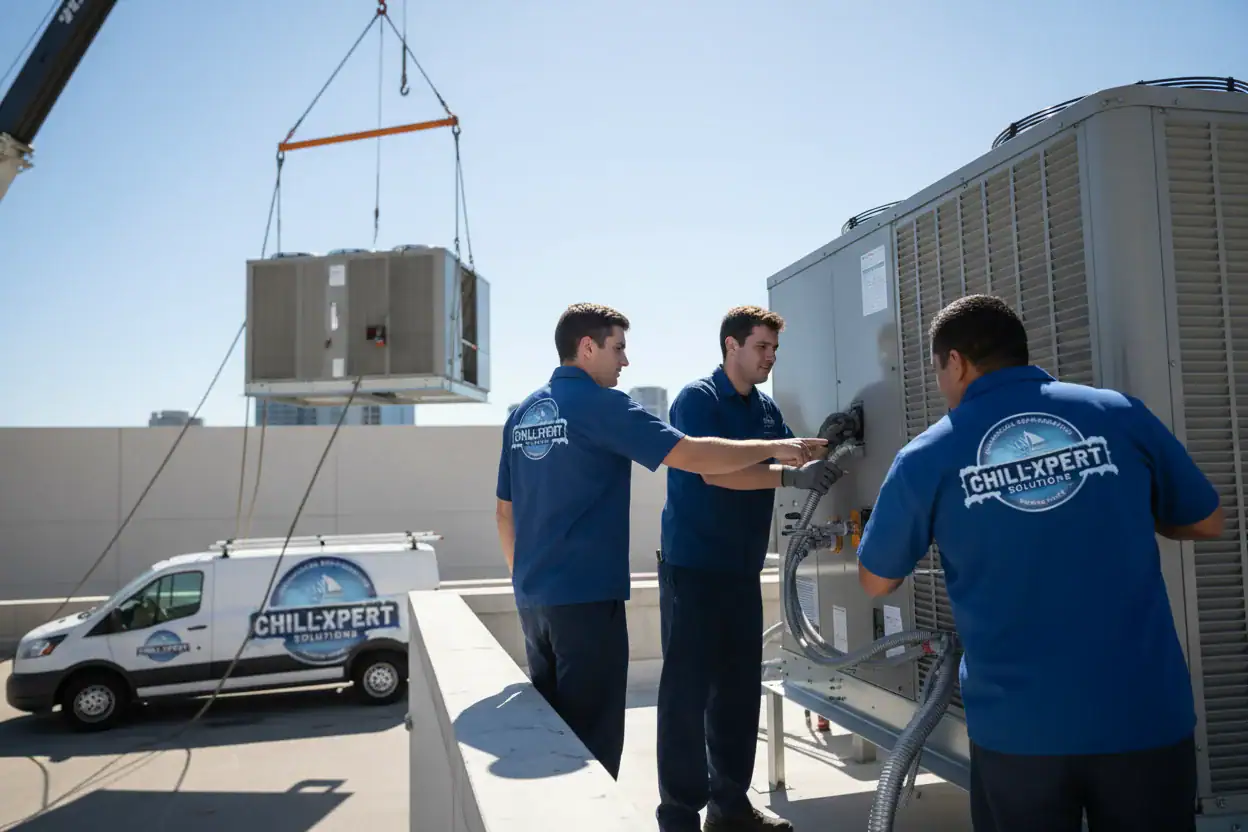
The biggest mistake homeowners make with AC replacement isn’t choosing the wrong brand or skipping the extended warranty. It’s ending up with the wrong size system because their contractor skipped the Manual J load calculation and guessed at what size you need based on square footage alone.
Manual J is the industry-standard protocol—developed by the Air Conditioning Contractors of America—for determining exactly how much heating and cooling your specific home requires. It accounts for square footage, ceiling height, insulation levels and type, window sizes and orientation, sun exposure throughout the day, occupancy patterns, appliance heat loads, and dozens of other factors that affect your home’s heat gain in summer and heat loss in winter. A proper load calculation takes 1-2 hours of detailed measurements and produces a precise BTU target for your equipment.
Most contractors don’t bother because it’s time-consuming and requires training. They use rules of thumb instead, like “400 square feet per ton” or “just match what’s already installed.” This shortcut leads to oversized systems that short-cycle and fail to dehumidify, undersized systems that run constantly and never reach your thermostat setting, and homeowners who never feel comfortable despite spending $6,000-$10,000 on new equipment.
An oversized AC cools your home too quickly and shuts off before it runs long enough to remove humidity from the air. Most AC units need at least 10 minutes of continuous runtime before they start dehumidifying effectively. If your system is frequently turning on and off every 5-7 minutes, it doesn’t allow enough time for moisture to condense on the evaporator coil and drain away. You end up with a cold, clammy house that feels uncomfortable even though the temperature is technically correct. You also get extra wear on your equipment from constant starting and stopping, which shortens compressor life and increases repair frequency.
An undersized system runs continuously during hot weather, struggling to reach your thermostat setting and never catching up on peak summer days. Your energy bills climb from the constant runtime, the equipment wears out faster from working so hard, and you lose the ability to maintain comfortable temperatures when you need it most. Some rooms stay warm no matter how low you set the thermostat.
Nassau County’s coastal climate makes proper sizing even more critical than inland locations. Humidity control requires adequate system capacity for both sensible cooling (temperature reduction) and latent cooling (moisture removal). Homes within a few miles of the water face different load requirements than homes further inland due to salt air, higher humidity levels, and different sun exposure patterns. A contractor who understands Long Island’s specific challenges will account for these factors in the load calculation instead of using generic assumptions.
Proper sizing also affects your ductwork requirements and overall system performance. If the load calculation shows you need a smaller system than what you’re replacing, your existing ducts might need modifications to match the new airflow requirements. Oversized ducts on a properly-sized system create velocity problems that reduce efficiency. Undersized ducts on any system create static pressure issues that force your equipment to work harder, reduce efficiency by 15-30%, and shorten equipment life.
If you bought an AC a few years ago or you’re comparing quotes that reference different efficiency numbers, you might be confused about SEER2 ratings and how they differ from the old SEER numbers you’ve seen before. Here’s what changed in 2023 and why it matters for your replacement decision in 2026.
SEER2 replaced SEER ratings in January 2023 as the new federal standard for measuring cooling efficiency. The “2” doesn’t mean it’s better or worse—it means the testing methodology changed to better reflect real-world performance in actual homes rather than idealized laboratory conditions. The new test uses higher external static pressure (0.5 inches of water column versus 0.1 inches) that simulates actual ductwork resistance in a typical residential installation, so the numbers are more accurate but numerically lower than the old ratings.
A system previously rated 16 SEER under the old test is now rated approximately 15.2 SEER2 under the new methodology. Your equipment didn’t become less efficient overnight—the yardstick just changed to be more realistic. When comparing systems in 2026, always compare SEER2 to SEER2, not to old SEER numbers, or you’ll think newer equipment is less efficient when it’s actually the same or better.
The minimum SEER2 requirement in New York (Northern region) is 13.4 for air conditioners and 14.3 for heat pumps. These are federal baseline standards that every new system must meet. Higher efficiency systems cost more upfront but reduce monthly operating costs significantly, and the savings compound over the 15-20 year lifespan of your equipment.
A 20 SEER2 unit is approximately 30% more efficient than a 14 SEER2 unit. In Long Island’s climate where your AC runs heavily from May through September and often into October, that efficiency difference translates to $400-$600 in annual energy savings on your electric bill. Over a 15-year lifespan, you’re looking at $6,000 to $9,000 in total savings, which can justify the $2,000-$3,000 higher upfront cost for the more efficient equipment.
Federal tax credits provide up to $2,000 for qualifying high-efficiency equipment under the Inflation Reduction Act. To qualify in 2026, split-system air conditioners need at least 17 SEER2 and 12 EER2 (Energy Efficiency Ratio 2, which measures peak-load efficiency). Heat pumps need 17 SEER2, 12 EER2, and 8.5 HSPF2 (Heating Seasonal Performance Factor 2). These requirements are significantly stricter than minimum standards, so not every system qualifies even if it’s marketed as “high efficiency.” Your contractor should be able to tell you which specific models meet the credit requirements and provide the manufacturer’s certification for your tax filing.
The refrigerant transition also affects your replacement decision and long-term service costs. New systems manufactured in 2026 use R-32 or R-454B refrigerants instead of R-410A, which is being phased out due to environmental regulations. These new refrigerants have Global Warming Potential that’s 70% lower than R-410A, require about 20% less refrigerant charge, and improve efficiency slightly. If you’re replacing an older system that uses R-22 or even R-410A, you’re moving to more environmentally friendly technology that will remain serviceable and affordable to repair for the next 15-20 years instead of facing obsolete refrigerant costs.
AC replacement cost in Nassau County ranges from $4,500 to $12,000+ depending on system size, SEER2 efficiency rating, and installation complexity. But the number that matters most isn’t the price tag on the equipment—it’s whether replacement makes more financial sense than continuing to repair your existing system and throw money at aging technology.
Use the $5,000 rule and the 50% rule to guide your decision with actual math instead of guessing. Look at your system’s age, repair frequency over the last 12-24 months, and refrigerant type. Factor in energy efficiency gains from newer models, available federal tax credits, and the compounding savings over 15-20 years. And most importantly, make sure any contractor you work with performs a proper Manual J load calculation instead of guessing at system size based on square footage or matching what’s already installed.
If you’re ready to get transparent pricing and expert guidance on your AC replacement without the runaround or surprise charges, we provide free estimates with upfront costs, proper Manual J load calculations, and clear explanations of what you’re actually paying for. With over 40 years of experience serving Nassau and Suffolk County, we bring the same technical expertise from complex commercial refrigeration and marine HVAC systems to residential installations—ensuring you get the right system, sized correctly, installed properly, the first time.
Article details:
Share:
Continue learning: