Warm beer, foam problems, and mystery shutdowns — here's what's actually going wrong with your beer cooler and what to do about it before it costs you a weekend.
Share:
Summary:
When your beer cooler starts acting up, it rarely fails all at once. It drifts. The pours get foamy. The temperature reads fine on the unit but the beer at the tap tells a different story. By the time something breaks completely, you’ve already lost product, frustrated customers, and burned through a Friday night wondering what went wrong. This guide is for bar owners, taproom operators, and restaurant managers across Nassau County who want to understand what’s actually happening inside their draft beer system — and what to do about it before it turns into an emergency.
Most bar owners know the basics: beer goes in cold, comes out cold, everyone’s happy. But the draft beer cooling system doing that job is more involved than a standard refrigerator.
It’s not just a box keeping things chilled — it’s a chain of components that have to work together precisely. When any one of them drifts, the whole pour suffers. At its core, a draft beer cooling system includes the walk-in cooler where kegs are stored, the trunk lines carrying beer from the cooler to the taps, and — in longer draw systems — a glycol power pack that keeps the beer cold along the entire length of that run.
Each piece has its own maintenance requirements, its own failure modes, and its own tolerance for neglect. Understanding how they connect is the first step toward catching problems early.
If your bar has taps more than a few feet from the cooler, you almost certainly have a glycol beer system. A glycol power pack circulates a chilled mixture of food-grade propylene glycol and water through insulated trunk lines alongside the beer lines, keeping the beer at the right temperature all the way to the faucet.
It’s an elegant solution to a real physics problem — but it’s also a system that most general refrigeration repair companies aren’t equipped to properly diagnose or service. The glycol concentration has to stay between 30 and 40 percent propylene glycol — and it has to be food-grade, USP-grade propylene glycol specifically. Automotive antifreeze is not an acceptable substitute. It’s toxic, and it will contaminate your system.
Beyond the chemistry, the glycol itself degrades over time and should be replaced annually. Levels should be checked quarterly. If the pump runs low on glycol, it can freeze and fail. If there’s too much, the system loses cooling efficiency. It’s a narrow window, and getting it wrong is expensive.
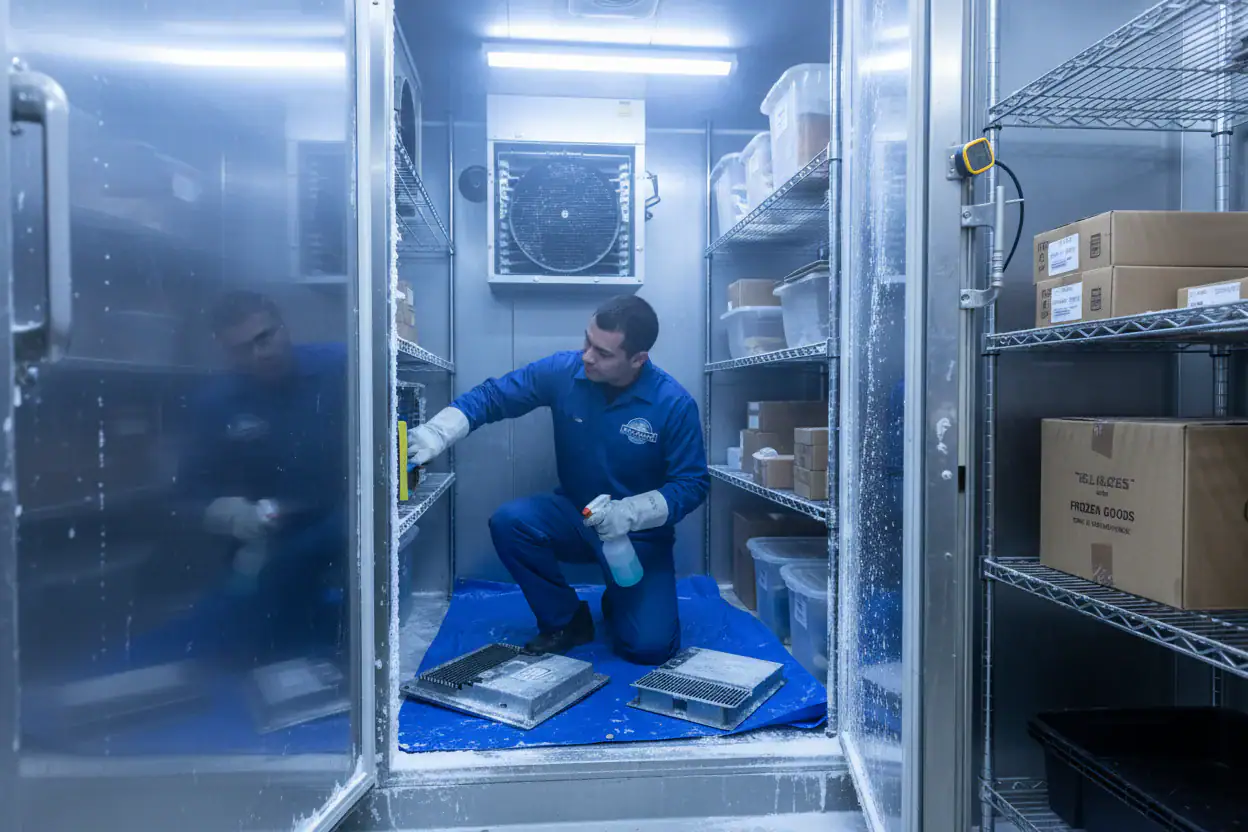
The walk-in cooler should hold between 36°F and 38°F. The glycol bath in the power pack should run between 26°F and 29°F. Here’s the part that catches a lot of operators off guard: even if your chiller unit is reading the correct temperature, the beer at the faucet can be significantly warmer because of how much line it traveled through.
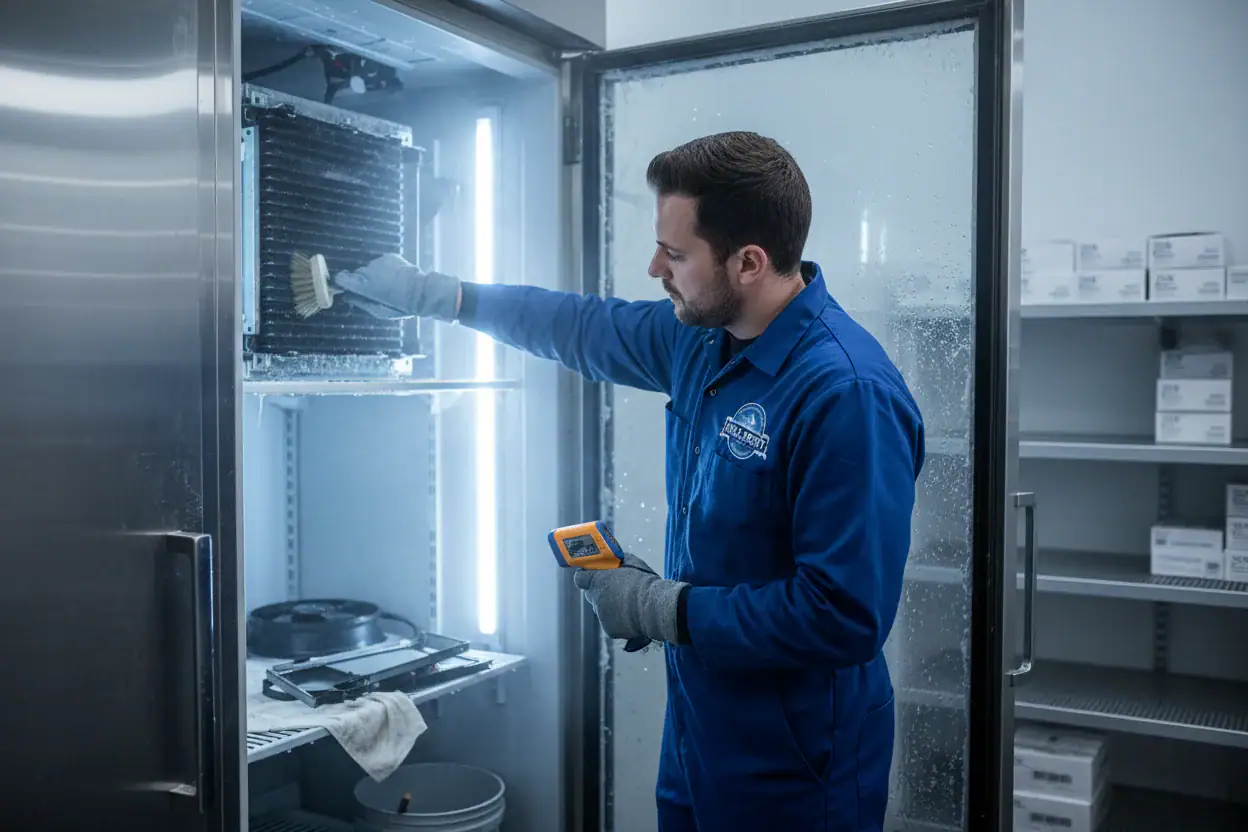
Nine out of ten draft beer system problems trace back to temperature — which means the cooler and the glycol system are where you need to focus first. Glycol system service also includes inspecting the trunk lines every six months for ice buildup, insulation damage, or leaks. The condenser on the power pack should be checked every three to five weeks and cleaned as needed.
These aren’t suggestions — they’re the intervals the industry runs on, documented in the Brewers Association Draft Beer Quality Manual. Skip them long enough and you’re not maintaining a system; you’re just waiting for it to fail.
This is one of the most common misconceptions we run into. Bar owners who are diligent about their beer line cleaning schedule sometimes assume that covers the whole system. It doesn’t.
Beer line cleaning — running a caustic solution through the lines on a 14-day cycle, with an acid-based cleaner every third or fourth cleaning — is a sanitation protocol. It handles bacterial growth and off-flavors. It does not address the mechanical and thermal side of the system. Your glycol power pack, your condenser coils, your pump, your trunk line insulation — none of that is touched by a beer line cleaning service.
A bar that cleans its lines religiously but never has the glycol system serviced is like someone who brushes their teeth but hasn’t seen a dentist in five years. One problem is being managed; the other is quietly getting worse. The financial stakes here are real.
Research from Modern Restaurant Management found that at a 20% waste rate on a 20-tap bar, a venue can lose the equivalent of 26,000 pints per year — roughly $130,000 in missed revenue at $5 per pint. That waste doesn’t happen because the lines are dirty. It happens because the temperature is off, the foam is excessive, and the pours are inconsistent. That’s a cooling system problem, not a sanitation problem.
Nassau County’s craft beer scene makes this especially relevant. Barrier Brewing in Oceanside — the county’s first craft brewery — Oyster Bay Brewing Co., and Garvies Point Craft Brewery in Glen Cove all depend on properly functioning draft systems to protect the quality of beer they’ve worked hard to produce. So does every bar in Freeport, every gastropub along Merrick Road, and every venue in Long Beach that’s packed on a summer Saturday.
A glycol system that hasn’t been serviced in two years is a liability, not just an inconvenience.
Want live answers?
Connect with a Chill Xpert Solutions expert for fast, friendly support.
Some failures announce themselves clearly — the unit stops running, the beer is visibly warm, something is obviously broken. But most beer cooler problems give you signals well before they reach that point.
The operators who catch them early spend less money and lose less product. The ones who wait until the system fully breaks down tend to do it on a Friday night in July. Knowing what to look for is half the battle. The other half is knowing when the problem is beyond a quick adjustment and needs a qualified technician.
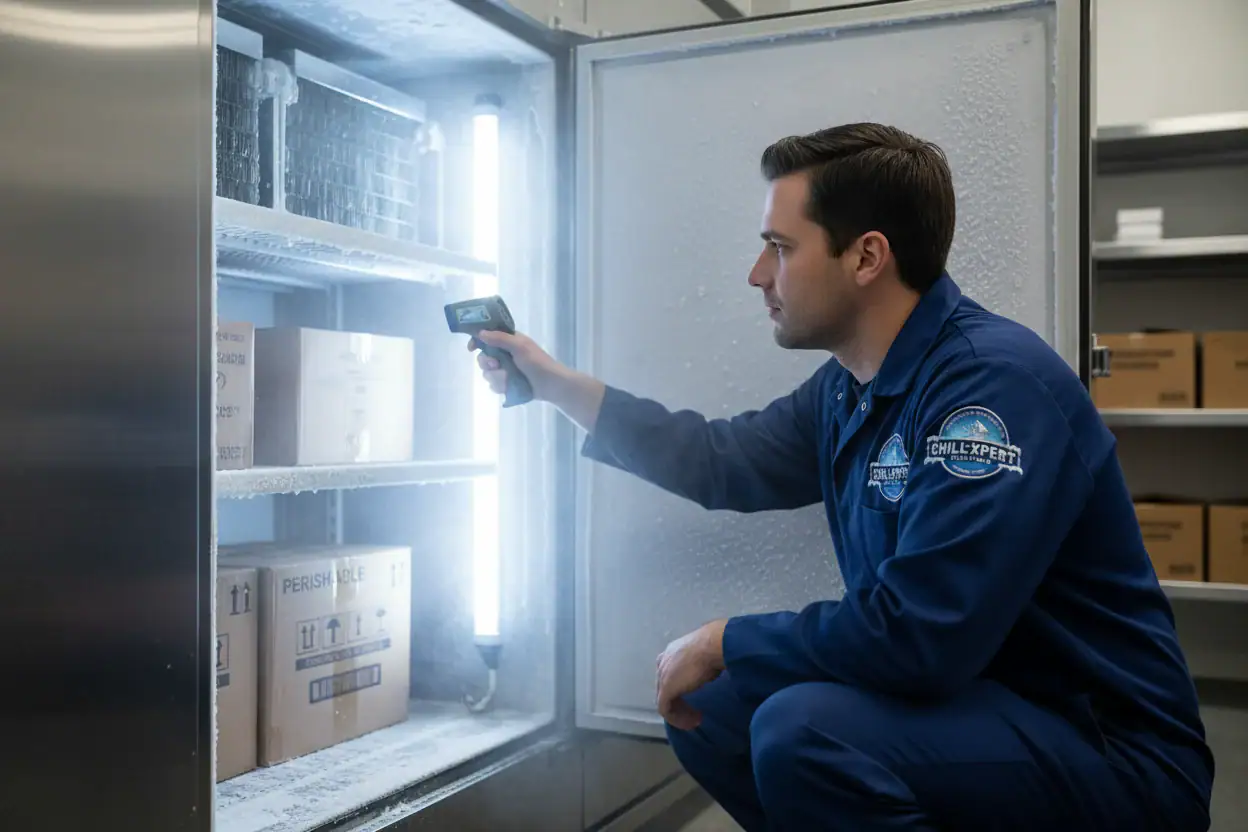
Excessive foam is the most common complaint, and it has a short list of likely causes — all of them temperature-related. If the walk-in cooler has drifted above 38°F, if the glycol bath isn’t holding its range, or if the trunk lines have lost insulation integrity, the beer warms up in transit and foams at the tap.
The pour looks bad, the customer is frustrated, and you’re losing product on every glass. Warm beer that doesn’t foam is a different problem. It often points to a compressor issue, a refrigerant leak, or a condenser that’s caked with dust and can’t dissipate heat efficiently.
Long Island’s coastal climate — the salt air and persistent humidity that come with being bordered by the Atlantic to the south and the Long Island Sound to the north — accelerates corrosion on outdoor condenser units faster than most operators expect. A condenser that looks fine visually can be running at reduced efficiency because of salt buildup that’s invisible until you clean it.
Unusual noises from the glycol power pack are worth taking seriously. The pump should run smoothly and quietly. Any grinding, clanking, or irregular cycling is a red flag. So is a unit that runs constantly without reaching its target temperature — that’s a sign the system is working harder than it should to compensate for something that’s failing.
If your unit is short-cycling — turning on and off more frequently than normal — that usually points to a refrigerant issue, a faulty thermostat, or a compressor that’s struggling. Left alone, short-cycling causes additional wear and accelerates the timeline to a full breakdown.
Not every commercial refrigeration company can competently service a glycol beer system. This isn’t a knock on anyone — it’s just a specialty, and most local repair companies are set up for walk-in coolers and reach-in units, not the pump sizing, glycol chemistry, and trunk line configuration that a draft beer system requires.
Calling the wrong company doesn’t just waste time. It can result in a misdiagnosis, an incomplete repair, and the same problem recurring two weeks later. The first thing to ask any technician is whether they hold EPA Section 608 certification. This isn’t optional — it’s a federal requirement under the Clean Air Act for anyone who works with refrigerants. A technician without it is not legally qualified to handle the refrigerant side of your system.
Beyond certification, ask whether the company carries parts for your equipment or has to order them. A technician who shows up, diagnoses the problem, and then tells you the part will arrive in five to seven days is a technician who just extended your downtime by a week. Stocked parts vans matter, especially when you’re running a bar and every day the system is down is a day you’re losing revenue.
Ask whether they use subcontractors. Some companies dispatch third-party technicians whose qualifications and accountability aren’t the same as a direct employee. You want to know exactly who is working on your system and that the company sending them stands fully behind the work.
Finally, ask for a clear estimate before any work begins. Upfront pricing isn’t a luxury — it’s a basic professional standard. If a company can’t tell you what the repair will cost before they start, that’s a problem worth paying attention to.
We’ve been serving Nassau County bars, taprooms, and restaurants for over 40 years. We know the coastal conditions here, we know the equipment, and we know what it takes to get a draft beer system back online fast. Our technicians are EPA Section 608 certified, we carry genuine parts, and we don’t use subcontractors. When we give you an estimate, that’s the number.
A draft beer system that’s well-maintained runs quietly in the background and never makes the news. One that isn’t tends to fail at the exact moment you can least afford it — a packed summer weekend, a private event, the Saturday before a holiday.
The difference between those two outcomes is usually just consistent attention: annual glycol service, regular condenser cleaning, 14-day line cleaning, and a technician who actually knows what they’re looking at. If you’re in Nassau County and your system is showing any of the warning signs above — or if you simply can’t remember the last time it was properly serviced — it’s worth getting someone out to take a look before the problem makes that decision for you.
Chill Xpert Solutions offers free estimates, same-day availability, and the kind of experience that only comes from four decades of doing this work on Long Island.
Article details:
Share:
Continue learning: