What does commercial HVAC repair actually cost on Long Island? Here's a straight breakdown by repair type, plus what drives the final number.
Share:
Summary:
You got a quote. Maybe it was for a compressor, maybe a refrigerant recharge, maybe something the technician couldn’t even fully explain. And now you’re sitting with a number you have no way to benchmark.
That’s the situation most Nassau County business owners find themselves in — not because they’re not savvy, but because commercial HVAC pricing is genuinely opaque. Labor rates vary. Parts markups vary. Emergency surcharges exist on a spectrum that would surprise most people.
This breakdown covers what commercial HVAC repair actually costs on Long Island in 2026, what drives those numbers, and what to watch for so you don’t end up paying twice for the same problem.
Most commercial HVAC repairs in Nassau County fall somewhere between $150 and $500 for common issues — diagnostic fee, labor, and parts included. That’s the realistic range for typical service calls: a failed capacitor, a tripped contactor, a clogged drain line, a thermostat that’s gone bad.
The numbers climb significantly when major components are involved. Compressor replacements, coil swaps, and refrigerant work on aging systems are where invoices start to look very different. Understanding what drives each category helps you evaluate a quote before you sign anything.
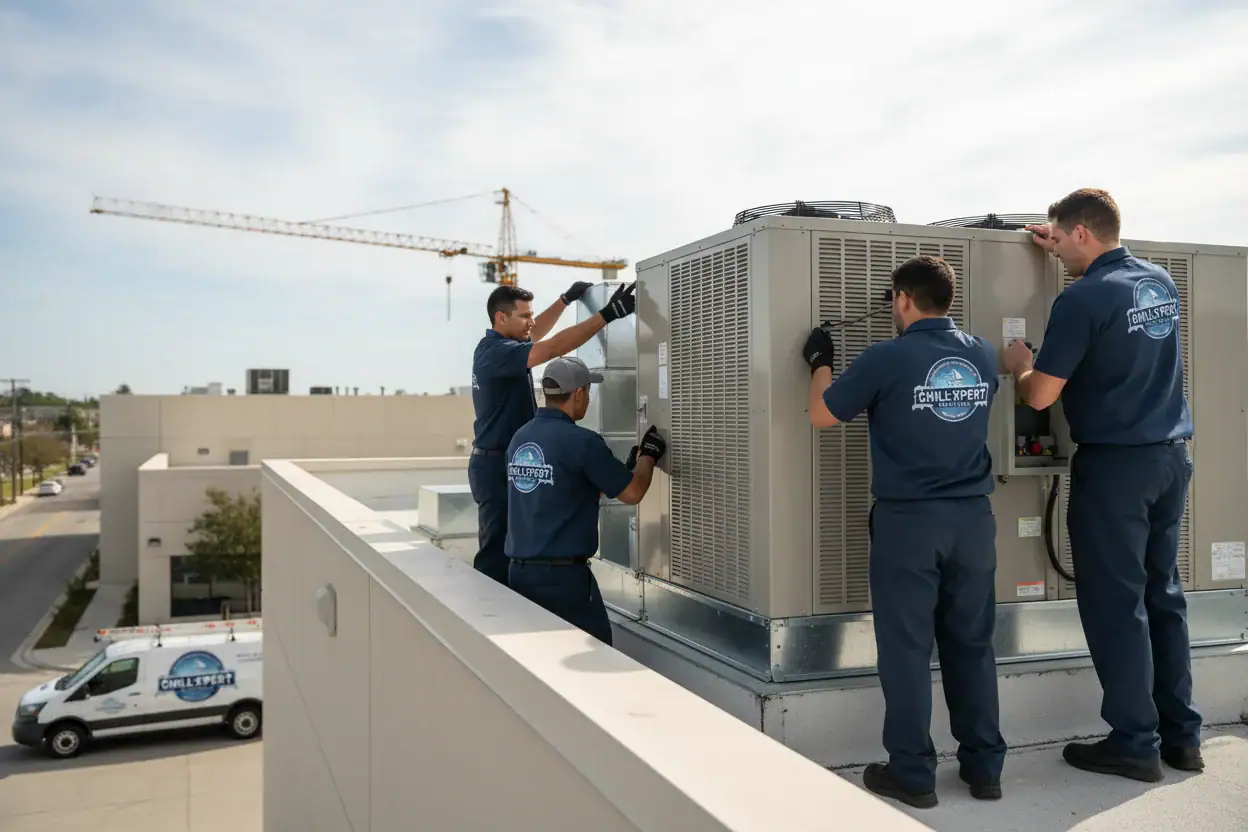
A commercial compressor replacement is one of the most significant repairs a business owner will face. On Long Island, expect the total cost to fall between $3,000 and $10,000 for most commercial systems, with more complex or larger-capacity units running higher. That range covers parts and labor, but it doesn’t account for refrigerant refill, which can add another $100 to $600 depending on the type of refrigerant your system uses.
If your system still runs on R-22 — the older refrigerant that was phased out of production — that refrigerant cost alone changes the math considerably. R-22 now runs $90 to $150 per pound because remaining supplies are extremely limited. A recharge that would cost $250 to $400 on a modern R-410A system can balloon to $500 to $1,500 on an R-22 system. Many commercial buildings across Nassau County, particularly those built in the 1980s and 1990s, are still running legacy R-22 equipment. If yours is one of them, that’s a conversation worth having before any repair work begins.
The other variable is timing. A compressor that fails on a Tuesday afternoon is a very different situation from one that fails on a Friday night before a full dining room or a Saturday wedding at a catering hall in Garden City, NY. After-hours emergency labor rates typically add $100 to $250 on top of the standard repair cost, and some contractors charge significantly more than that for nights, weekends, and holidays. Knowing this going in means you can make a faster, clearer decision when it matters most.
One more thing worth knowing: compressors have a service life of roughly 8 to 15 years. When repair costs approach half the cost of a new unit on a system that’s already 12 or more years old, replacement often makes more financial sense than repair. A good technician will tell you that directly rather than push you toward a repair that buys you another 18 months.
Not every commercial HVAC repair is a major event. A significant portion of service calls involve components that wear out on a predictable cycle — fan motors, blower motors, control boards, and condenser coils. These repairs are less dramatic than a compressor replacement, but the costs are real and worth understanding.
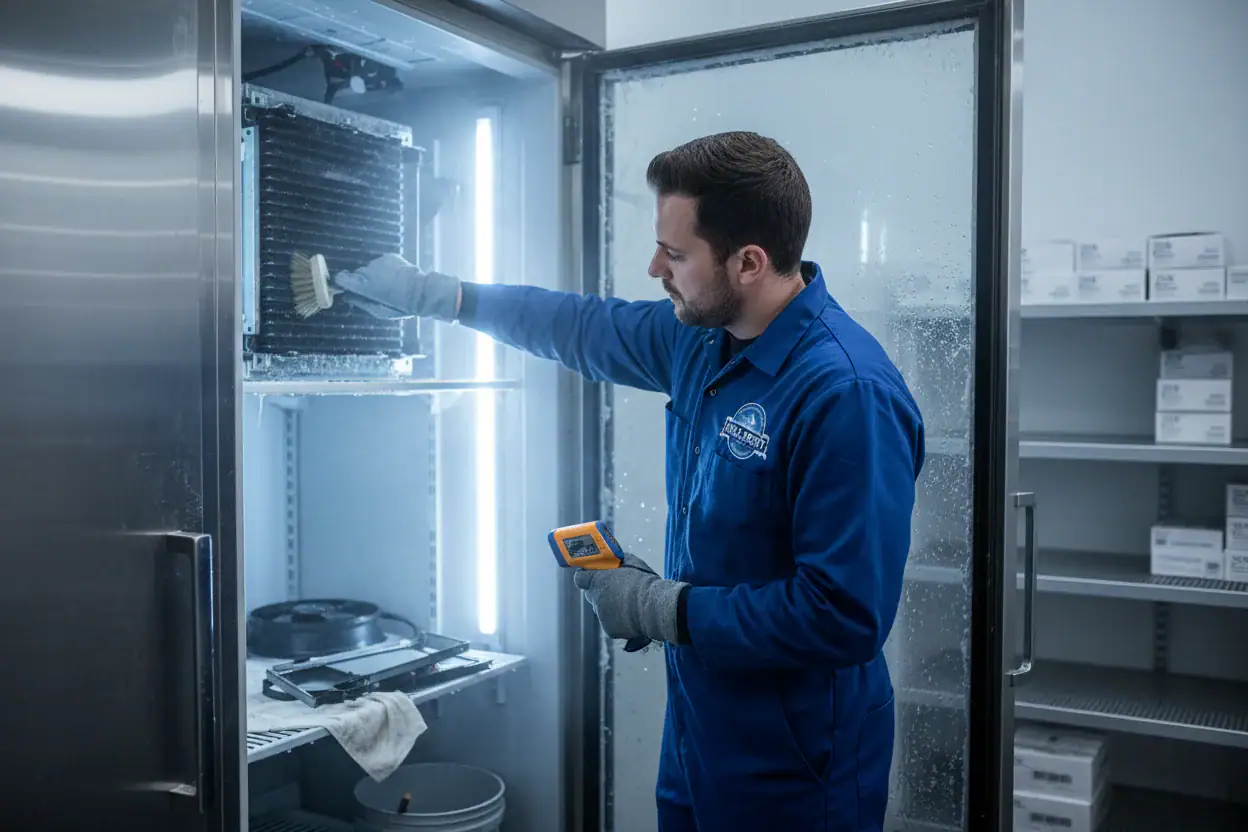
Fan motor and blower motor replacements typically run between $200 and $700 for the motor itself, with total costs including labor landing between $300 and $1,000 depending on the system and the accessibility of the component. Condenser fan motor repair specifically tends to fall in the $300 to $600 range.
These are working parts that cycle constantly, and in Nassau County’s coastal environment — where salt air off the South Shore accelerates corrosion on outdoor condenser units — they tend to wear faster than they would in an inland market. If your facility is in Freeport, Long Beach, Oceanside, or along the Great South Bay, this is a real maintenance consideration, not a worst-case scenario.
Coil replacements are more involved. An evaporator coil replacement runs $600 to $2,000. A condenser coil replacement runs $900 to $2,900. The wide ranges reflect differences in system size, unit age, and parts availability for older equipment.
Electrical and controls work covers a broad range of repairs. A circuit board replacement typically costs $200 to $600. Thermostat replacement runs $120 to $350 depending on the model. These are often the first things a technician checks on a service call, and when they’re the root cause, the total repair cost is usually on the lower end of the range.
Labor in Nassau County runs $75 to $150 per hour as a baseline. The Northeast carries a 20 to 40 percent premium over Midwest and Southern markets, which is worth keeping in mind when comparing quotes from contractors in different regions or when evaluating national cost guides that don’t account for local market conditions.
Want live answers?
Connect with a Chill Xpert Solutions expert for fast, friendly support.
Commercial HVAC systems are more complex, run longer hours, and carry higher stakes when they fail. A residential system that goes down means a hot house. A commercial system that goes down can mean spoiled inventory, a closed dining room, or a catering event that falls apart.
That operational reality is reflected in the cost structure. Commercial repairs typically run 30 to 60 percent higher than comparable residential repairs, driven by larger equipment, higher-capacity refrigerant systems, and the fact that commercial operators often need emergency response at hours when labor rates are at their peak.
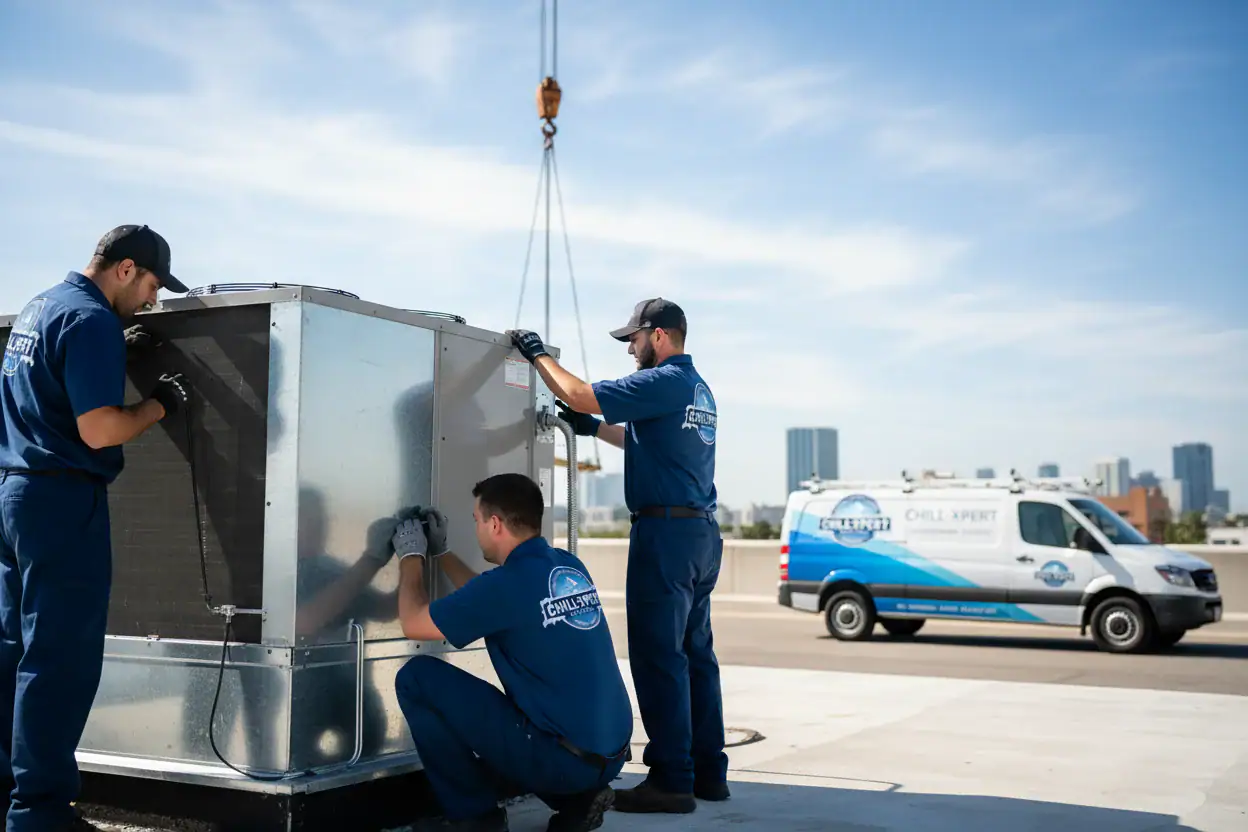
Emergency HVAC repair is its own category, and the cost structure is meaningfully different from a standard daytime service call. After-hours labor rates on Long Island typically start at $140 to $210 per hour as a baseline, with some contractors charging $400 to $600 per hour for nights, weekends, and holidays. Add an emergency surcharge of $100 to $250 on top of the repair itself, and the total cost of a Saturday night compressor failure is considerably higher than the same repair on a Wednesday morning.
For a restaurant on Hempstead Turnpike or a deli on Merrick Road running commercial refrigeration 24/7, every hour of downtime has a direct dollar value — in lost sales, in food that can’t be held at temperature, and in customers who don’t come back. The repair cost is finite. The downstream cost of a prolonged outage often isn’t.
This is why response time matters as much as hourly rate when you’re evaluating contractors for emergency work. The HVAC industry is currently short roughly 110,000 technicians nationally, which means that during peak summer demand on Long Island, many contractors are running 24 to 48 hour response windows even for emergencies. For a commercial operator with temperature-sensitive inventory or a full event booked for the next day, that gap is a serious problem.
We dispatch immediately and arrive in under two hours across Nassau and Suffolk counties. We also stock parts for major brands on our trucks, which is why about 70 percent of our emergency calls get resolved on the first visit. That’s the operational difference between a business that reopens the same night and one that’s still waiting on a part three days later.
The fear of being overcharged is the most common reason business owners search for commercial HVAC repair costs before calling anyone. It’s a reasonable fear. The information gap between a contractor and a commercial operator is real, and some contractors take advantage of it — through inflated parts markups, vague invoices, or repairs that address the symptom rather than the cause.
A few things to watch for. First, ask for an itemized estimate before any work begins. A legitimate contractor will separate the diagnostic fee, labor, and parts clearly. If a quote arrives as a single lump sum with no breakdown, that’s a reason to ask questions.
Second, be cautious about dramatically above-retail parts pricing. Parts markups in the 20 to 30 percent range are standard and fair. Markups that push refrigerant or components to multiples of their actual cost are not — and they do happen.
Third, make sure the contractor is EPA Section 608 certified. Under federal law, any technician who handles or adds refrigerant to an existing system is required to hold this certification. It’s not optional, and it’s not a formality. Unlicensed work in New York can void your equipment warranty and create insurance complications you won’t discover until you need to file a claim.
Finally, consider what a “cheap” repair actually costs when it doesn’t hold. A general HVAC contractor who misdiagnoses a complex commercial refrigeration issue — a walk-in cooler, a beer system, a deli case — can leave you with a temporary fix that fails again in three weeks. At that point, you’ve paid twice for the same problem and lost additional downtime in between. For Nassau County businesses running food service or catering operations, that cycle is genuinely expensive.
Our technicians are EPA-certified, direct employees — not subcontractors — and they carry genuine OEM parts on their trucks so the job gets done right the first time. We’ve been serving restaurants, delis, catering halls, and airports across Nassau County for over 40 years. Free estimates, written quotes before work begins, and a clear explanation of what we found and why it failed. That’s what honest service looks like in practice.
Most commercial HVAC repairs on Long Island fall within a predictable range once you understand what drives the cost — the component involved, the time of day, the age of the system, and the refrigerant type. The numbers in this guide give you a real benchmark, not a national average that ignores what labor actually costs in Nassau County.
The bigger point is this: the repair invoice is almost never the full cost of an HVAC failure. Response time, first-visit resolution, and the quality of the diagnosis all affect what you ultimately spend — and how quickly you get back to operating normally.
If you’re dealing with a system that’s down, showing warning signs, or coming off a repair that didn’t hold, Chill Xpert Solutions offers free estimates with no obligation. Call us, describe what you’re seeing, and we’ll give you a straight answer.
Article details:
Share:
Continue learning: