Not every HVAC contractor is equipped to handle commercial refrigeration. Here's what the difference actually costs you when something goes wrong.
Share:
Summary:
You’ve probably called an HVAC company for a refrigeration problem before. Maybe it went fine. Maybe they showed up, poked around, ordered a part, and came back three days later — while your walk-in sat at the wrong temperature and your food hung in the balance. Or maybe they fixed the symptom and you were calling again six weeks later with the same issue.
The question most Nassau County restaurant owners, deli operators, and catering managers never think to ask before they call is a simple one: does this company actually specialize in commercial refrigeration, or is it just one of fifteen services they list on their website? The answer matters more than the hourly rate.
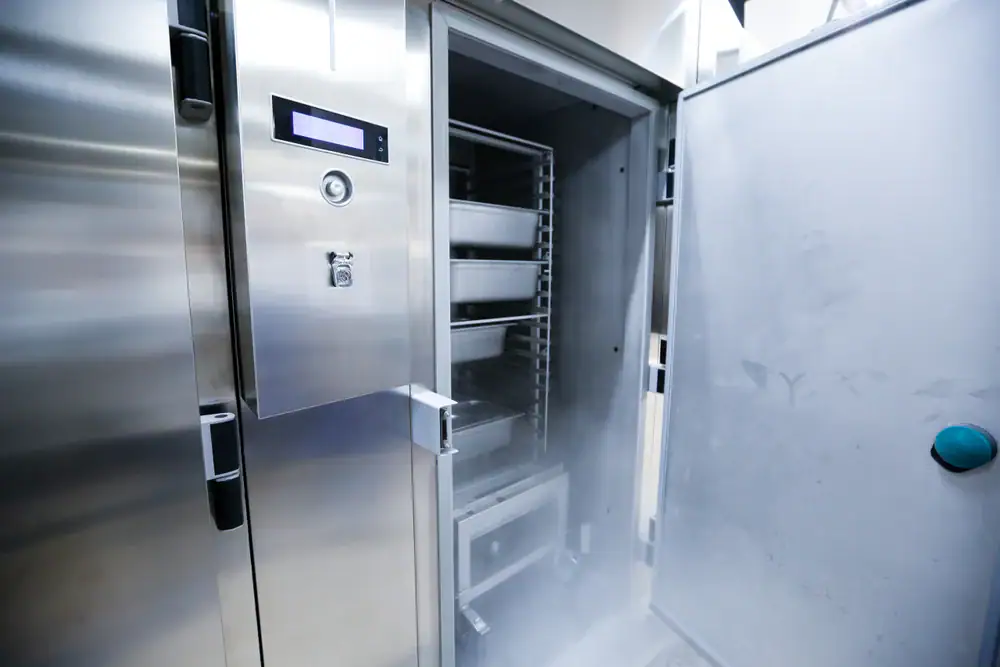
Commercial refrigeration and comfort HVAC share some components — compressors, refrigerant lines, condensers — but they are not the same trade. A commercial refrigeration technician is trained specifically on refrigeration cycles, cold-storage thermodynamics, compressor diagnostics, and the food-safety temperature compliance requirements that Nassau County health departments enforce. That’s a different body of knowledge than what’s required to service a rooftop air handler or a residential furnace.
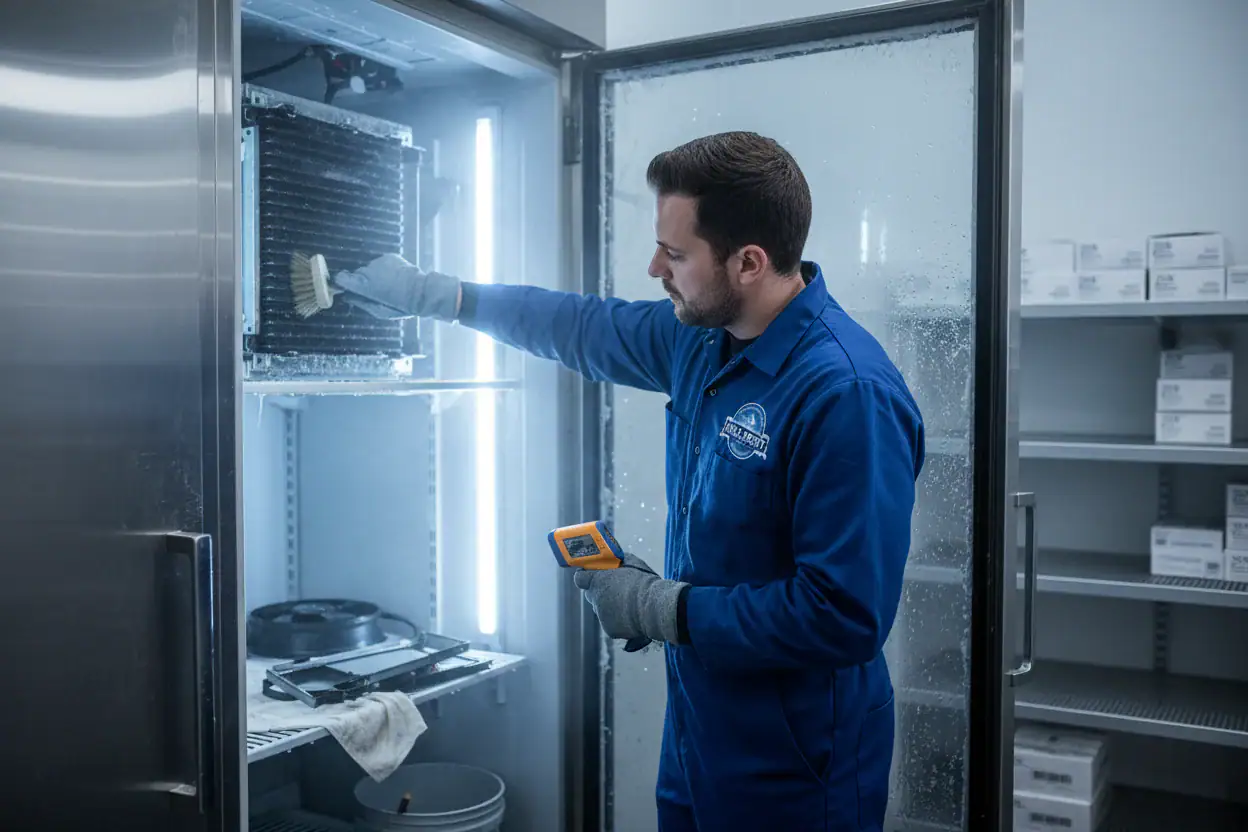
The practical difference shows up when something goes wrong. A technician who works on commercial refrigeration systems every day knows what a failing compressor sounds like on a specific brand of reach-in unit. They know which parts fail first on a walk-in cooler in a coastal environment like Nassau County, where salt air off the Atlantic accelerates corrosion on condenser coils in ways that inland contractors rarely account for. That pattern recognition — built over years of seeing the same failures — is what makes a specialist faster and more accurate than a generalist who’s figuring it out as they go.
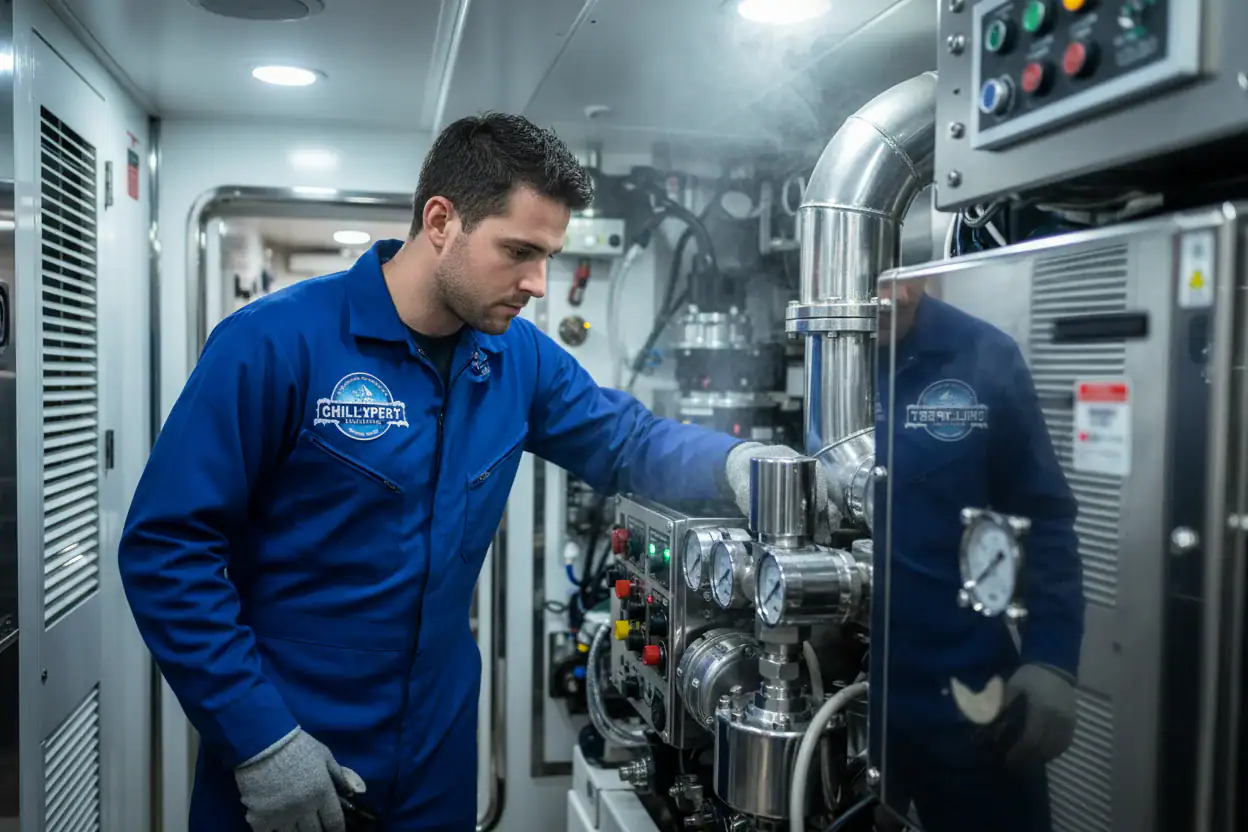
It’s fair to ask: if HVAC and refrigeration use similar equipment, why can’t a skilled HVAC technician handle commercial refrigeration repair? In some cases, they can handle basic issues. But the further you get from basic, the wider the gap becomes.
General HVAC technicians are trained and tested primarily on heating, ventilation, and air conditioning systems — the kind that regulate indoor temperature for human comfort. Commercial refrigeration systems are designed to maintain precise, low temperatures for food safety, often running continuously under heavy load. The tolerances are tighter, the stakes are higher, and the diagnostic process is different. A two-degree temperature variance in a restaurant dining room is uncomfortable. The same variance in a walk-in cooler holding perishable inventory can trigger a Nassau County Health Department violation and a forced disposal of product worth thousands of dollars.
Federal law adds another layer. Anyone who services, maintains, or repairs equipment that could release refrigerants into the atmosphere is required by the EPA to hold Section 608 certification. There are four certification types — Type I covers small appliances, Type II covers high-pressure systems, Type III covers low-pressure systems, and Universal covers all of them. A technician without the appropriate certification is not legally permitted to purchase or handle regulated refrigerants. That’s not a technicality — civil penalties for violations can reach $44,539 per day. If you hire a contractor whose technicians aren’t properly certified, the liability exposure doesn’t stay with the contractor. It starts with them and can extend to you.
Most generalist HVAC companies are licensed and insured — that’s table stakes. The question worth asking is whether their technicians hold Universal EPA Section 608 certification, whether they carry parts inventory for commercial refrigeration brands on their trucks, and whether the person showing up is their own employee or a subcontractor they called because they don’t have a refrigeration tech on staff. Those three questions will tell you more about the quality of the repair than any number of stars on a listing.
Here in Nassau County, the density of food-service businesses along corridors like Hempstead Turnpike and Sunrise Highway means there’s no shortage of HVAC companies willing to take a commercial refrigeration call. The shortage is in companies that are actually equipped to handle it correctly — and quickly — when the stakes are high.
Here’s something that doesn’t come up in most contractor conversations but probably should: when you call a commercial HVAC company for a refrigeration emergency, who actually shows up?
Many multi-trade HVAC companies — the kind that handle plumbing, construction, and commercial refrigeration under one roof — don’t keep dedicated refrigeration technicians on staff. When a refrigeration call comes in, they dispatch whoever is available or, more commonly, they call a subcontractor. That subcontractor may be perfectly competent, or they may have no history with your equipment, no parts on their truck for your brand, and no accountability to the company you thought you hired. If something goes wrong, you’re left navigating a dispute between two businesses while your walk-in sits warm.
This isn’t a hypothetical. It’s a common enough pattern in the Nassau County commercial service market that it’s worth treating as a standard vetting question: “Do you use subcontractors for refrigeration work?” A company that can answer “no” — and back it up with a clear policy — is giving you something genuinely valuable, not just a marketing line.
The subcontractor issue compounds when you factor in parts availability. General contractors and multi-trade HVAC companies rarely stock an extensive inventory of commercial refrigeration components. When a generalist diagnoses a problem, they often have to order the part — which means your system stays down for however long shipping takes, on top of however long it took to get the diagnosis right. A specialist who carries parts for major brands on their service trucks can often resolve the same problem the same day. For a Nassau County restaurant running a Friday night dinner service or a deli handling the morning rush, the difference between same-day resolution and a two-day wait is not an inconvenience. It’s a financial event.
Approximately 30% of commercial refrigeration downtime traces back to improper maintenance — often performed by technicians who weren’t trained specifically on refrigeration systems. The first repair is rarely the most expensive part. The expensive part is the cascade: spoiled inventory, lost revenue, a second service call, and the health department inspection that follows a temperature log anomaly. Choosing a specialist from the start is almost always cheaper in total than calling a generalist first and a specialist second.
Want live answers?
Connect with a Chill Xpert Solutions expert for fast, friendly support.
Nassau County has over 5,700 permitted food-serving establishments — restaurants, delis, school cafeterias, catering halls, taverns, and mobile food units — every one of them legally required to maintain safe food temperatures. That regulatory reality means commercial refrigeration isn’t optional infrastructure. It’s a compliance requirement enforced by the Nassau County Department of Health, which actively inspects and permits food operations across the county.
When you’re vetting a commercial refrigeration contractor — whether proactively or in the middle of an emergency — there are a handful of concrete things worth checking. Certifications, parts availability, subcontractor policy, and response time are the four that matter most. Everything else is secondary.
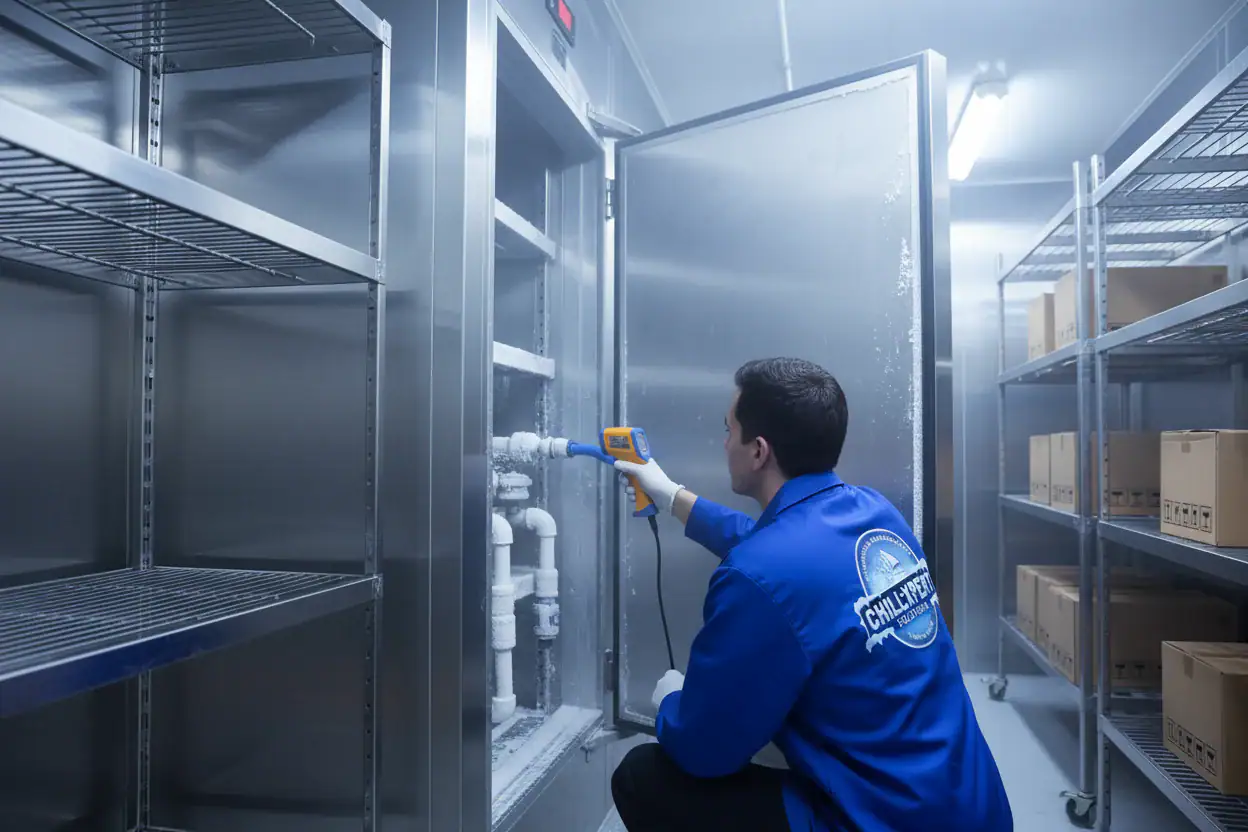
New York State does not issue a universal HVAC contractor license at the state level. Licensing for HVAC and refrigeration contractors is handled at the county level, which means Nassau County has its own requirements separate from what a Suffolk County or New York City contractor would carry. If a contractor is licensed in another county but not Nassau County, that’s worth clarifying before work begins.
On top of county licensing, every technician who handles refrigerants must hold EPA Section 608 certification — this is a federal requirement, not a suggestion. Universal certification (covering all equipment types) is the standard you want to see for commercial refrigeration work. You can ask for certification documentation directly; a reputable contractor will have it readily available.
Beyond credentials, look at how long the company has been operating specifically in commercial refrigeration — not HVAC broadly, but refrigeration. A company that has been servicing walk-in coolers, reach-in units, ice machines, and display cases for decades has seen failure patterns that a newer or more generalist operation simply hasn’t encountered. That depth of experience is what produces accurate first diagnoses rather than educated guesses that lead to repeat service calls.
Manufacturer authorization is another signal worth checking. An authorized repairer for a specific brand has met that manufacturer’s training and quality standards, which often affects whether warranty coverage remains intact after a repair. If your walk-in cooler or commercial ice machine is under warranty, having an unauthorized technician service it can void that coverage — an expensive oversight that’s easy to avoid by asking the right question upfront.
Finally, ask about response time and what “emergency service” actually means. Some companies list 24/7 availability but route after-hours calls to an answering service that schedules for the next morning. Others guarantee a specific response window and back it up with technicians on call. For Nassau County businesses that run dinner services, late-night operations, or weekend catering events, the distinction between a guaranteed two-hour response and “we’ll get there when we can” is the difference between a manageable situation and a crisis.
Most commercial refrigeration guidance is written for generic commercial environments. Nassau County isn’t a generic commercial environment.
The county sits between the Atlantic Ocean to the south and Long Island Sound to the north. Salt air is a year-round presence, and it accelerates corrosion on condenser coils, refrigerant lines, and outdoor components in ways that inland contractors often underestimate — or simply aren’t trained to look for. A maintenance protocol designed for a restaurant in a landlocked suburb doesn’t account for the same wear patterns as one serving a waterfront deli in Long Beach or a catering hall in Oceanside. The coastal exposure is real, it compounds over time, and it’s one of the reasons that refrigeration systems in Nassau County tend to need more frequent coil cleaning and component inspection than standard maintenance schedules suggest.
This is also why the choice of parts matters. Marine-grade components and corrosion-resistant materials aren’t just for boats — they’re relevant for any commercial refrigeration system operating in a salt-air environment. A contractor who understands coastal conditions will specify the right materials during installation and flag early corrosion signs during maintenance visits. A contractor who doesn’t will replace the same part twice.
The same coastal geography that creates refrigeration challenges also creates demand for a service that most commercial HVAC companies in Nassau County don’t offer at all: marine HVAC. Yacht clubs along the north shore in Oyster Bay and Bayville, marinas in Freeport and Barnum Island, and private vessels throughout the county’s waterways all require specialized cooling and refrigeration systems that operate in saltwater environments. It’s a niche that requires a distinct skill set — and it’s one of the reasons that a company with genuine marine HVAC experience tends to have a deeper understanding of corrosion, humidity management, and coastal-specific refrigeration demands than a strictly land-based contractor ever will.
For Nassau County food-service businesses, the practical takeaway is this: ask your refrigeration contractor whether they have experience servicing systems in coastal environments, and whether their maintenance protocols account for salt-air exposure. If they look at you blankly, that’s useful information.
The best time to vet a commercial refrigeration contractor is before your walk-in fails on a Saturday night. By the time you’re in a crisis, your options narrow fast — and the contractor you can reach quickest isn’t always the one you’d choose if you had time to ask the right questions.
What separates a refrigeration specialist from a general HVAC contractor isn’t just training on paper. It’s parts on the truck, certified technicians who are actually employees, a clear answer on subcontractors, and the kind of pattern recognition that only comes from years of working specifically on commercial refrigeration systems in a market like Nassau County.
If you’re ready to have that conversation — or you just want a straight answer about what your system actually needs — we at Chill Xpert Solutions are available around the clock, and the person who picks up can actually help.
Article details:
Share:
Continue learning: