That refrigerator running louder than usual? It might not be broken yet, but dirty condenser coils could be pushing it there faster than you think.
Share:
Summary:
Most refrigeration problems do not announce themselves. There is no alarm and no obvious warning, just a unit running a little harder than it used to, an energy bill that keeps creeping up, and a compressor getting closer to the end of its life.
Dirty condenser coils are behind more commercial refrigeration failures than almost anything else. On Long Island, where salt air, coastal humidity, and some of the highest electricity rates in the country work against you, the stakes are higher than almost anywhere else. Here is what is happening inside your equipment and why it matters more than most people realize.
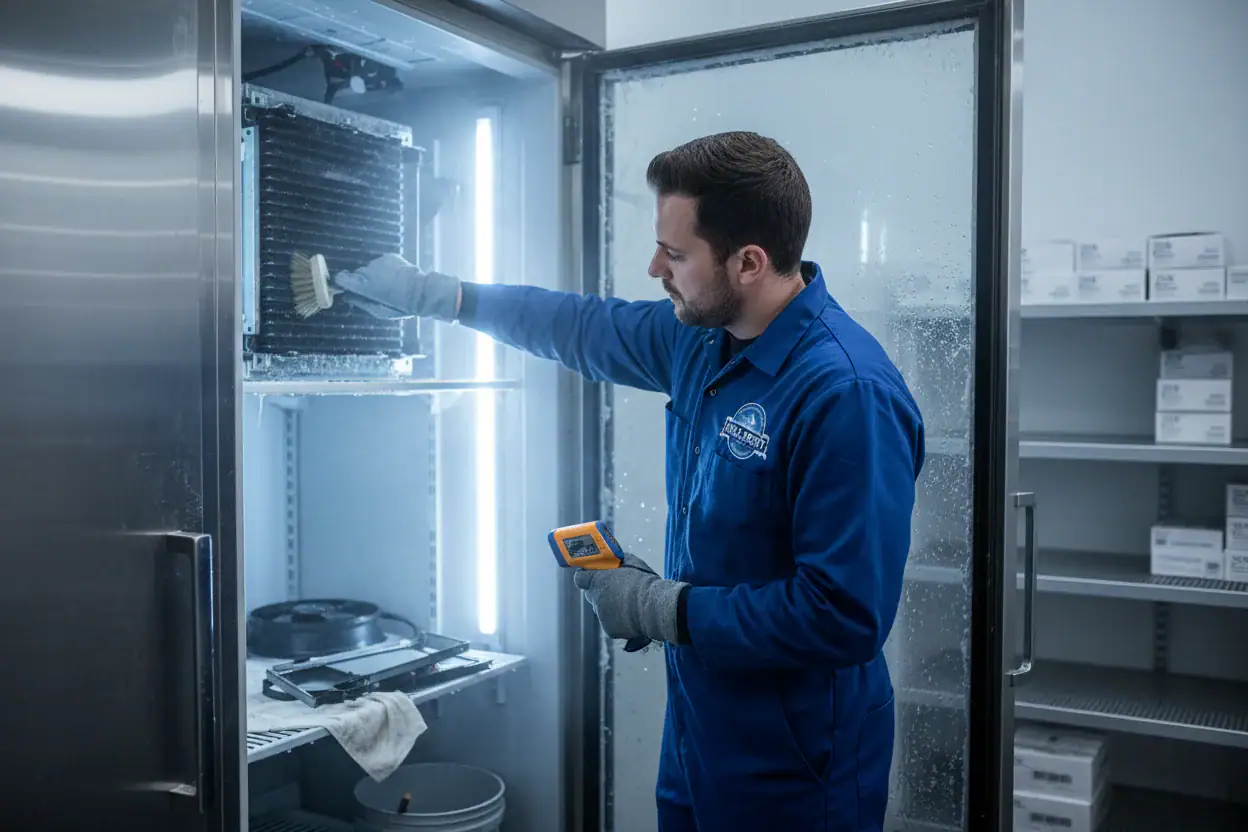
Condenser coils are where your refrigeration system releases heat. The refrigerant inside absorbs heat from your cooler, carries it to the condenser, and dumps it into the surrounding air. That is the basic cycle, and it only works if the coils can breathe freely.
When grease, dust, and debris coat those coils, airflow gets restricted and heat builds up. The system cannot release what it needs to release, so the compressor works harder to compensate. A unit that used to cycle on for ten minutes and off for ten minutes might start running twenty or thirty minutes straight, or stop cycling off altogether.
That continuous run state is where the real damage begins. It brings not just inefficiency, but accelerated wear on the most expensive component in the system.
Consider this figure: the compressor accounts for roughly 95 percent of a refrigeration system’s total energy consumption. When dirty condenser coils force that compressor to run harder and longer, almost every extra watt the system draws goes straight to your PSEG Long Island bill.
Research consistently shows that fouled condenser coils can increase a refrigeration unit’s energy consumption by 40 to 50 percent. In some documented cases, the increase has been closer to double. For a restaurant or deli running multiple units around the clock across Nassau County or Suffolk County, that is not a rounding error, but a meaningful monthly cost compounding week after week.
PSEG Long Island already charges some of the highest commercial electricity rates in the continental United States. Context matters here. The same dirty-coil penalty adding a few dollars a month to an energy bill in a lower-rate market adds significantly more locally. A Nassau County restaurant owner paying a premium for electricity every month incurs an even steeper penalty for neglected maintenance than an operator elsewhere.
Refrigeration already accounts for up to 45 percent of a food service operation’s total energy costs under normal conditions. Layering in the inefficiency of dirty coils on top of already high PSEG rates creates a rapid and very real financial drag. Unlike a broken piece of equipment, this problem remains invisible; the unit keeps running, the cooler stays cold enough, and money keeps leaving through the meter.
The fix is straightforward. Condenser coil cleaning forms a basic part of any professional maintenance visit. Timing matters, however, and recommended intervals on Long Island are more aggressive than generic maintenance guides suggest, for reasons detailed below.
The energy cost is a slow drain, whereas compressor failure hits like a cliff.
When a compressor runs continuously because dirty coils prevent the system from dissipating heat properly, it operates under chronic stress. It is not designed to run without cycling off, meaning the heat it generates has nowhere to go. Over time, sustained overload degrades the compressor’s internal components until it eventually fails.
Compressor replacement is far from a minor repair. Depending on the unit, it represents a significant portion of total replacement costs, frequently pushing the economics toward full system replacement on older units. Either way, it brings a disruption taking your refrigeration offline, forcing inventory losses, and putting operations under pressure at the worst possible moment.
The harder reality is that this failure is almost entirely preventable. A condenser coil cleaned on a proper schedule prevents this chain of events. The compressor cycles normally, the system runs efficiently, and equipment lasts. Commercial refrigeration systems receiving consistent professional maintenance routinely achieve 15 or more years of service life, whereas neglected systems typically fail within 8 to 10 years.
That gap of five to seven additional years from the same capital investment represents the true value of a maintenance program. It is not just about feeling proactive, but about extending equipment life and avoiding expensive, disruptive failures.
Warning signs exist for those who know what to look for: a compressor that never seems to cycle off, a unit running warm to the touch near the condenser, temperatures holding only barely, and an energy bill climbing without explanation. Any one of these warrants a call, and together they mean time is running out.
Want live answers?
Connect with a Chill Xpert Solutions expert for fast, friendly support.
Most general guidance on condenser coil cleaning recommends servicing twice a year. That serves as a reasonable baseline for a landlocked restaurant in a temperate climate, but Long Island fits neither description.
Nassau County and Suffolk County operators run refrigeration equipment in a coastal environment where salt air accelerates corrosion on condenser coils and electrical components, summer humidity regularly exceeds 80 percent, and summer temperatures routinely push into the mid-to-upper 90s. This combination creates an environment far more demanding than the twice-yearly standard was ever designed to address.
For businesses near the water, which includes a large share of Long Island operations, the proper interval for condenser coil cleaning is closer to every 90 days. High-volume restaurants and delis accumulating grease rapidly need that same frequency regardless of coastal proximity.
Salt air does more than just corrode condenser coils; it accelerates the spread of corrosion once started. A coil developing a small area of corrosion in a non-coastal market might stay contained for years, but a coastal environment spreads that corrosion faster while humidity worsens it by keeping metal surfaces wet long enough for oxidation to take hold.
This presents a specific challenge for businesses along the South Shore, the North Shore, and the East End. A waterfront restaurant in Freeport, a catering hall near the Great South Bay, or a marina operation in Montauk deals with more than normal grease and dust accumulation. They face an additional layer of environmental stress standard maintenance programs were never built to handle.
Practically speaking, maintenance providers applying generic national standards leave Long Island businesses underserved. Coastal condenser coils require more frequent cleaning, sometimes supplemented by marine-grade coatings and inhibitors protecting against salt air corrosion between visits.
Summer compounds every stress factor. When ambient temperatures push into the 90s, a condenser unit coated in salt residue and grime cannot dissipate heat effectively, forcing the compressor to fight both environmental heat and fouled coils simultaneously. This makes summer peak season for commercial refrigeration failures on Long Island, and it explains why pre-summer maintenance in April and May should happen every single year without exception.
Winter introduces its own stresses. Temperatures drop into the low 20s, door seals contract, and defrost cycles become critical. Thermal cycling involving extreme cold followed by extreme heat season after season wears on refrigerant lines, door gaskets, and condenser components until something eventually gives.
Another dimension often overlooked involves the health code angle.
The FDA Food Code requires commercial cold storage to hold food at 41 degrees Fahrenheit or below. Bacteria can double in as little as 20 minutes once food enters the danger zone above that threshold. A condenser coil failure pushing a walk-in cooler above temperature is not merely an operational problem, but a food safety event with serious consequences.
In Nassau County, health department inspection reports are public record accessible online. A critical violation for improper refrigeration temperatures does not stay between management and the inspector; it becomes visible to anyone searching inspection history, creating reputational exposure extending well beyond fines.
This aspect of commercial refrigeration maintenance rarely enters conversations until something goes wrong. A unit running while failing to hold proper temperature, such as sitting at 44 degrees Fahrenheit instead of 38 degrees Fahrenheit, might not feel like an emergency, but an inspector walking in during that window changes everything. If the root cause is dirty condenser coils unserviced for two years, explaining that becomes a difficult conversation.
The businesses we work with across Long Island, including restaurants, delis, catering halls, and airport food service operations, understand this risk. They have witnessed refrigeration turning from a maintenance issue into a compliance issue. A consistent maintenance program protects equipment, inspection records, inventory, and hard-earned reputations.
For high-volume event operators, such as Nassau County catering halls hosting hundreds of guests or East End waterfront restaurants packing out every weekend from Memorial Day to Labor Day, peak season refrigeration failures are potentially business-ending events.
Dirty condenser coils are the most preventable cause of commercial refrigeration failure. On Long Island, where coastal conditions, high electricity rates, and strict health code enforcement raise the stakes, staying ahead of this problem matters more than almost anywhere else.
The math remains straightforward. A maintenance visit cleaning coils, checking refrigerant levels, calibrating thermostats, and inspecting door seals costs a fraction of a compressor replacement, while adding years to existing equipment life.
If your units run harder than before, your energy bill keeps creeping up, or you cannot remember the last time your condenser coils were cleaned, addressing it sooner rather than later is wise. Chill Xpert Solutions has provided service across Nassau County, Suffolk County, and the rest of Long Island for over 40 years, offering free estimates with no hidden fees so finding out where you stand costs nothing.
Article details:
Share:
Continue learning: