Long Island summers are hard on commercial refrigeration. Here's what Nassau County business owners should know before the heat peaks and the calls stack up.
Share:
Summary:
Most commercial refrigeration failures don’t announce themselves. There’s no alarm, no warning light, no obvious moment when everything goes wrong. What actually happens is slower — a compressor that’s been working a little harder than it should, a condenser coil that hasn’t been cleaned since last fall, a door gasket that’s slightly warped but still closes. None of it looks like a crisis in March. All of it looks like a crisis in August.
If you operate a food service business in Nassau County, summer is when your refrigeration equipment gets tested hardest — and when the consequences of a failure are most unforgiving. Here’s what to watch for, what it means, and what you can actually do about it.
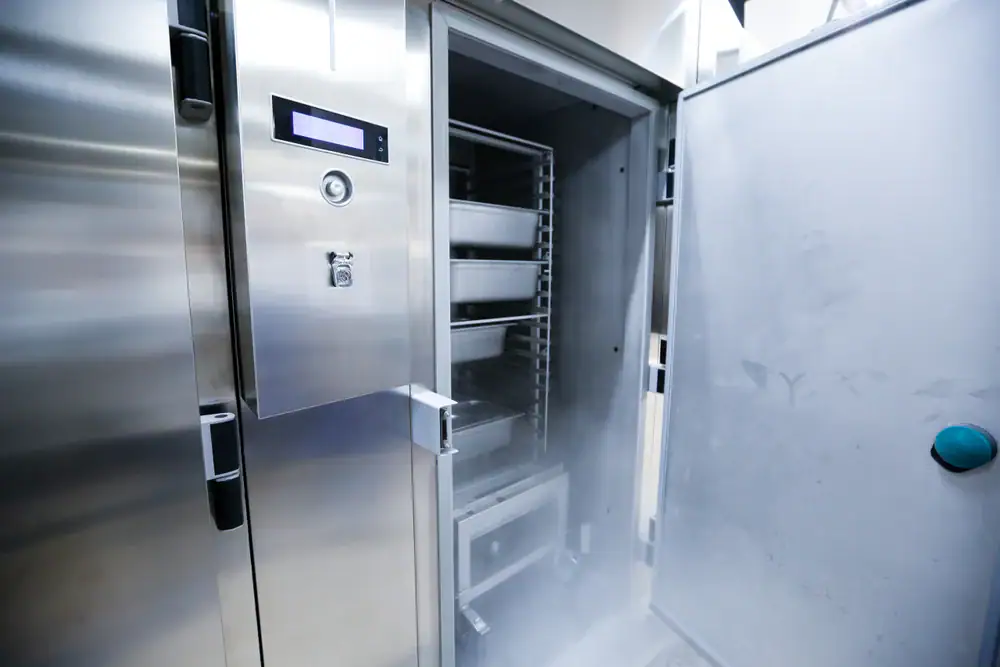
A walk-in cooler that’s “not working” can mean a dozen different things — and most of them don’t start with a total breakdown. They start with temperature drift. The unit is running, the compressor sounds fine, but the interior is sitting at 47°F instead of 36°F. That gap is the warning most owners miss until the health inspector or a spoiled delivery makes it impossible to ignore.
The most common culprits are dirty condenser coils, a failing door seal, low refrigerant, a malfunctioning thermostat, or an evaporator fan that’s starting to give out. Each one has a different fix, a different urgency level, and a different cost. The frustrating part is that several of them can exist simultaneously — and none of them are obvious from the outside.
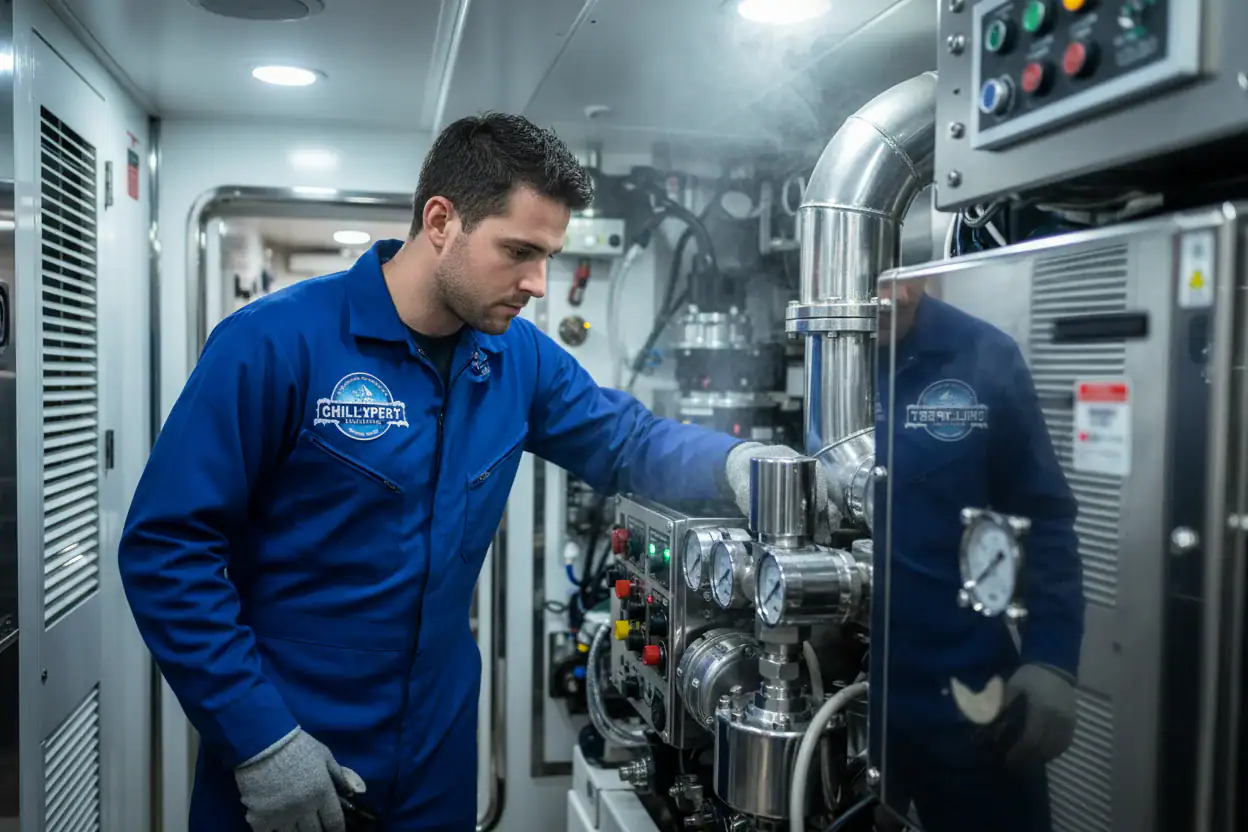
There’s a version of “maintenance” that means wiping down the exterior and calling it done. That’s not what we’re talking about. Real commercial refrigeration maintenance involves checking the things that actually cause failures — and doing it before summer turns your kitchen into a 95-degree environment that forces every component to work at its limit.
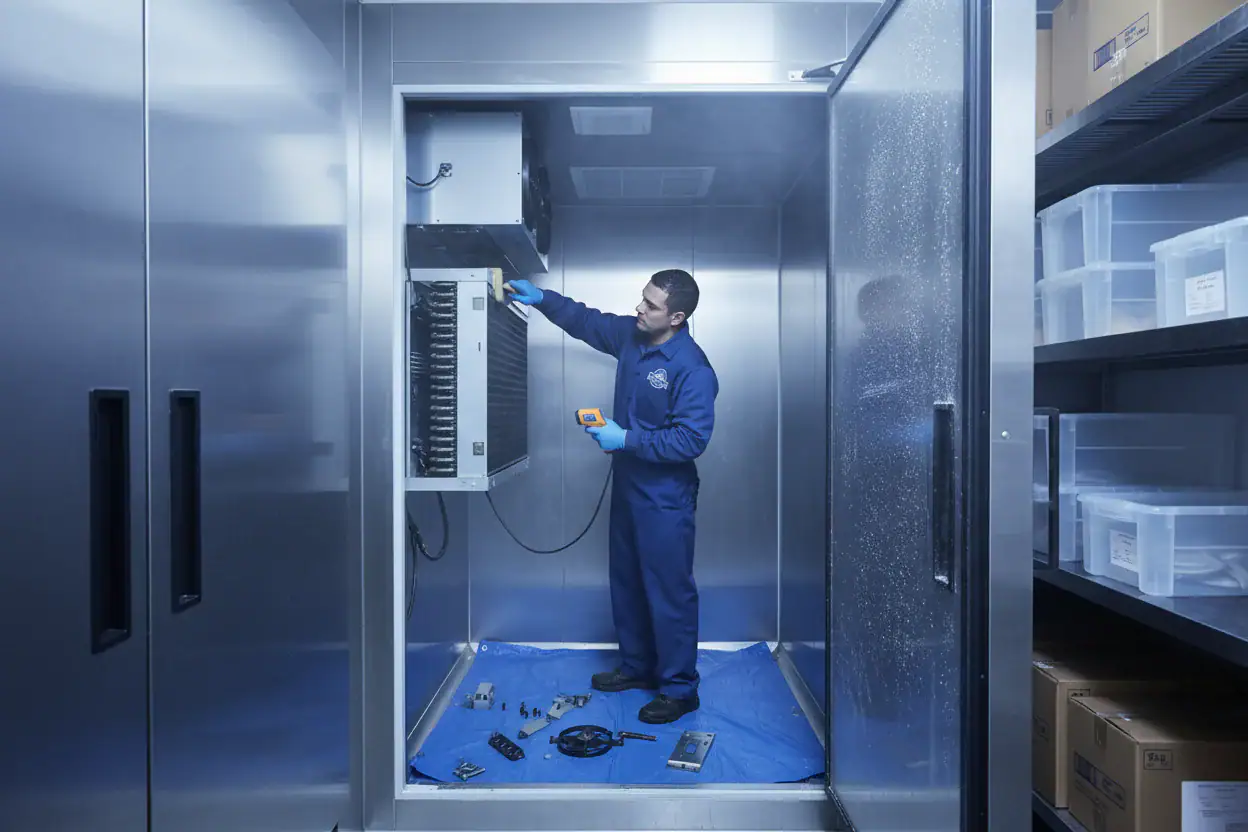
Condenser coils are a good place to start. These coils release heat from the refrigeration system, and when they’re coated in grease, dust, and the kind of airborne grime that builds up in a commercial kitchen, they can’t do that job efficiently. The compressor compensates by working harder. Over time, that extra strain shortens the compressor’s life significantly. We recommend cleaning condenser coils at minimum every six months — but in a high-volume kitchen environment on Long Island, quarterly cleaning is more realistic.
Door gaskets are another one that gets overlooked. A gasket that’s warped, torn, or simply not sealing properly allows warm, humid air to infiltrate the cooler continuously. In a Nassau County summer, that ambient air can be 85°F with humidity that makes it feel worse. Every time that warm air enters the cooler, the system has to work to remove it. The result is higher energy consumption, more wear on the compressor, and — if the infiltration is bad enough — frost buildup on the evaporator coil that eventually blocks airflow entirely.
Refrigerant levels, electrical connections, thermostat calibration, evaporator fan function — these all belong in a proper maintenance inspection. Not because checking them is complicated, but because finding a problem at a scheduled visit is dramatically less expensive than finding it when your walk-in hits 50°F on a Friday night before a full weekend of service. We’ve been doing this work across Long Island for over 40 years, and the pattern is consistent: the businesses that stay ahead of maintenance rarely end up in emergency situations. The ones that wait tend to call us at the worst possible time.
This is something that doesn’t come up in generic troubleshooting guides, but it matters if you’re running a food service business anywhere near Nassau County’s South Shore or North Shore waterfront. Long Island’s coastal position means your refrigeration equipment isn’t just dealing with summer heat — it’s dealing with heat and humidity together, which is a meaningfully different challenge.
Humid air carries more heat energy than dry air at the same temperature. That means your walk-in cooler has to work harder to maintain interior temperature on a muggy Long Island afternoon than it would in a drier climate at the same thermometer reading. Condenser coils foul faster. Compressors run longer cycles. Door seals that were adequate in April start showing their limits in July.
For businesses near the water — waterfront restaurants in Freeport, Long Beach, or Rockville Centre, yacht clubs along the North Shore, catering halls in Massapequa — there’s an additional factor: salt air. Saltwater-laden air accelerates corrosion on condenser coils, electrical connections, and exterior components in ways that most general appliance repair companies aren’t trained to address. Our background in marine HVAC means we work on refrigeration systems aboard boats and yachts where saltwater corrosion, tight spaces, and thermal stress are constant factors. That experience translates directly to commercial refrigeration work across Nassau County.
The practical implication for Nassau County business owners is that the standard maintenance timeline — clean coils every six months, inspect annually — may not be aggressive enough for your specific environment. If your equipment is near the water or in a high-humidity kitchen with heavy cooking volume, the interval between inspections probably needs to be shorter.
Want live answers?
Connect with a Chill Xpert Solutions expert for fast, friendly support.
Freezer problems carry higher stakes than cooler problems, almost by definition. A walk-in cooler drifting to 47°F gives you a window to respond. A walk-in freezer that’s lost its ability to hold temperature is moving toward a total inventory loss, and the timeline is shorter than most owners expect.
The symptoms often start subtly — frost accumulation on the evaporator coil, ice crystals forming on product packaging, or the unit running almost continuously without recovering temperature. Each of these points toward something specific, and identifying which one matters before the situation escalates.
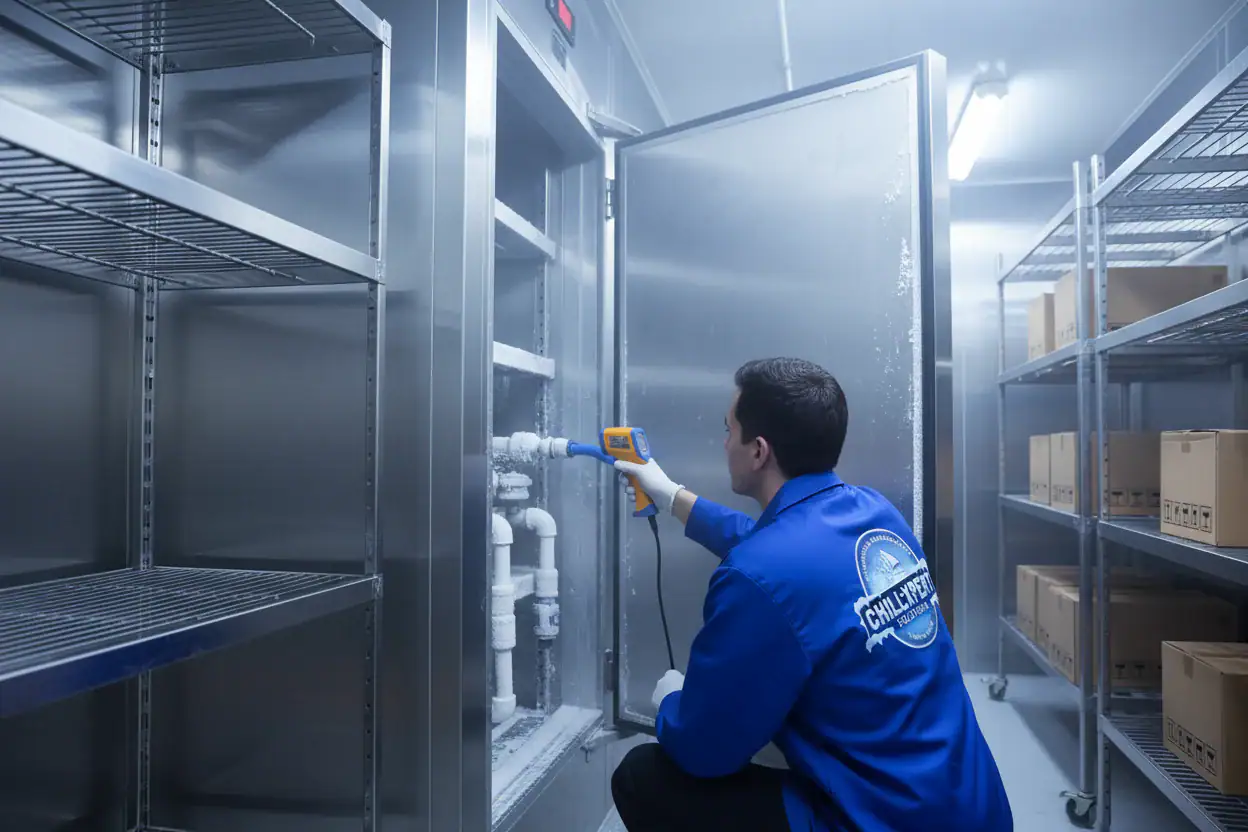
Defrost cycle failure is one of the most common causes of a walk-in freezer that’s slowly losing its ability to cool. Every commercial freezer runs a defrost cycle to prevent ice from building up on the evaporator coil — when that cycle fails, ice accumulates until it blocks airflow entirely. The unit keeps running, but it can’t move cold air through the space effectively. From the outside, it looks like a cooling problem. The actual fix is restoring the defrost function and clearing the coil.
Dirty condenser coils are just as much a freezer problem as a cooler problem. The same fouling that reduces a cooler’s efficiency will push a freezer past its thermal limits faster, because the temperature differential the system has to maintain is much greater. A cooler needs to stay around 36°F; a freezer needs to hold at 0°F or below. Any reduction in system efficiency hits freezer performance harder.
Door seal failure is worth taking seriously in a freezer context. Warm air infiltrating a walk-in cooler is a problem. Warm, humid air infiltrating a walk-in freezer causes that moisture to freeze immediately on contact with interior surfaces — accelerating ice buildup, straining the defrost system, and creating a cycle of problems that compounds quickly. If you’re seeing frost accumulation on the door frame or floor near the entrance, that’s the seal telling you something.
Compressor trouble is the scenario everyone fears, and for good reason — it’s the most expensive component in the system. Signs of a failing compressor include the unit running continuously without reaching set temperature, unusual clicking or grinding sounds at startup, or a compressor that trips its thermal overload and shuts down. A compressor that’s struggling in June may fail completely in August when ambient temperatures push it to its limit. Getting it diagnosed before peak season is almost always less expensive than an emergency replacement mid-summer.
This is the question most owners dread, and it deserves a straight answer rather than a sales pitch. The honest version is: it depends on the age of the equipment, the nature of the failure, and the operating environment.
A compressor replacement on a unit that’s four years old and otherwise in good condition is almost always worth doing. The same repair on a unit that’s twelve years old, has corroded coils, degraded insulation panels, and a history of recurring problems is a different calculation entirely. You’re not just paying for the compressor — you’re buying time on a system that’s likely to present the next problem within a year or two.
For Nassau County businesses operating near the water, coastal conditions accelerate this timeline. Salt air and humidity degrade insulation panels, corrode electrical components, and wear on refrigerant lines faster than the same equipment would age in an inland environment. A unit that might last fifteen years in a controlled inland kitchen may need serious attention at ten years on Long Island’s South Shore.
When we have the repair-versus-replace conversation with customers, our goal is always to give you an honest read — not to push a replacement you don’t need, and not to patch a system that’s going to cost you more in the long run. That starts with a real diagnostic: understanding what failed, why it failed, and what the rest of the system looks like. We explain what we find clearly — what the problem is, what caused it, and what your actual options are.
If you’re running a catering hall in Garden City, a deli on Hempstead Turnpike, or a waterfront restaurant in Freeport, NY, the stakes of getting this decision wrong are high. An unexpected replacement during peak summer season is a logistics nightmare. A repair that buys six months before the next failure is an expensive way to defer the inevitable. Getting a clear-eyed assessment before summer starts is the move that gives you actual options.
The window between now and peak summer demand is the best time to find out where your refrigeration equipment actually stands. Not because it’s convenient, but because it’s the only time you have real options — schedule a maintenance visit, address a borderline component, make a replacement decision on your own timeline rather than in the middle of a Saturday service rush.
Nassau County’s summer is unforgiving to equipment that’s been running on borrowed time. The heat, the humidity, the coastal air, and the volume of business that comes with beach season and catering season all arrive at once. The businesses that come through it without incident are almost always the ones that didn’t wait for a failure to take refrigeration seriously.
We offer free estimates and can typically be on-site across Nassau and Suffolk County in under two hours. We’ve been doing this work on Long Island for over 40 years — and if something needs attention before summer, we’ll tell you exactly what it is and why. That’s how Chill Xpert Solutions approaches every job.
Article details:
Share:
Continue learning: