Not every marine AC system works for every boat. Here's how to tell which type actually fits your vessel — and why the wrong choice costs more than just money.
Share:
Summary:
If you’re researching marine AC units, you’ve probably already discovered that the options are more complicated than they look. Self-contained, split systems, chilled water, reverse-cycle, hatch-mounted — the terminology stacks up fast, and most of what’s written online is aimed at selling you a product, not helping you make the right call for your specific boat.
The system that works perfectly on a 35-foot center console in Oyster Bay Harbor is not the same one that belongs on a 60-foot trawler docked at a Manhasset Bay marina. Getting this wrong means a system that runs constantly, cools poorly, strains your electrical panel, or fails by August. We’ve seen it happen too many times on Nassau County docks. Here’s how to sort it out.
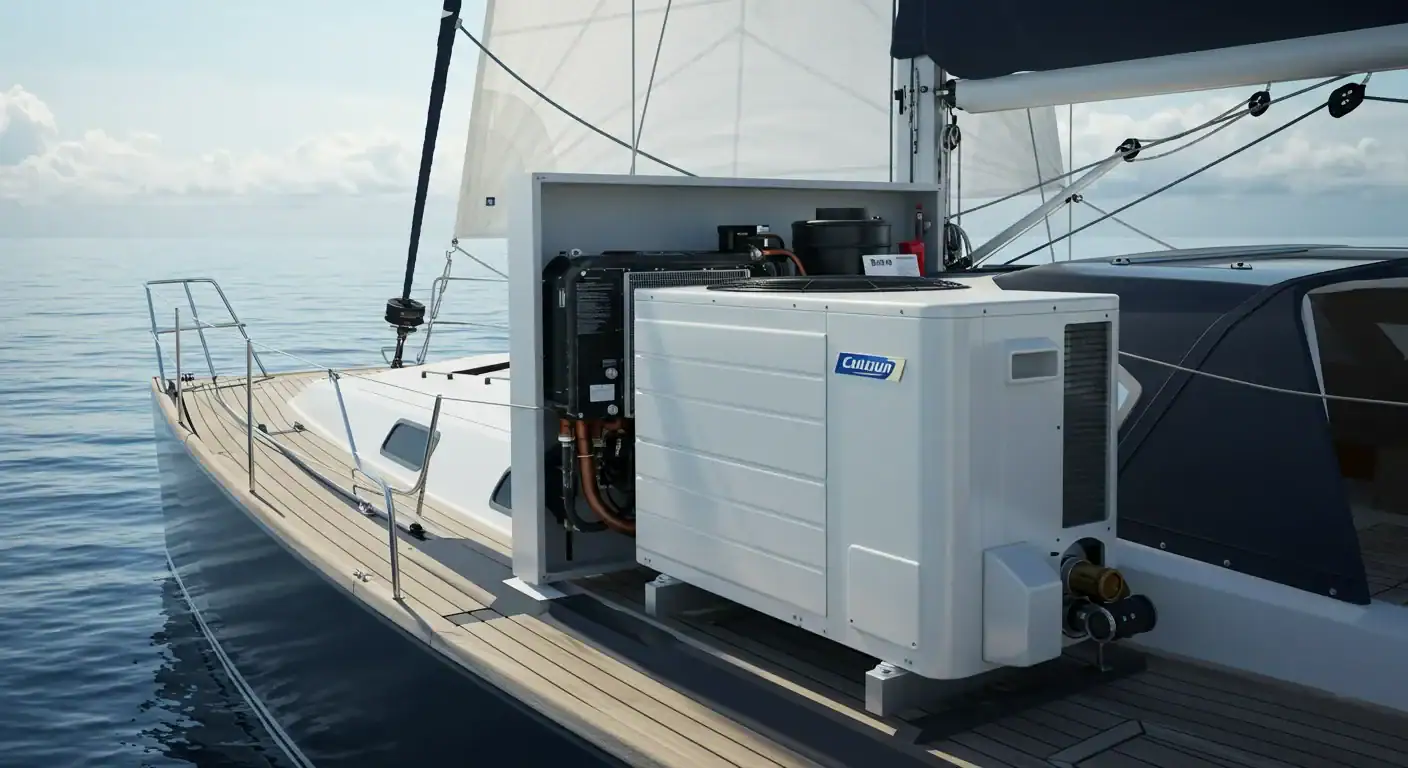
There are three configurations that cover the vast majority of recreational and semi-commercial boats: self-contained units, split systems, and chilled water systems. Hatch-mounted units exist as a fourth option, though they occupy a narrow use case we’ll cover separately.
The fundamental difference between all marine air conditioning units and anything you’d put in a house comes down to one thing: how they reject heat. A home AC dumps heat to the outdoor air. A marine system pumps raw seawater through the condenser to carry that heat away from the boat. That single design difference is why a residential HVAC contractor — even a skilled one — cannot competently install or service a marine system. The seawater plumbing, the through-hull fittings, the corrosion-resistant materials, the power constraints — none of it translates from land-based work.
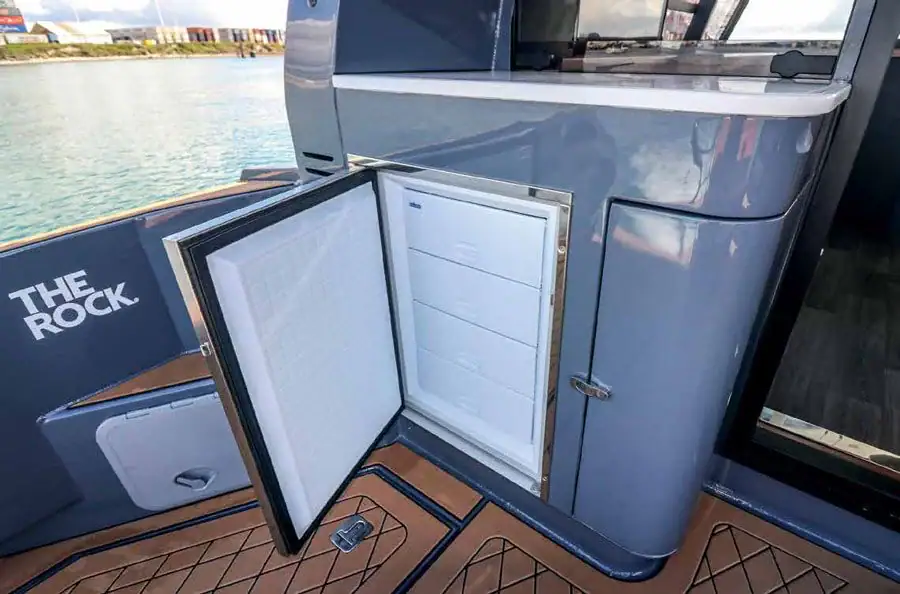
Self-contained units pack the compressor, evaporator, and condenser into a single housing, typically installed below deck in a berth, under a settee, or in a dedicated equipment space. They connect to a seawater intake, a drain, and your vessel’s electrical panel — and they push cooled air through short duct runs to the cabin.
For boats in the 25-to-45-foot range, self-contained units are usually the right answer. They’re straightforward to install, relatively easy to service, and available in BTU ranges that cover most single-cabin and two-cabin layouts. The practical ceiling on ducting is roughly 15 feet from the unit — push past that and airflow suffers. If your boat has a single main cabin and a V-berth or aft cabin, one or two self-contained units typically handles the load without overcomplicating the installation.
Power consumption is a real consideration here. A 16,000 BTU unit draws somewhere in the range of 13 to 15 amps continuously. If you’re docked at a marina with shore power — which describes most Nassau County boat owners on the North Shore — that’s manageable. If you’re running off a generator or anchoring out regularly, that draw adds up fast and you need to plan for it before you buy.
One thing that catches boat owners off guard: sizing matters more than most people realize. Bigger is not automatically better. An oversized unit short-cycles — it cools the air quickly but shuts off before it can pull enough humidity out of the cabin. On a Long Island summer afternoon with 75% humidity, that means a cabin that feels clammy even when the temperature reads fine.
The general rule is 150 to 250 BTUs per square foot of cabin space, but hull color, glazing, insulation, and whether you’re in a covered slip all shift that number. A proper load calculation, not a rough guess, is what keeps you from buying the wrong unit.
Once you’re working with a vessel over roughly 50 feet — or any boat with three or more separate spaces to cool — the self-contained approach starts to show its limits. Running multiple self-contained units means multiple compressors, multiple seawater circuits, multiple points of failure, and a significant spike in peak electrical demand every time they all kick on simultaneously. That’s where chilled water systems become not just viable but genuinely preferable.
A chilled water system works differently. Instead of each unit having its own compressor, a central chiller cools water and circulates it through insulated lines to fan coil units installed throughout the boat. Each fan coil delivers conditioned air to its space, but the heavy mechanical work happens in one place. The result is quieter cabins (no compressor noise in the living space), more even cooling across multiple zones, and lower peak electrical demand because the load is distributed rather than stacked.
The capacity range is substantial — chilled water systems can be configured from around 16,000 BTU up to very large multi-zone installations. For a 65-foot motoryacht with a master stateroom, two guest cabins, a salon, and a pilothouse, a chilled water system is almost certainly the right answer. For a 38-foot sailboat with one main cabin, it’s overkill and the added complexity isn’t worth it.
There’s a Nassau County-specific reality worth noting here. The North Shore’s Long Island Sound waters run cooler than open ocean, which actually works in your favor — cooler seawater means more efficient heat rejection from the condenser, which reduces the load on the compressor. Boats operating primarily in Sound waters tend to see better efficiency numbers than the same system would deliver in warmer Atlantic waters off the South Shore. That said, Sound waters carry marine growth and salt content that demand regular strainer and condenser maintenance regardless of system type. Neglecting that maintenance is one of the most common reasons we see systems underperform or fail ahead of schedule.
Want live answers?
Connect with a Chill Xpert Solutions expert for fast, friendly support.
Hatch-mounted units come up constantly in online research, and the conversations in boating forums are pretty consistent: boat owners who bought one for a small V-berth are often satisfied, and boat owners who bought one hoping to cool a full cabin are almost always disappointed.
These units mount in an existing deck hatch, draw power from a standard outlet or shore power connection, and require no through-hull plumbing — which is their main appeal. Installation is simple, and for a small sleeping space where you just want to take the edge off on a hot night at the dock, they can do the job. The limitations become obvious quickly when the space gets larger, the ambient temperature climbs, or you’re not plugged into shore power.
The honest case for hatch units is narrow but real. If you have a small forward cabin on a 28-to-32-foot boat, you don’t want to deal with through-hull plumbing, and you spend most of your time docked at a marina with shore power, a hatch unit can make that cabin genuinely comfortable overnight. They’re also worth considering as a temporary solution while you plan a permanent installation, or on a boat where a full built-in system simply isn’t practical given the layout.
Where they consistently fall short is in anything resembling real cooling demand. Nassau County summers are legitimately hot — July highs regularly push into the upper 80s with humidity in the 70 to 80 percent range. A hatch unit on a 40-foot boat trying to cool a full salon on a Saturday afternoon in July is going to run continuously and still leave you uncomfortable. The BTU output just isn’t there for larger spaces, and because these units use air-side cooling rather than seawater cooling, they’re fighting the ambient heat rather than efficiently rejecting it overboard.
Noise is the other consistent complaint. Hatch units sit right in the living space, and the compressor noise is constant when the unit is running. On a calm night at anchor, that hum gets old quickly. Built-in self-contained units aren’t silent either, but they’re typically installed in a compartment below deck, which puts meaningful distance and insulation between the compressor and the people trying to sleep.
The portability argument — that you can take a hatch unit from boat to boat or use it elsewhere — sounds appealing in theory but rarely plays out in practice. Most boat owners who buy a hatch unit with that logic end up leaving it installed permanently because removing and reinstalling it is more hassle than it’s worth. If you’re going to use it in one place consistently, a permanent installation almost always serves you better.
The biggest mistake Nassau County boat owners make with marine AC isn’t choosing the wrong system type. It’s hiring someone who doesn’t actually understand marine systems to install or service it.
We’ve been doing this work for over 40 years, and we’ve seen the same failure pattern repeat itself. A boat owner gets a quote from a general HVAC contractor — someone who does good work on houses and commercial buildings — and the price looks reasonable. The contractor installs the system. It works for a season, maybe two. Then the seawater plumbing starts to fail because it wasn’t installed with marine-grade hose and proper clamp specifications. Or the electrical connections corrode because they weren’t sealed for a saltwater environment. Or the through-hull fitting was never properly supported and it works loose over a winter of movement in the slip.
At that point, the boat owner is paying twice: once for the original installation and once for us to come in, diagnose what went wrong, and fix it properly. We’ve had this conversation with enough boat owners in Oyster Bay, Port Washington, and Long Beach to know it’s a predictable outcome when the work isn’t done by someone who genuinely understands marine systems.
The technical reasons aren’t complicated, but they’re specific. Marine AC systems require seawater plumbing that self-drains to prevent air locks. They require centrifugal pumps sized to deliver roughly 3 gallons per minute of seawater flow per ton of cooling capacity. They require materials that can handle constant salt exposure, vibration, and the thermal cycling of a system that runs hard in summer and sits dormant through winter. None of that knowledge transfers automatically from residential or commercial HVAC work — it has to be learned specifically in the marine context.
Britannia Yacht Club trusts us with their members’ vessels. That kind of institutional trust isn’t earned by doing adequate work — it’s earned by doing the job right the first time, explaining what we found and why it matters, and being available when something needs attention. That’s the standard we hold ourselves to on every boat we work on, whether it’s a 30-foot daysailer in a Manhasset Bay slip or a large yacht being commissioned for the season.
If your boat is under 45 feet with one or two cabins, a self-contained marine AC unit is almost certainly the right starting point. If you’re working with a larger vessel or multiple zones, a chilled water system is worth a serious look. Hatch-mounted units have their place, but that place is narrower than the marketing suggests.
What matters as much as the system type is who installs it. Marine AC work done by someone without genuine marine experience tends to fail in ways that are expensive and sometimes dangerous. Getting a proper load calculation, marine-grade materials, and seawater plumbing done correctly from the start is what separates a system that runs reliably for years from one that becomes a recurring problem.
If you’re not sure which direction is right for your boat, we’re happy to talk it through. Chill Xpert Solutions offers free estimates, and our team can assess your vessel, your usage patterns, and your power setup before recommending anything. No pressure — just a straight answer from people who’ve been doing this work on Long Island for a long time.
Article details:
Share:
Continue learning: