What does marine AC installation actually cost on Long Island? Here's what Nassau County boat owners need to know before getting a quote.
Share:
Summary:
You’ve done enough searching to know that marine HVAC installation costs “vary widely” — which is the least useful thing anyone can tell you when you’re trying to figure out whether to budget $5,000 or $20,000. The truth is, the range is real, and it exists for legitimate reasons. Boat size, system type, installation complexity, and where you’re located all move the number significantly. And if you’re docked in Nassau County, a few factors specific to this market push costs higher than the national guides suggest. Here’s what boat owners across the county are actually paying for marine HVAC and refrigeration, and why.
The biggest variable in any marine AC installation quote isn’t labor or even the unit itself — it’s the type of system your boat needs. There are three distinct system types, and they don’t overlap much in terms of cost, complexity, or appropriate vessel size. Getting this part wrong is an expensive mistake, which is why any reputable marine HVAC installer starts with an assessment of your boat before quoting anything.
Self-contained units are the most common choice for boats under roughly 35 feet. The equipment itself typically runs between $1,500 and $2,500, and installation adds labor that averages around 20 hours at specialist rates. Total installed costs for a straightforward single-unit job on a smaller boat generally land in the $4,000 to $8,000 range.
Split systems serve mid-size vessels — think 35 to 50 feet — where a single self-contained unit won’t cover the space. These jobs run $8,000 to $18,000 depending on how many zones you’re cooling and how accessible the installation points are.
Chilled water systems are the territory of larger yachts, and those projects can reach $24,000 or more.

Most marine HVAC cost guides you’ll find online were written from a Southern or West Coast perspective. Florida installers don’t need to winterize systems. Southern California boats don’t sit in Great South Bay salt air from October through April. Those guides give you a baseline, but they don’t account for what Nassau County specifically adds to the equation.
The county’s dual-water geography matters here. Boats docked on the South Shore — in Freeport, Baldwin Harbor, or along Reynolds Channel — face constant salt air exposure from the Atlantic and the bay. North Shore vessels in Oyster Bay, Manhasset Bay, or Port Washington deal with Long Island Sound conditions. Both environments accelerate corrosion on condensers, copper tubing, and electrical connections faster than you’d see in a freshwater or warmer-climate setting.
That means marine-grade corrosion protection isn’t optional here — it’s baseline. Components that meet that standard cost more than what a generalist contractor might spec.
Then there’s the New York metro labor market. Standard HVAC labor rates in Nassau County run $75 to $150 per hour for general work. Marine HVAC specialists command more than that, and for good reason — the work is categorically different. Installing a through-hull fitting, configuring a seawater cooling circuit, and making sure every connection is vibration-resistant and properly grounded on a boat’s electrical system requires training that most HVAC technicians simply don’t have. Hiring someone without that background to save money on labor is one of the more common ways boat owners end up paying twice.
Finally, there’s winterization. Every Nassau County boat owner with a marine AC system needs to have the seawater flushed from the raw-water circuit before temperatures drop — otherwise, you risk freeze damage to components that are not cheap to replace. That’s an annual service cost that most national guides don’t mention at all, because in warmer markets, it doesn’t exist. Budget for it. It’s not optional here.
A question that comes up constantly from Nassau County boat owners is some version of: “How many BTUs do I need?” It’s the right question, and the answer matters more than most people expect — because oversizing is just as problematic as undersizing, and it’s a more common mistake.
The general rule for pleasure boats is around 14 BTUs per cubic foot of space being cooled. Areas with heavy sun exposure — a pilothouse, an unshaded helm station, a cabin with large windows facing south — need more, typically 16 to 19 BTUs per cubic foot. Below-deck staterooms used mainly at night need less, around 10 to 12 BTUs per cubic foot. These aren’t rough estimates. They’re the numbers that determine whether your system actually controls humidity, or just cycles on and off without ever pulling the moisture out of the air.
An oversized unit will cool the air quickly, then shut off before it’s had time to properly dehumidify the cabin. On a boat in Nassau County’s July humidity, that means clammy air, condensation on surfaces, and a system that feels like it isn’t working even though it technically is.
Proper sizing requires someone to actually measure your boat’s spaces, account for sun exposure and insulation, and calculate load accurately — not eyeball it or default to “go bigger to be safe.” This is why a real marine HVAC assessment starts before any equipment is ordered. We walk through the boat, assess the electrical capacity, look at the available installation space, and calculate what the system actually needs to do. That process takes time, but it’s what separates an installation that works well for years from one that creates problems from day one.
Want live answers?
Connect with a Chill Xpert Solutions expert for fast, friendly support.
Most boat owners have a general sense that marine AC installation is more complicated than a home unit — but the specifics are worth understanding, especially if you’ve ever gotten a quote from a general HVAC contractor and wondered why it looked different from a marine specialist’s quote.
The core difference is that marine HVAC systems use seawater for cooling. That means every installation involves a through-hull fitting and seacock for the cooling water intake, a raw-water pump, and plumbing that has to be self-draining — so that if the boat is ever lifted out of the water, all the seawater in the circuit drains out rather than creating air locks that disrupt flow when the boat goes back in. None of that exists in a residential or commercial HVAC job.
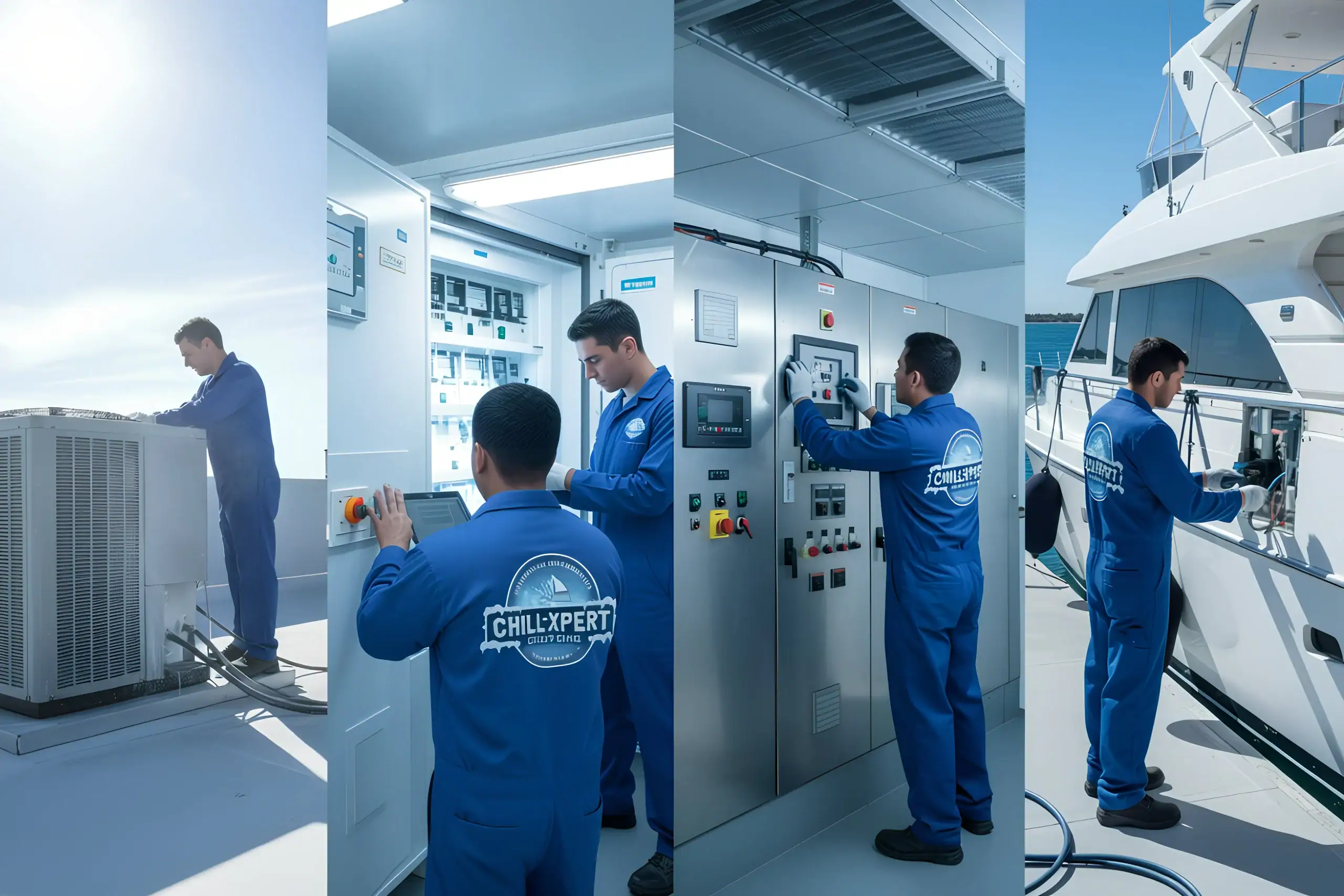
Beyond the through-hull work, a proper marine AC installation involves mounting all components in a way that handles constant vibration — something land-based equipment never has to deal with. Connections that aren’t properly secured will loosen over time. On a boat, that means refrigerant leaks, electrical faults, or condensation drainage failures, all of which are expensive to diagnose and fix after the fact.
Condensation drainage is its own consideration. Marine AC systems produce significant condensate, and that water has to go somewhere safe — typically the bilge, via a properly configured drain line. If it’s routed incorrectly, you end up with water pooling in places it shouldn’t, which creates mold, odor, and structural concerns over time.
The electrical side of the job is equally specific. Marine HVAC systems have to be wired in a way that doesn’t overload the boat’s existing electrical capacity, and any system that uses refrigerant requires a technician with EPA Section 608 certification to charge it legally. That’s a federal requirement, not a suggestion. It’s one of the clearest reasons why hiring a general HVAC contractor for a marine installation is a gamble — not because they’re unqualified in their own field, but because the marine environment adds layers of technical and regulatory complexity that fall entirely outside residential or commercial HVAC training.
We’ve been doing this work since the 1980s, and the calls we get most often from boat owners who’ve had a bad experience almost always start the same way: “The guy I hired said he could figure it out.” Marine HVAC is a specialty for a reason. The salt air alone — whether you’re docked in Freeport’s canals or moored off Oyster Bay — will expose every shortcut within a season or two.
Nassau County’s boating season creates a predictable pattern that affects both availability and, indirectly, cost. The window from March through April is when installation schedules are open and installers have time to do the job right. By May, the calendar fills up fast. By June and July, the only appointments available are for emergency work — and emergency work, by nature, costs more and gets done under pressure.
If you’re planning a new installation or a system upgrade, the time to move on it is before the season starts. That’s not a sales pitch — it’s just how the Nassau County marine service calendar works. Boat owners who wait until they’re sweating through a July weekend in Freeport or trying to enjoy a weekend on the Sound out of Port Washington are the ones calling for emergency service at rates that reflect the urgency.
There’s also the question of what “ready for the season” actually means. A proper installation takes time — the assessment, the equipment order, the installation itself, and a test run before you take the boat out. Compressing that into a few weeks in late May is possible, but it leaves no room for anything unexpected. Starting the conversation in March or early April gives everyone — you and your installer — the time to do this properly.
We offer free estimates and start every job with a thorough consultation. There’s no obligation, and getting a number in hand early costs you nothing. What it does is give you a clear picture of what you’re looking at before the season is already underway and your options have narrowed.
The wide range you see when you search marine HVAC installation cost isn’t evasion — it reflects real variables that only resolve once someone looks at your boat. Vessel size, system type, installation complexity, and the specific conditions of Nassau County’s coastal environment all move the number. What you can control is who you talk to and how early you start.
A qualified marine specialist will give you a clear estimate before any work begins, explain what the system will involve, and size it correctly for your boat — not just for the sale. That’s the standard we’ve held to for over 40 years of marine HVAC work across Nassau County, Suffolk County, and the broader Long Island waterfront.
If you’re ready to get a real number for your boat, reach out to Chill Xpert Solutions. We’ll start with a free consultation, assess what your vessel actually needs, and give you a straight answer on cost — no guessing, no pressure.
Article details:
Share:
Continue learning: