A cooler that's "cold enough" might still fail a Nassau County health inspection. Here's what inspectors actually look for — and what's at stake if your equipment falls short.
Share:
Summary:
Your walk-in cooler is running. The compressor sounds fine. The food feels cold. So you’re good, right?
Not necessarily. Nassau County health inspectors don’t just check whether your refrigeration equipment is on — they check whether it’s holding food at the temperatures required by New York State Sanitary Code and Nassau County Public Health Ordinance. A unit drifting at 44°F instead of 41°F is a critical violation, even if nothing looks or smells wrong yet.
This guide covers what inspectors actually measure, what happens when your equipment doesn’t meet the standard, and how staying ahead of the problem protects your restaurant, your inventory, and your reputation.
The most common misconception we hear from restaurant operators across Nassau County is that their cooler just needs to feel cold. In reality, inspectors are working against a specific set of standards, and “feels cold” doesn’t make the cut.
Under Nassau County Public Health Ordinance and New York State Sanitary Code, cold TCS foods — that’s Temperature Control for Safety foods, meaning anything that can support bacterial growth — must be held at 41°F or below. That’s not a guideline. That’s the threshold, and inspectors use calibrated thermometers to verify it.
If your unit is holding at 43°F or 44°F, you’re looking at a critical violation, regardless of how long the food has been in there or how it looks. What makes this particularly frustrating for operators is that a cooler can appear to be functioning normally while still failing the standard.
Dirty condenser coils, a struggling compressor, a worn door gasket letting warm air seep in — none of these announce themselves loudly. The unit runs, the light comes on, and everything seems fine until an inspector pulls out a thermometer.
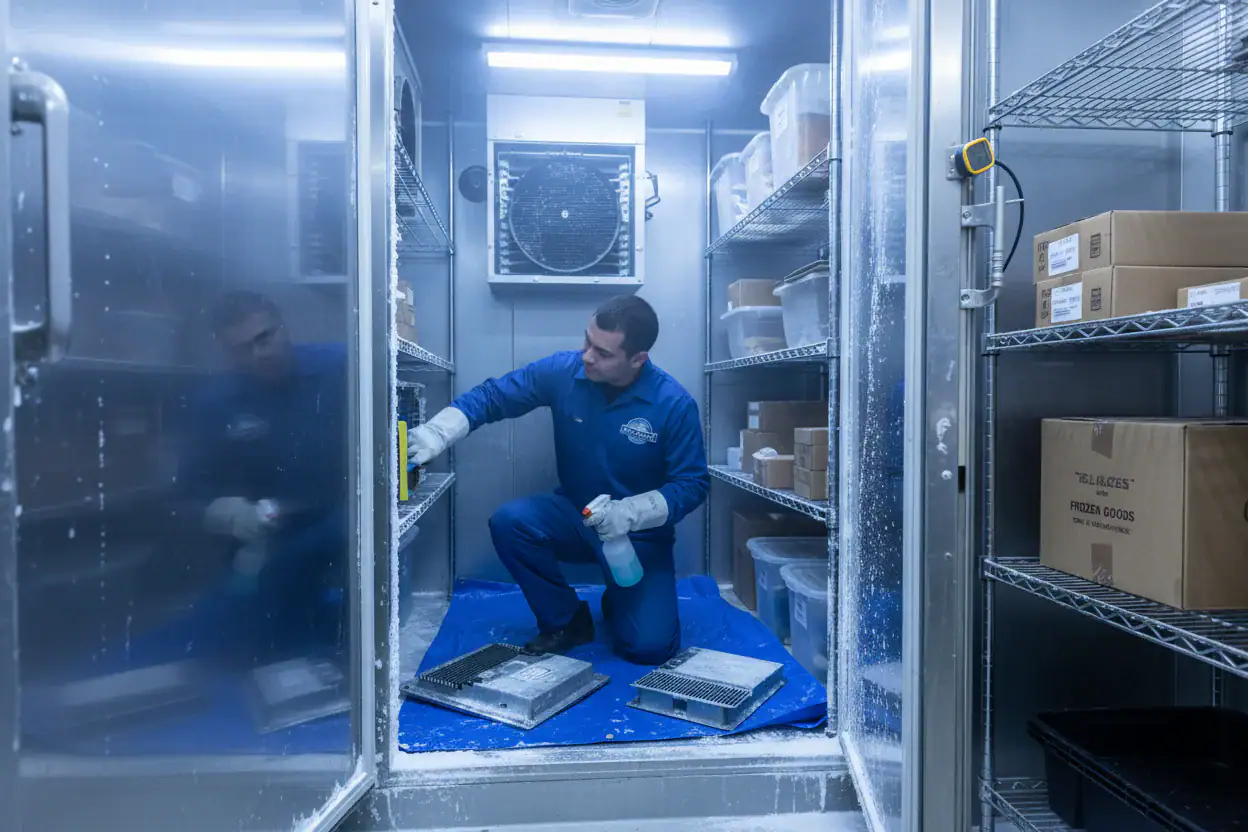
Nassau County’s food service inspection program documents violations using a coded system, and several of those codes relate directly to refrigeration performance. Understanding them matters because these aren’t just internal records — Nassau County’s food service inspection data is publicly available and refreshed monthly. Anyone can search it.
Item 5C is one of the most commonly cited refrigeration violations. It’s classified as a Critical Violation — marked in red in the county’s system — and it applies when potentially hazardous foods are not stored under proper refrigeration. If your cooler can’t maintain 41°F or below, this is the code that shows up on your inspection record.
Item 5B covers the cooling process itself. Food that’s being cooled after cooking must drop from 120°F to 70°F within two hours, and then from 70°F to 45°F within the following four hours. A cooler that’s already struggling to maintain temperature makes that cooling window nearly impossible to hit, which is exactly how a single equipment issue turns into multiple violations on the same report.
Item 2E rounds out the picture. It’s cited when accurate thermometers aren’t available or aren’t being used to monitor food temperatures during cooking, cooling, reheating, and holding. Inspectors expect you to verify your equipment is performing correctly — and to have the tools to do it.
All three are Critical Violations, which means they require immediate correction. They’re not the kind of thing you note and address before the next scheduled inspection. The inspector expects action on the spot, and if the issue can’t be resolved during the visit, it stays on your public record.
In March 2025, 35 Nassau County restaurants received critical health violations in a single month, with refrigeration failures appearing repeatedly in the documented causes. That’s not a slow month for the county’s food protection program — that’s a normal month. Every one of those violations is searchable by anyone who wants to look up a restaurant before making a reservation or placing a catering order.
A cooler that’s clearly broken — compressor dead, unit warm to the touch — is an obvious problem. But a cooler that’s running while slowly drifting above the 41°F threshold is far more common, and far more likely to catch you off guard during an inspection.
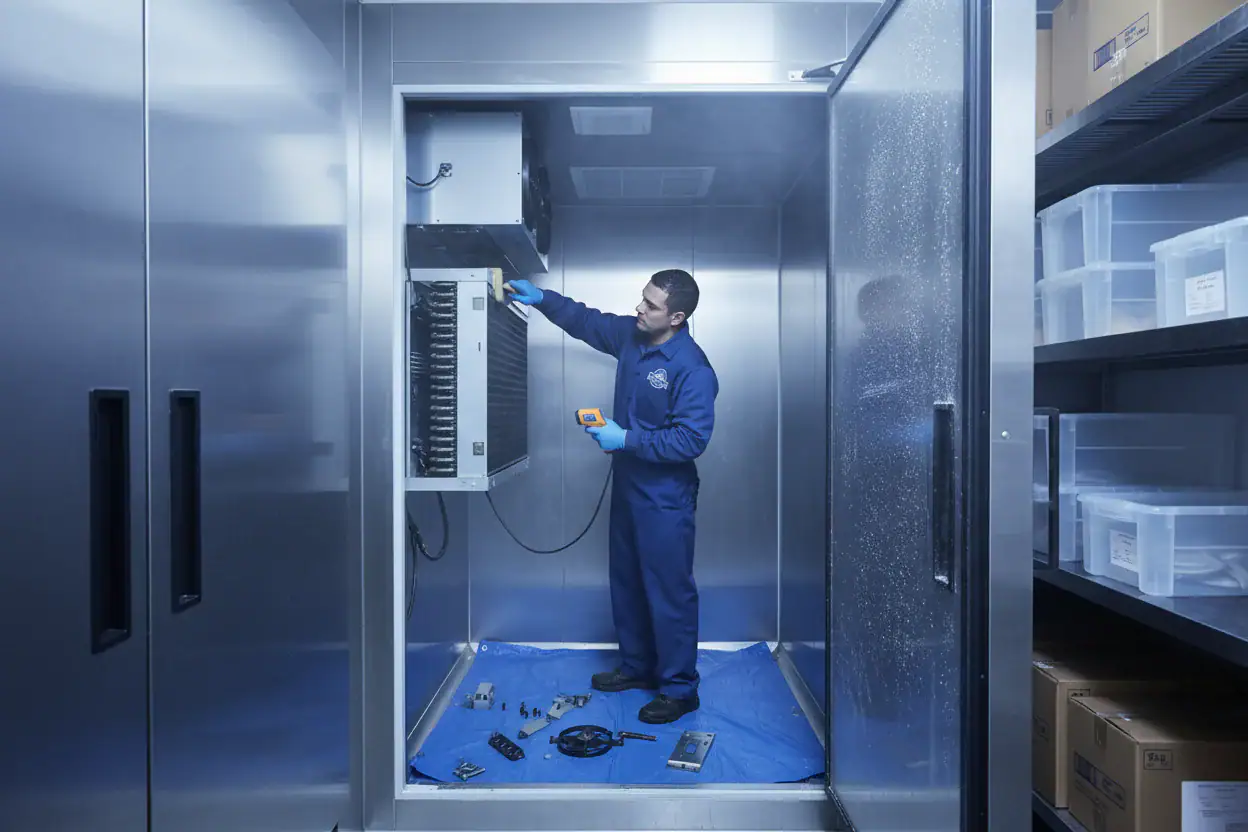
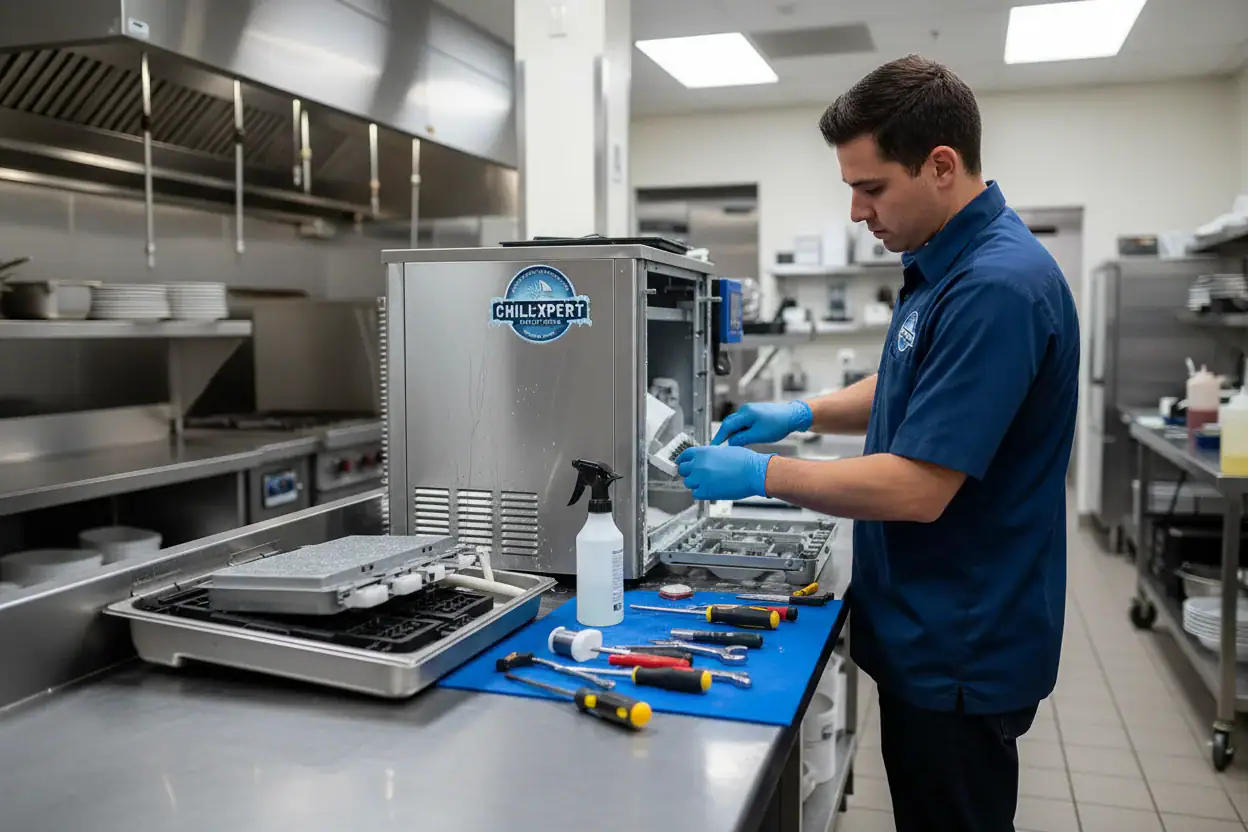
Condenser coils that haven’t been cleaned accumulate grease and dust over time, reducing the unit’s ability to shed heat. In a busy restaurant kitchen, this happens faster than most operators realize. The unit keeps running, but it’s working harder to maintain temperature — and eventually, it can’t keep up.
Long Island’s summers accelerate this significantly. When outdoor temperatures are regularly hitting 85°F to 95°F with high humidity, every piece of refrigeration equipment in your kitchen is under more stress than it was in February. This is especially true for restaurants on the South Shore and in high-volume dining corridors across Nassau County, where kitchens often run at full capacity for extended stretches.
Door gaskets are another common culprit. A worn or cracked gasket lets warm kitchen air bleed into the cooler continuously. The compressor compensates, runs longer cycles, and still can’t maintain the target temperature consistently — especially during the lunch and dinner rushes when the door is opening and closing constantly.
Refrigerant issues are the third major category. A slow leak doesn’t announce itself with a sudden failure. The unit gradually loses cooling capacity over weeks or months, and the temperature creeps upward so slowly that it’s easy to miss without regular monitoring. By the time an inspector walks in and takes a reading, the unit may have been out of compliance for a while.
The common thread is that the problem was developing long before it became visible. Regular service — most commercial refrigeration equipment should be inspected every three to six months, and busy restaurant kitchens may need more frequent attention — is the only reliable way to catch these issues before they show up on a public inspection report.
Want live answers?
Connect with a Chill Xpert Solutions expert for fast, friendly support.
Walk-in freezers and reach-in freezers operate under a different set of standards than coolers, but the inspection logic is the same: inspectors are checking specific temperatures, not just whether the unit is running.
Frozen food must be maintained at 0°F or below. A freezer that’s holding at 10°F or 15°F may keep food solidly frozen to the touch, but it’s not meeting the standard — and a slow drift upward from a struggling compressor or a defrost cycle that’s not calibrated correctly can push the unit out of compliance without any obvious warning signs.
The stakes with freezer failures are also higher in terms of inventory value. Depending on what a Nassau County restaurant is storing, a single freezer failure can mean losses that dwarf what a cooler failure costs. Getting ahead of freezer maintenance isn’t just a compliance issue — it’s a straightforward business protection decision.
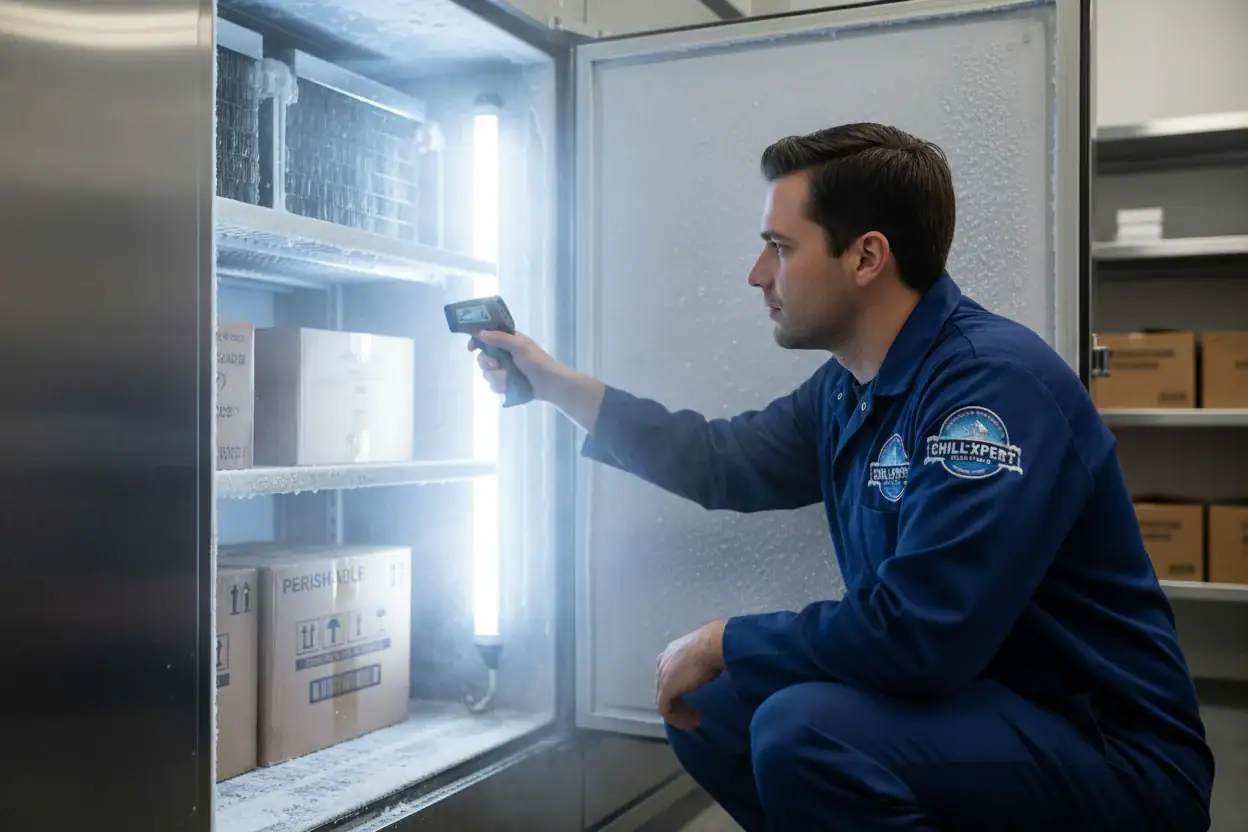
The challenge with commercial freezer failures is that the early warning signs are easy to dismiss. Ice buildup around the door frame or on interior walls is often the first indicator — it suggests the door seal isn’t closing completely or the defrost cycle isn’t clearing properly. Most operators assume it’s normal and wipe it down. It’s not normal. It’s the unit telling you something is off.
Unusual compressor cycling is another signal. If you notice the compressor running almost constantly, or if the unit is significantly louder than it used to be, the system is working harder than it should to maintain temperature. That kind of sustained stress shortens the life of the compressor considerably and usually precedes a more serious failure.
Temperature fluctuations after the door has been closed for several hours are worth paying attention to as well. A properly functioning freezer should hold a stable temperature. If you’re seeing variation of more than a few degrees between morning and evening readings — and you’re not opening the unit frequently — something is affecting the unit’s ability to maintain its set point.
For Nassau County restaurant operators, the timing of freezer failures matters as much as the failure itself. A freezer going down in late November, when catering halls and restaurants are stocking up for the holiday season, is a fundamentally different problem than the same failure in early March. The inventory at risk is larger, the replacement lead times are longer because suppliers are stretched, and the disruption to service comes at the worst possible moment. Addressing maintenance before peak season is the kind of decision that looks obvious in hindsight and proactive in practice.
Not every freezer issue requires replacement. A technician who diagnoses the root cause — whether that’s a refrigerant issue, a failing defrost heater, a worn door gasket, or a compressor that’s on its way out — can often resolve the problem at a fraction of the cost of a new unit. The key is getting an honest assessment from someone with real commercial refrigeration experience, not a generalist who defaults to recommending replacement because repair requires more diagnostic work.
Not every technician who shows up in a search result for commercial refrigerator repair service is actually qualified to work on commercial refrigeration equipment. This distinction matters more than most operators realize, and it has legal implications as well as practical ones.
Under EPA Section 608 of the Clean Air Act — specifically 40 CFR Part 82, Subpart F — any technician who services, repairs, or maintains equipment that could release refrigerants into the atmosphere is required to hold EPA 608 certification. This isn’t optional, and it isn’t a formality. Hiring an uncertified technician to work on refrigerant-containing equipment creates liability for your business, not just for the technician.
Before anyone opens a panel on your walk-in cooler or reach-in unit, ask directly whether they hold EPA 608 certification and what type. Universal certification covers all equipment categories and is the standard to look for in commercial refrigeration work.
Beyond certification, the practical question is whether the technician has actual commercial kitchen experience — not residential appliance repair experience applied to commercial equipment. Commercial refrigeration systems run longer cycles, handle larger refrigerant charges, operate under more sustained stress, and are subject to a regulatory framework that residential equipment simply isn’t.
A technician who primarily services home refrigerators and takes on commercial jobs opportunistically is not the same as someone who has spent decades working in restaurant kitchens, catering halls, and food service operations across Nassau County. Parts availability is another factor that separates a genuinely useful commercial refrigerator repair service from one that will diagnose your problem and then tell you they need to order parts and come back in a few days.
In a restaurant environment, a few days is not a viable timeline. A technician who stocks parts for major commercial refrigeration brands on their vehicle can often complete the repair in a single visit — which is the difference between a manageable service call and a multi-day disruption to your operation.
Finally, consider whether the company uses its own technicians or subcontracts the work. When you call a company and a technician arrives, you should know that person works for the company you hired, has been vetted by them, and carries the same accountability. Subcontracted work introduces credential uncertainty and makes it harder to hold anyone accountable if the repair doesn’t hold.
We’ve been doing this work across Nassau County for over 40 years — in restaurants, delis, catering halls, and airports. We carry parts for major brands on our trucks, we send our own certified technicians, and we give you a clear picture of what’s wrong and what it’ll cost before any work begins. That’s how the job should be done.
The through-line in all of this is straightforward: a cooler or freezer that appears to be working is not necessarily a cooler or freezer that will pass inspection. Nassau County inspectors are checking specific numbers — 41°F for cold TCS food storage, defined cooling rate windows, thermometer availability — and the public record of what they find is searchable by anyone.
Proactive maintenance isn’t a luxury for restaurants that have the budget for it. It’s the most reliable way to avoid a critical violation appearing on a publicly accessible inspection report, losing inventory to a failure that was weeks in the making, or scrambling for a technician during dinner service when your options narrow fast.
If you’re in Nassau County and you’re not sure whether your refrigeration equipment is actually performing to code — or if you already know something isn’t right — Chill Xpert Solutions is worth a call. We offer free estimates, we respond fast, and we’ll tell you exactly what we find.
Article details:
Share:
Continue learning: