When your walk-in cooler stops working, every minute counts. Here's what to check, what to leave alone, and when to make the call.
Share:
Summary:
Your walk-in cooler isn’t cooling the way it should. Maybe the temperature crept up overnight. Maybe it stopped cold in the middle of a dinner rush. Either way, you’re not reading this because you’re curious — you’re reading it because something is wrong and you need answers fast.
The good news is that some walk-in cooler problems have simple causes you can check in minutes. The bad news is that others look simple but aren’t, and the wrong move can make things worse. This guide helps you tell the difference — so you can act quickly, protect your inventory, and know exactly when it’s time to stop troubleshooting and pick up the phone.
The FDA’s food safety guidelines are clear: perishable food that stays above 41°F for four or more hours must be discarded. Between 70°F and 125°F, bacteria like Salmonella and Listeria can double every 20 minutes. That four-hour window starts the moment your cooler stops doing its job — not when you notice it.
So the first thing to do isn’t panic, and it isn’t call someone. It’s take stock. Check the actual temperature inside the unit. If it’s still below 41°F, you have time to troubleshoot methodically. If it’s already climbing, your window is narrowing and you should be calling a certified technician while you run through the basics — not instead of it.
Before assuming the worst, check the obvious: Is the unit in defrost mode? Many walk-in coolers run scheduled defrost cycles that temporarily raise the interior temperature. Is the door sealing properly? A gasket that’s torn, warped, or just not latching can let warm air flood the box continuously. Is the unit overpacked? Blocking airflow around the evaporator coil is one of the most common reasons a cooler struggles to hold temperature, and it’s completely invisible from the outside.
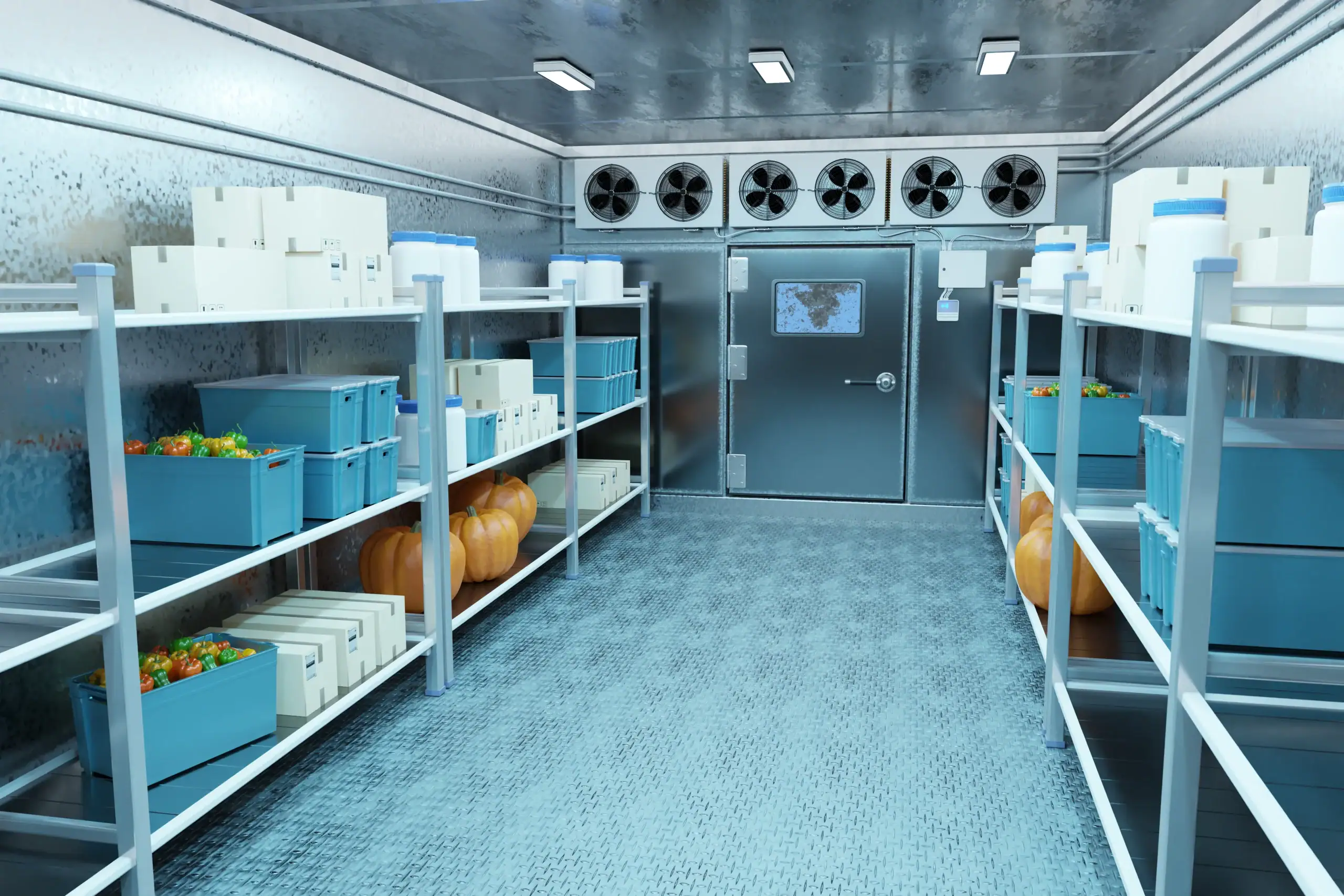
There’s a real difference between what a business owner can safely investigate and what requires an EPA-certified technician. Knowing that line saves you time and keeps you from accidentally making a fixable problem worse.
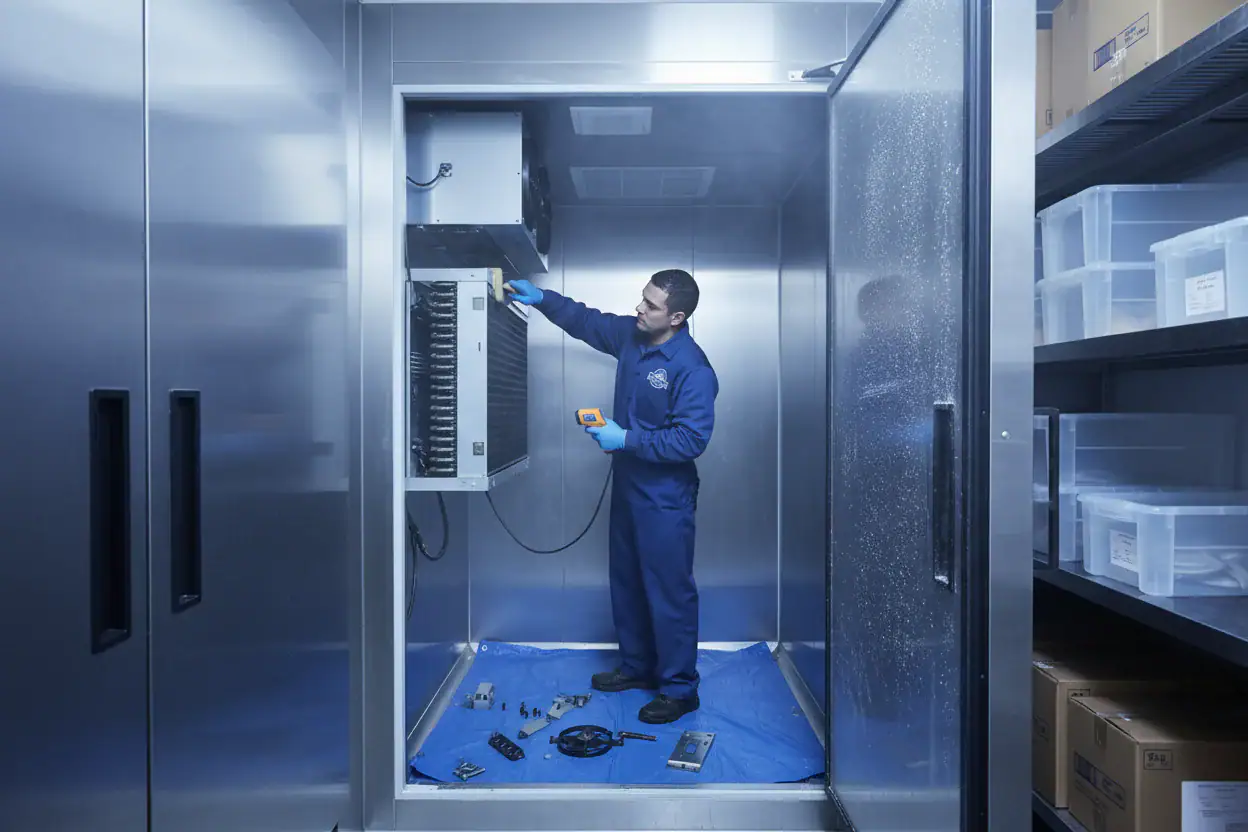
On the safe side: check your thermostat setting first. It sounds obvious, but settings get bumped, especially in busy kitchens. Confirm it’s set correctly and hasn’t shifted. Next, look at the condenser coils — these are typically located on the exterior of the unit near the compressor. If they’re visibly caked with dust, grease, or debris, restricted airflow is likely reducing the system’s ability to reject heat. Dirty coils are one of the leading causes of temperature problems, and they’re supposed to be cleaned at least twice a year.
Check the evaporator fan inside the cooler. If it’s not spinning or is moving slowly, air isn’t circulating across the coil properly and the box can’t cool evenly. Listen for unusual noises — a grinding or rattling fan motor is telling you something. Look at the door gaskets closely. Run your hand around the perimeter of the closed door. If you feel air escaping anywhere, the seal is compromised and warm air is getting in constantly.
What you should not attempt yourself: anything involving refrigerant. If you suspect a refrigerant leak — which can show up as ice buildup on the evaporator coil, a hissing sound near the lines, or a system that runs constantly without ever reaching temperature — stop there. Under federal law (the Clean Air Act, 40 CFR Part 82), any technician who handles refrigerants must hold EPA Section 608 certification. This isn’t a technicality. Attempting to add refrigerant yourself is illegal, and adding it to a system with a leak just delays the real repair while potentially damaging the compressor.
The same goes for compressor diagnostics, electrical work, and defrost timer replacements — these require tools and training that go well beyond a basic inspection. If your compressor is running constantly without cycling off, that’s usually a sign that the system is struggling — not a sign that it’s working hard. Dirty evaporator coils, low refrigerant, or a failing component can all cause continuous compressor operation, and none of those are self-service fixes.
Walk-in freezers and walk-in coolers share a lot of the same components, but they operate under completely different conditions — and they fail in different ways. A cooler needs to hold around 35–38°F. A freezer needs to hold 0°F or below. That gap matters enormously when you’re troubleshooting.
The most common culprit in a walk-in freezer that’s losing temperature is ice buildup on the evaporator coil. Freezers rely on a defrost cycle to periodically melt the ice that accumulates on the coil during normal operation. If the defrost timer or defrost heater fails, ice builds up until it chokes off airflow entirely — and the unit can no longer cool. From the outside, this looks like a temperature problem. Inside, the coil is buried in a solid block of ice. The fix isn’t turning the unit off and letting it melt — it’s replacing the failed defrost component so the cycle runs correctly going forward.
Freezers are also more sensitive to door seal failures than coolers are. At 0°F, even a small gap in the gasket lets in enough warm, humid air to create significant ice buildup around the door frame and on the coil — which then compounds the defrost problem. If you’re seeing frost accumulation around the door or on the walls near the entry point, the gasket is almost certainly compromised.
One thing that’s easy to miss with freezers: the temperature may look acceptable on the display but be dangerously inconsistent inside. A display thermostat reads one point in the unit; the actual temperature at different locations — especially near the door or at the top of the box — can vary significantly if airflow is obstructed. If you have a separate thermometer, use it to spot-check multiple locations. If you don’t, get one. The display alone isn’t enough to confirm that everything stored in the unit is actually at safe temperature.
If your walk-in freezer is running but not reaching or holding 0°F, and the basic checks don’t reveal an obvious cause, you’re likely looking at a refrigerant issue or a compressor problem. At that point, the call to a certified technician isn’t optional — it’s urgent.
Want live answers?
Connect with a Chill Xpert Solutions expert for fast, friendly support.
Generic troubleshooting guides are written for generic conditions. Nassau County, NY isn’t generic.
The combination of Long Island Sound humidity, Atlantic salt air, and the seasonal swings between summer heat indices above 95°F and winter freeze-thaw cycles creates conditions that push commercial refrigeration systems harder than their specs assume. If your unit is within a mile or two of the water — whether you’re on the North Shore in Great Neck or Old Brookville, or on the South Shore in Merrick, Oceanside, or Massapequa — salt-laden air is accelerating corrosion on your condenser coils in ways that inland technicians often don’t recognize or know how to address.
This isn’t just theory. We’ve seen it firsthand across Nassau County for over 40 years. A maintenance schedule that works fine for a restaurant in central Nassau County may not be enough for a waterfront catering hall or a marina operation on the Sound.
Summer is when most walk-in cooler failures happen in Nassau County, and the reason is straightforward. When ambient temperatures climb and humidity sits at 70–80% — which is normal for a Long Island summer — your condensing unit has to work significantly harder to reject heat. The hotter and more humid the air around the condenser, the less efficiently it can do its job. Systems that run fine in spring start struggling in July, and the ones that were already borderline fail outright during the first real heat wave.
For businesses near the water, the condenser coil corrosion problem compounds this. Salt air doesn’t just look bad on metal — it degrades the coil’s ability to transfer heat efficiently. A corroded coil works harder for the same output, which means more wear on the compressor and higher energy consumption. Over time, this shortens the life of the entire system.
Winter creates a different problem. Nassau County’s freeze-thaw cycles — temperatures that drop below freezing and then climb back above it repeatedly through the winter months — stress refrigerant lines, condenser coil fins, and electrical connections on outdoor units. Spring is a predictable secondary failure season as a result.
The practical takeaway is that if you’re operating a walk-in cooler in Nassau County, the standard “clean the coils once a year” advice isn’t enough. We recommend twice a year as the minimum, and for coastal locations, more frequent inspections make sense. The drain line should be flushed annually. Any system that’s more than ten years old and hasn’t had a professional inspection in the past twelve months is operating on borrowed time — especially heading into summer.
There’s a point in every walk-in cooler problem where the DIY checklist ends and the phone call begins. Knowing where that line is — and knowing what to ask when you make the call — can save you time, money, and a second service visit.
Call a technician immediately if: the temperature is above 41°F and climbing, you suspect a refrigerant leak, the compressor is running continuously without cycling, you hear grinding or clanging from the mechanical components, or the unit has completely stopped running. These are not situations where waiting to see if it resolves itself is a viable strategy. The four-hour food safety window doesn’t pause while you wait for a callback.
When you do call, ask three things before you commit to anything. First: are your technicians EPA Section 608 certified? This is a federal requirement for anyone handling refrigerants, and it’s not an optional credential. If the answer is vague or they can’t confirm it, that’s your answer. Second: do your trucks carry parts for my brand? A technician who diagnoses on visit one and returns days later with parts is a serious problem when your business can’t function without the cooler. Third: what’s your actual response time? “Fast service” means nothing. A specific commitment — like being on-site in under two hours across Nassau and Suffolk counties — is what you need to hear.
One more thing worth knowing: if a technician can’t produce their EPA 608 certification card on request, don’t let them work on the system. This isn’t about being difficult — it’s about your legal exposure as a business owner. Refrigerant handling by an uncertified person is a federal violation, and if something goes wrong, that liability doesn’t stay with the technician.
The best time to establish a relationship with a qualified refrigeration company is before something breaks. A preventive maintenance contract — with scheduled inspections, coil cleanings, and priority dispatch — is how you avoid the 2 AM emergency call entirely. But if you’re already in the emergency, the criteria above will help you find someone who can actually solve it, not just show up and diagnose it.
If your walk-in cooler is struggling, the most important thing you can do is act quickly and act in the right order. Check the obvious first — thermostat, door seal, defrost cycle, airflow. If those don’t explain the problem, stop there and call a certified technician. Don’t add refrigerant, don’t reset breakers hoping for a miracle, and don’t wait until morning if the temperature is already climbing.
Nassau County’s coastal climate means your system is working harder than most — and it deserves service from someone who understands that. Salt air, summer humidity, and freeze-thaw cycles are real factors that affect how often your system needs attention and what kinds of problems it’s most likely to develop.
If you need help now — or you want to get ahead of the next failure before it happens — we at Chill Xpert Solutions have been serving Nassau County restaurants, delis, catering halls, and food service operations for over 40 years. Reach out for a free estimate and talk to someone who actually picks up the phone.
Article details:
Share:
Continue learning: