Not sure what a fair repair quote looks like? This guide breaks down what drives commercial refrigerator repair costs — and what red flags to watch for.
Share:
Summary:
Your walk-in cooler stops holding temperature on a Friday afternoon. Your reach-in display case is running warm. Whatever the situation, the first question most Nassau County restaurant owners, deli operators, and catering hall managers ask isn’t “who do I call?” — it’s “what is this going to cost me?”
That’s a fair question, and it deserves a straight answer. Commercial refrigerator repair pricing isn’t random, but it can feel that way when you’re getting quotes that don’t explain themselves. Here’s what’s actually driving the numbers — and what to look for before you agree to anything.
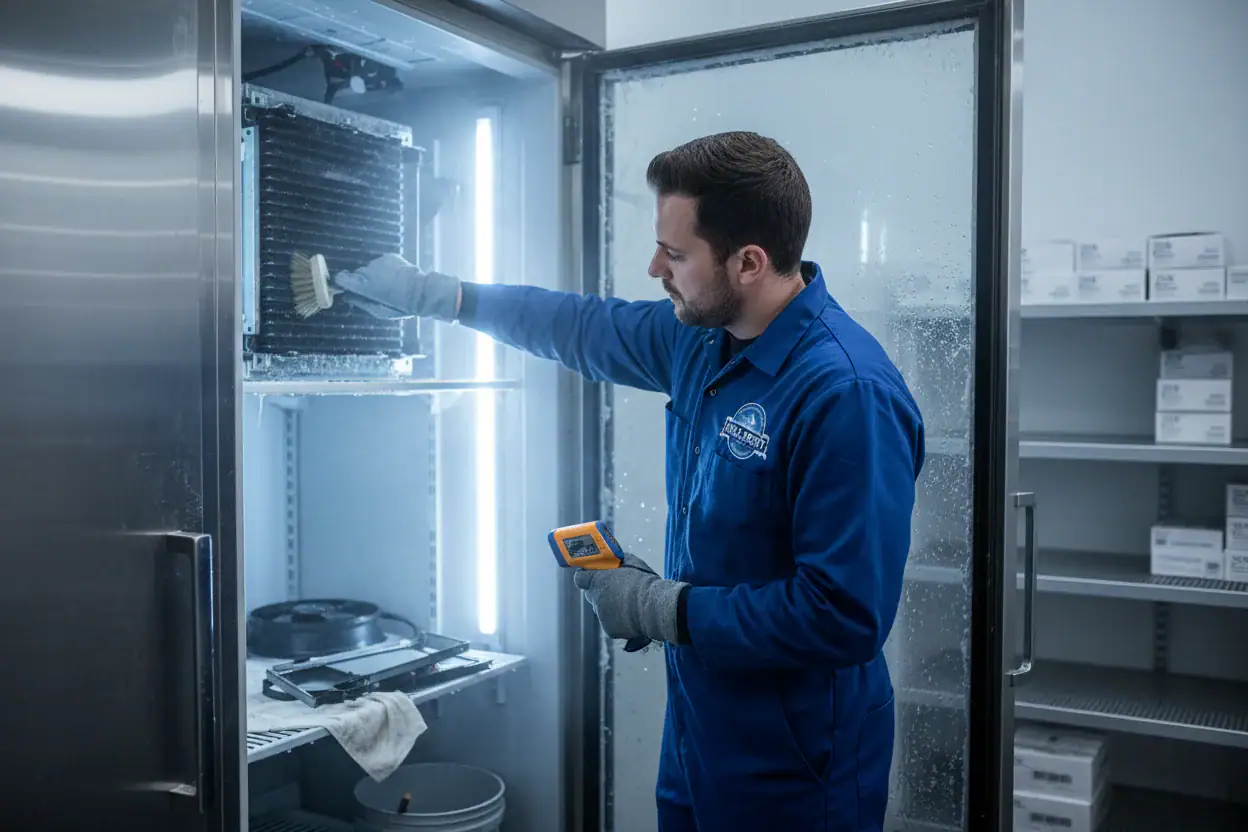
The biggest reason repair quotes vary so much is that commercial refrigeration problems aren’t all the same. A worn door gasket is a quick fix. A failed compressor on a large walk-in cooler is a different conversation entirely. The type of repair, the parts involved, and the labor required all factor into the final number — and we’ll break all of that down for you before any work begins.
Beyond the repair itself, a few other variables consistently affect what you’ll pay. Equipment age matters — older units often require harder-to-source parts, which takes more time and can cost more. Brand matters too, because some manufacturers use proprietary components that are more expensive to replace. And where you’re located matters more than most people realize.
Nassau County sits in the New York metro area, and urban and near-urban markets typically run 20 to 40 percent higher than suburban or rural markets for commercial refrigeration service. That’s not a Nassau County problem specifically — it reflects higher labor costs, greater demand, and the logistical reality of operating in a dense market. It’s worth knowing going in so a quote doesn’t catch you off guard.
There’s also something more specific to Nassau County that most general contractors won’t mention: the coastal environment here accelerates wear on refrigeration equipment in ways that inland markets simply don’t experience. Salt air eats through condenser coils faster than most people expect. The humidity rolling off Long Island Sound puts extra strain on compressors during the summer months. If you’re running a restaurant in Oceanside, NY, a deli near Freeport, NY, or a catering hall anywhere on the South Shore, your equipment is working harder than a comparable unit in a landlocked market — and it shows up in repair frequency and cost over time.
This is one reason we’ve spent over 40 years developing expertise specifically in the Long Island environment. We use marine-grade components and corrosion-resistant materials on coastal installations because we’ve seen what happens when you don’t. A technician who doesn’t understand the Nassau County coastal context isn’t giving you a complete picture of what your equipment actually needs.
Emergency timing is another cost factor worth understanding. After-hours and weekend calls carry overtime premiums — typically in the range of 25 to 50 percent above standard rates. That’s industry-standard, not a red flag. What is a red flag is when a company doesn’t tell you about those premiums before they show up. We tell you the after-hours rate upfront, before we dispatch a technician.
This is where a lot of Nassau County business owners get burned — not by the repair itself, but by the billing process around it. A diagnostic fee is standard. We typically charge between $60 and $100 for a diagnostic visit, and that fee is credited toward the repair if you approve the work. If a company charges a diagnostic fee and then adds it on top of everything else, that’s worth questioning.
Beyond the diagnostic, a legitimate written estimate should itemize parts and labor separately. You should know exactly what part is being replaced, what it costs, and what the labor rate is. Vague line items like “service and repair” with a single total number aren’t acceptable on a commercial job. You’re a business operator, not a residential customer — you have a right to understand what you’re paying for.
Parts sourcing matters more than most people think. Genuine OEM parts — components made by or approved by the original equipment manufacturer — cost more upfront than aftermarket alternatives, but they last longer and they don’t void your equipment warranty. We stock genuine parts for the major brands we service, which is part of why roughly 70 percent of our emergency calls get resolved on the first visit. Every return visit is another day of disruption for your operation — that first-visit fix rate matters.
One more thing worth knowing: the AIM Act’s ongoing HFC phasedown has raised costs for certain refrigerant types in 2024 and 2025. If your repair involves refrigerant handling, expect that to be reflected in the estimate. It’s not a markup — it’s a regulatory reality that applies to every licensed technician in the country.
Want live answers?
Connect with a Chill Xpert Solutions expert for fast, friendly support.
This is the question that comes up most often when a repair estimate feels high. It’s also the question where you most need an honest answer — and where some technicians have a conflict of interest. A company that only does repairs has an incentive to recommend repairs. A company that only sells new equipment has an incentive to recommend replacement. What you want is someone who’ll give you the actual analysis.
The general industry benchmark is this: if the cost of repair exceeds roughly half the cost of replacement, and the equipment is more than 10 to 12 years old, replacement often makes more economic sense over a three-to-five-year horizon. But that’s a starting point, not a rule — equipment condition, repair history, energy efficiency, and how central that unit is to your operation all factor in.
Age alone doesn’t tell the whole story. A 12-year-old walk-in cooler that’s been properly maintained and runs efficiently might be worth repairing. A 7-year-old unit with a history of recurring problems, poor energy performance, and a compressor that’s now failing is a different calculation entirely. The question isn’t just what the repair costs today — it’s what the next 18 months look like if you make that repair.
When you’re evaluating a quote on older equipment, ask the technician directly: if we make this repair, what else is likely to fail in the next year or two? A good technician can look at the overall condition of the unit and give you a realistic answer. If they can’t — or won’t — that tells you something.
Energy efficiency is also part of the equation. Older refrigeration equipment typically runs less efficiently than modern units, and that gap shows up in your monthly utility bill. Walk-in box installations done with current equipment can save up to $150 annually in energy costs compared to aging systems. That’s not a dramatic number on its own, but it compounds — and it’s worth factoring into a repair-vs.-replace decision on a unit that’s already struggling.
What you want to avoid is making a $1,500 repair on a unit that’s going to need another $2,000 repair six months later. That’s the scenario where replacement would have been smarter from the start. We give customers a clear diagnostic picture before any work begins precisely so you’re not making that decision blind.
There are a few questions worth asking any company before you let them touch your equipment. First: are your technicians EPA Section 608 certified? This is a federal requirement for any technician who handles refrigerants. It’s not optional, and it’s not a formality — an uncertified technician working on a refrigerant system is doing so illegally, and the liability for that can fall back on you as the property owner. Ask the question directly and expect a direct answer.
Second: are you an authorized service provider for my equipment brand? Factory authorization means the technician has been trained and certified by the manufacturer to work on that specific equipment using approved parts. It’s a meaningful credential, especially if your unit is still under a manufacturer’s warranty. Using an unauthorized technician can void that warranty entirely.
Third: do you carry parts on the truck? This one matters more than it sounds. A technician who has to order parts and come back in three to five days is a technician who’s leaving your operation in limbo. In a Nassau County summer — when your walk-in is running at full capacity during your busiest service weeks — that delay is a real operational problem.
Finally: what’s your response time? For an active failure, this is often the deciding factor. We respond in under two hours across Nassau County and Suffolk County, and we’ve been doing it for over 40 years. That’s not a tagline — it’s the standard we’ve built our reputation on, from Long Beach, NY to Great Neck, NY, from the Gold Coast yacht clubs to the catering halls and delis that keep Nassau County running.
Commercial refrigerator repair costs are rarely simple, but they should always be transparent. You deserve to know what’s wrong, what it costs to fix it, and why — before any work starts. That’s not asking too much. That’s just how a legitimate repair company operates.
If you’re in Nassau County and you’re dealing with a unit that’s struggling, failing, or already down, the most important thing you can do right now is get a real diagnosis from someone who knows commercial equipment and knows this market. Not a ballpark number over the phone. A written estimate, a clear explanation, and an honest answer about whether repair or replacement makes more sense for your specific situation.
That’s exactly what Chill Xpert Solutions provides — and has provided to restaurants, delis, catering halls, and commercial operators across Nassau County for more than 40 years. Reach out for a free estimate and find out where you actually stand.
Article details:
Share:
Continue learning: